Fire and rescue services
Call 198.
Medical emergencies
Call 195, or go to the hospital.
Police
Call 911, or go to the nearest police station.
Always get a police report when you report a crime.
Your insurer should have a 24-hour emergency number.
Call 198.
Call 195, or go to the hospital.
Call 911, or go to the nearest police station.
Always get a police report when you report a crime.
Your insurer should have a 24-hour emergency number.
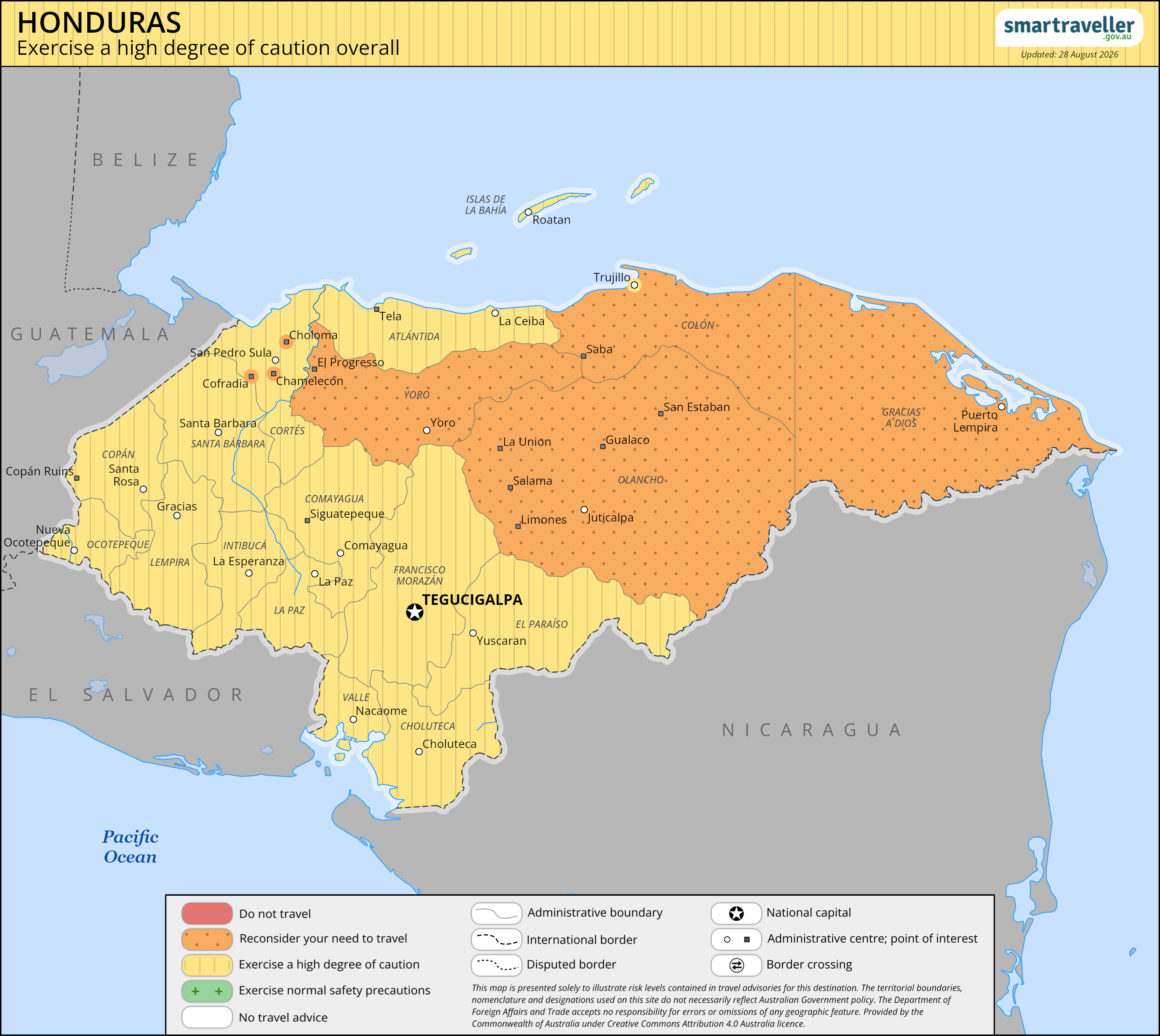
Exercise a high degree of caution in Honduras due to the threat of violent crime.
Reconsider your need to travel to:
See Safety
The department of Gracias a Dios is a remote area where law enforcement and access to government services are limited. Levels of criminal activity are high.
Full travel advice: Safety
Full travel advice: Health
Full travel advice: Local laws
Full travel advice: Travel
Full travel advice: Local contacts
Petty crime, like pickpocketing and bag-snatching, is common. You're at risk:
Take extra care of your valuables in:
To prevent petty crime:
Report problems to the police.
If you're attacked or robbed, don't resist. If criminals have guns or weapons, they may injure or kill you. People have been killed and injured resisting criminals. It is useful to carry a small amount of cash to hand out if you’re robbed.
The Bay Islands are generally safer than mainland Honduras. Crime is lower, but petty crime is common. Tourists can be the victims of violent crime. Theft from homes and long-term rentals happens.
More information:
Violent crime is widespread in Honduras. This includes:
Crime often involves firearms and organised crime groups. There have been mass shootings in urban centres.
Honduras has very high rates of murder. Take safety precautions.
Travellers have been sexually assaulted, often following spiking of food or drink. These incidents are on the rise.
Travellers have been affected by violent crime:
Active criminal groups mean murder rates are high in:
Violent crime is common in remote and border areas of Honduras. There are often no police or security services.
Cross-border drug smuggling increases the danger in:
Local police may not respond to violent crime. Help for victims can be limited.
To protect yourself from violent crime:
If you're a victim of violent crime, especially rape, get medical help straight away. Honduras has a high risk of HIV/AIDS infection.
If you're walking alone, you could be at risk of violent crime.
To stay safe:
Scams and credit card fraud are a risk.
Instances of credit card and ATM fraud can occur. Take precautions when using debit or credit cards.
Scam artists target foreign visitors and residents. The scams come in many forms and can cause great financial loss. Warn your friends and family to be sceptical if they’re asked to transfer funds to you in Honduras. Tell them to contact you to check that you’ve made this request.
Women travelling alone may encounter instances of sexual harassment and verbal abuse.
More information:
Kidnapping occurs across the world with political, ideological and criminal motives. Foreigners, including Australians, have been kidnapped overseas while travelling. Kidnaps can happen anywhere, anytime, including in destinations that are typically at lower risk.
Express kidnappings can occur in urban areas in Honduras, and are often committed by organised gangs or taxi drivers. Victims are forced to withdraw money from ATMs to secure their release. If threatened, do not resist.
Use only well-known radio taxi companies with the phone number displayed on the vehicle's roof or ride-sharing applications. Don't hail taxis off the street. Note the taxi's registration number and phone number.
If, despite our advice, you travel to an area with a high risk of kidnapping, our ability to provide assistance in these destinations is extremely limited.
You’re responsible for your own safety. You can find more information on how to reduce your risk of kidnapping here: Kidnapping.
The Australian Government’s longstanding policy is that it doesn’t make payments or concessions to kidnappers. Ransom payments to kidnappers have funded further terrorist attacks and criminal activity. Ransom payments to terrorist groups are likely to contravene Australian counter-terrorism financing laws.
More information:
Demonstrations and protests against the government can occur. Some can turn violent, causing injuries and deaths. They may occur anywhere across the country and often affect public transport.
It's illegal for foreigners to take part in political demonstrations in Honduras.
To protect yourself during periods of unrest:
If you see a protest, leave as soon as it's safe.
More information:
Terrorism is a threat worldwide. Terrorist attacks could occur anywhere and at any time. Be alert to possible threats, especially in public places. Terrorists may target tourist areas or other places frequented by foreigners and where large crowds may gather.
Possible targets include:
To stay safe:
If there’s an attack, leave the area as soon as it's safe to do so.
More information:
Rescue services may not consistently meet international standards, and unpredictable tidal changes can result in powerful currents and common riptides. Lifeguards and warning flags may not be present on all beaches to signal hazardous conditions.
Tour operators and diving centres may not adhere strictly to international standards. When engaging in adventure sports such as diving. Choose a reputable company with proper insurance coverage.
Honduras can experience natural disasters and severe weather, such as:
To protect yourself if a natural disaster is approaching:
Get local advice before visiting areas affected by a disaster.
Register with the Global Disaster Alert and Coordination System to receive alerts on major disasters.
The Caribbean Disaster Emergency Management Agency is a regional disaster management agency.
The hurricane and rainy season is from June to November. Landslides, mudslides and flooding can happen.
If you're travelling during the rainy season, contact your:
Tropical storms and hurricanes can happen in other months. Hurricanes can change direction and strength suddenly.
If there is a hurricane or severe storm:
Severe weather may also affect:
To protect yourself if a hurricane is approaching:
Check the National Hurricane and Tropical Prediction Center for weather forecasts.
Honduras is located in an active earthquake zone. Minor earthquakes can cause considerable damage.
Know local earthquake safety measures for each place you visit.
Tsunamis may occur.
Receive tsunami alerts by registering with the following:
If you're near the coast, move immediately to high ground if advised by local authorities or if you:
Don't wait for official warnings, such as alarms or sirens. Once on high ground, check local media.
Zika virus is widespread in Honduras.
If you're pregnant, the Australian Department of Health and Aged Care recommends you:
Malaria is a risk throughout Honduras, including the Bay Islands. The risk increases during the rainy season, from May to November.
Other insect-borne diseases are present, including:
To protect yourself from diseases spread by insects:
Consider taking anti-malaria medication.
Get medical advice if you have a fever, muscle pain, rash or severe headache.
HIV/AIDS is a significant risk in Honduras.
Protect yourself if you are at risk of infection.
There's a high risk of rabies in Honduras. Avoid direct contact with all animals, especially:
Get urgent medical attention if you're bitten or scratched.
While travelling, take precautions, including keeping your distance from animals and closely supervising children.
Waterborne, foodborne and other infectious diseases are common. These include:
Serious outbreaks occur from time to time.
Many illnesses can be caused by eating food or drinking beverages contaminated by bacteria, parasites, toxins, or viruses, or by swimming or bathing in contaminated water.
To protect yourself from illness:
Get medical advice if you have a fever or diarrhoea.
Severe air pollution happens in Honduras during the dry season.
This can lead to respiratory problems. Before you travel, discuss the risks and how to manage them with your doctor.
Medical facilities in Tegucigalpa and San Pedro Sula are poor. Services outside these areas are extremely limited.
You usually need to pay cash upfront before doctors and hospitals will treat you, even in an emergency.
Doctors will rarely agree to work with your travel insurer. You may need to be reimbursed after you pay cash for your treatment. Doctors may only speak Spanish.
If you're seriously ill or injured, you may need to be evacuated to a place with appropriate facilities. Medical evacuation can be expensive. Make sure you get travel insurance that includes coverage for medical evacuation and hospital stays.
A full hyperbaric chamber is available on Roatan island. There are decompression facilities on the Bay Island of Utila.
Before diving, check that these facilities are operating. There is no advanced medical care on either island for diving accidents.
Penalties for drug offences, such as possession, use, or trafficking are severe and include long prison sentences in local jails.
More information:
Avoid public displays of affection.
Same-sex relationships are legal in Honduras, but the country is conservative.
Same-sex marriages aren't recognised in Honduras.
It's not illegal to discriminate based on sexual orientation or gender identity.
More information:
In Honduras it's illegal to:
To avoid breaking the law:
Honduras recognises dual nationality. If you're an Australian citizen, and also a Honduran citizen, the consular services we can provide to you may be limited.
More information:
It's illegal to photograph public buildings in Honduras. If you are unsure about a site, ask an official before you take photos.
Ask for permission before photographing anyone, especially women and children.
Australian passport holders with more than 6 months’ validity do not need a visa to enter Honduras.
For further information on entry requirements, contact the National Migration Institute via the WhatsApp phone number for migration related enquiries +50488406974.
Honduras is a member country to the Central American Border Control Agreement (CA-4), along with:
With a CA-4 tourist visa, you can travel freely by land between member countries within the 90-day period.
Your tourist card is dated from the first point of entry in any member country.
You can apply to extend the CA-4 visa before it expires at the National Institute of Migration (Spanish).
If you're not a tourist or you plan to stay longer, you'll need a visa.
Entry and exit conditions can change. Contact an embassy or consulate of Honduras for details about visas, currency, customs and quarantine rules. The Australian Government cannot intervene on your behalf if you do not meet your destination’s entry or exit requirements.
Make sure your passport is stamped on entry to Honduras. You may face a fine and delays if you fail to present an entry-stamped passport when departing Honduras.
On arrival and departure, you need to complete a pre-check form online at the Honduran National Institute of Migration website (available in English). You'll need to print out the confirmation email to present at the airport.
If you're travelling through the US, ensure you meet all current US entry or transit requirements, including if you are transiting through Hawaii.
If you're travelling via Canada, ensure you meet all entry and transit requirements.
Children aged under 21 travelling to or from Honduras alone or with only one parent or guardian must have permission from both legal guardians. They'll need a notarised letter of consent that meets language (Spanish) and other requirements.
Contact an embassy or consulate of Honduras for details.
More information:
Before you fly out of Honduras, you must pay an airport service fee if you're aged over 12.
Your ticket may include the service fee. If it doesn't, you'll need to pay at the airport with US dollars or local currency.
If you arrive from a country where yellow fever is a risk, you'll need a valid yellow fever vaccination certificate to enter Honduras. Some airlines may want to see one when you leave.
Find out about returning to Australia after exposure to yellow fever.
More information:
The local currency is the Lempira (HNL).
You can't exchange Australian dollars in Honduras. Bring US dollars or Euros.
You'll need to show your passport or a certified copy of your passport to exchange money.
Credit cards are widely accepted. Contact your bank to make sure your cards will work.
ATMs are available in major centres. Check your bank statements for ATM fraud.
Honduran urban and rural roads and highways are dangerous.
Armed robbery, car jackings and bus jackings occur.
Carjackers may target you leaving a major airport. You may be robbed at traffic lights or by criminals pretending to be injured.
It's more dangerous at night. Travelling by bus or car is risky after dark:
Transport and adventure tour operators may not meet Australian safety standards for:
Rescue services may not be as effective as those in Australia.
If taking part in adventure activities:
If appropriate safety equipment isn't available, use another provider.
To drive in Honduras, you need both:
You must get the IDP before arriving in Honduras.
Driving in Honduras can be dangerous, especially at night.
Hazards include:
Heavy rains, flooding, landslides and bridge collapses often damage roads.
Take route CA13 when travelling from the airport in San Pedro Sula.
Carjackings, busjackings and highway robberies are common, especially at night.
If you plan to drive:
More information:
Your travel insurance may not cover you for accidents on a motorbike or quad bike. Check your insurance covers it.
Always wear a helmet.
Use ride-share services where possible instead of taxis.
Taxis flagged from the street or at taxi stands may not be safe.
Use airport taxis or pre-book with a reputable company.
Airport taxi drivers wear clearly identifiable photo ID badges.
Taxi drivers often don't provide change, so be prepared to pay with small notes.
To safely use taxis:
Public transport is not safe. Vehicles are often poorly serviced and drivers aren't trained.
There are unmarked mine fields on both sides of the Honduras-Nicaragua border, especially in:
Don't leave known safe roads and areas.
Check Honduras's air safety profile with the Aviation Safety Network.
More information:
Honduran navy patrols may board private vessels to check papers.
Criminals posing as fishermen have carried out armed attacks against private vessels.
Depending on what you need, contact your:
Call 198.
Call 195, or go to the hospital.
Call 911 or 199, or go to the nearest police station.
Always get a police report when you report a crime.
Your insurer should have a 24-hour emergency number.
The Australian Government aims to provide high quality consular assistance. There are limits to what we can do. Read the Consular Services Charter to understand how we can assist you overseas.
Australia has a consulate in Tegucigalpa, headed by an Honorary Consul. The consulate provides limited consular assistance to Australians in Honduras. The Consulate can conduct passport interviews and provide provisional travel documents for emergency travel to the nearest Australian embassy. The Consulate can’t issue Australian passports. You can get full consular assistance from the Australian Embassy in Mexico City.
Residencial Las Cumbres, 1a Ave, 3ra Calle
Bloque E, Edif Grupo Terra
Tegucigalpa, Honduras
Phone: +504 2236 6936
Email: jgiron@terra-energia.com
You can get full consular assistance from the Australian Embassy in Mexico.
Ruben Dario No 55 (Polanco)
Col Bosque de Chapultepec., C.P.
11580 CDMX Mexico
Phone: +52 55 1101 2200
Email: consularpassports.mexico@dfat.gov.au
Website: mexico.embassy.gov.au
Facebook: @AusEmbMex
X: @AusEmbMex
Instagram: Australian Embassy, Mexico City
See the Embassy website for details about opening hours and any temporary closures.
In a consular emergency, if you can't contact an embassy, call the 24-hour Consular Emergency Centre on:
Be the first to know official government advice when travelling.