Fire and rescue services
Call 122.
Medical emergencies
Call 123 or go to the nearest hospital.
Police
Call 110 or visit the nearest police station.

Exercise a high degree of caution in Guatemala.
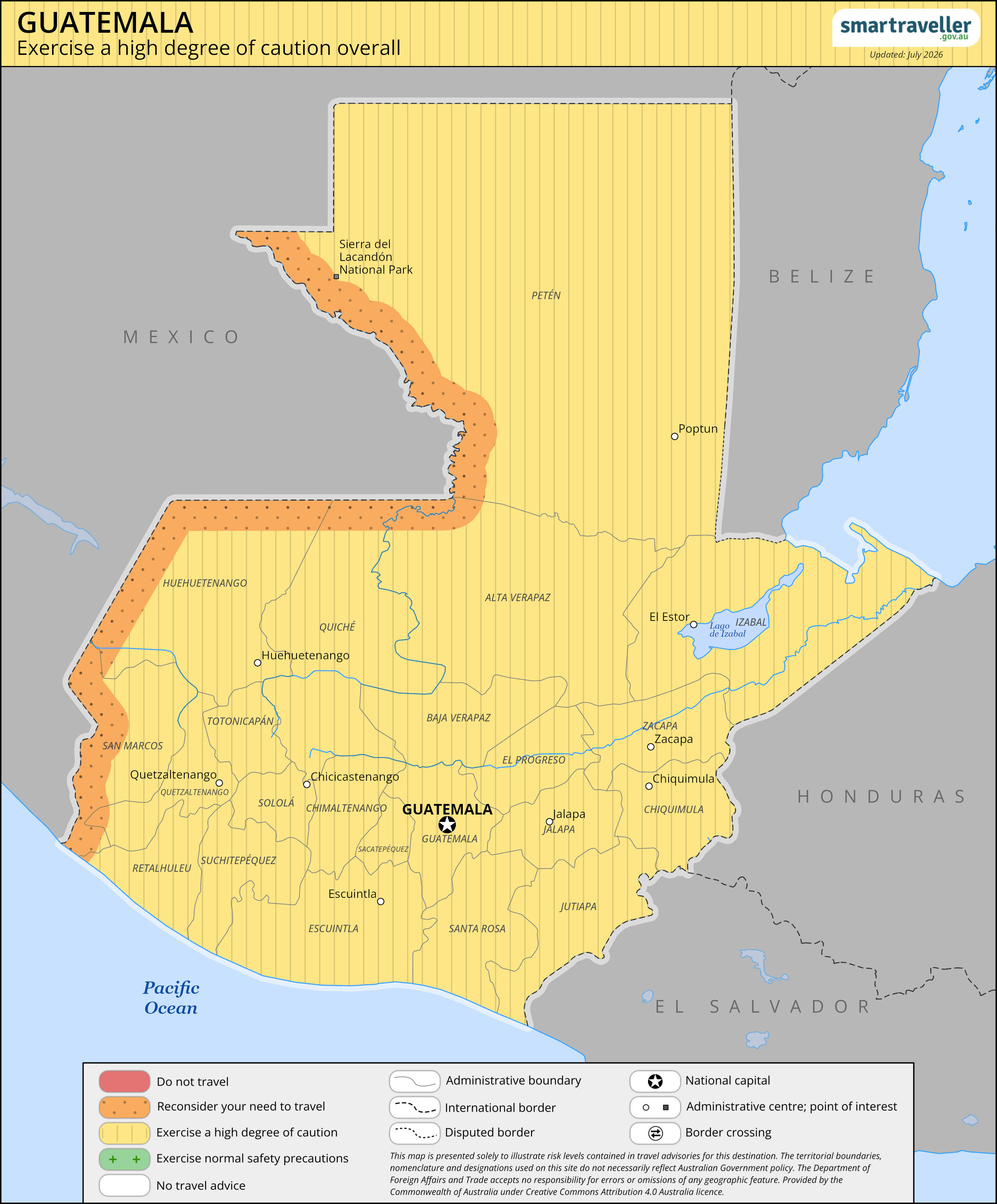
Exercise a high degree of caution in Guatemala overall due to the threat of violent crime.
Reconsider your need to travel to border areas between Guatemala and Chiapas State in Mexico.
Reconsider your need to travel to border areas between Guatemala and Chiapas State in Mexico due to organised crime and drug-related violence.
Full travel advice: Safety
Full travel advice: Health
Full travel advice: Local laws
Full travel advice: Travel
Full travel advice: Local contacts
The Guatemalan Government has declared state of prevention due to the threat of organised crime and gang activity, including recent attacks on police and unrest in prisons.
Under the state of prevention, authorities have expanded powers to respond to gang-related and organised criminal activity. The measure is intended to maintain public security and order nationwide.
According to authorities, the state of prevention does not affect day‑to‑day activities for most citizens and does not interrupt the operations of public or private institutions.
If you plan to visit Guatemala:
Petty crime is common, particularly pickpocketing and bag-snatching.
Take extra care of your valuables in:
To prevent petty crime:
More information:
Be cautious about snacks, beverages, gum and cigarettes offered to you as they may contain drugs, putting you at risk of sexual assault and robbery.
Violent crime is common in Guatemala, including:
Crime often involves guns. The risk of violent crime increases at night.
Areas at risk for violent crime, assault and robbery include:
Border areas between Guatemala and Chiapas State in Mexico are affected by organised crime and drug-related violence. Risks are higher from the Pacific Coast in San Marcos Department up to the Gracias a Dios border crossing in Huehuetenago Department.
If you're attacked or robbed, don't resist. If criminals have guns or weapons, they may injure or kill you.
To protect yourself from violent crime:
Be careful when crossing land borders. Only cross the border during daylight hours. Allow enough time to arrive in a major town before dark.
Criminals may target you when arriving at international airports or travelling to hotels in Guatemala City and Antigua.
Using an unofficial taxi increases your risk of robbery and assault. Safe options include:
Don't use taxis hailed from the street or taxi stands.
You can use an escort from the state-run tourist service PROATUR to reduce your travel risk.
Theft happens at budget hotels, particularly in Antigua.
To protect yourself while travelling by road:
To protect yourself if you're driving:
Scams and credit card fraud are a risk.
Instances of credit card and ATM fraud can occur. Take precautions when using debit or credit cards.
Scam artists target foreign visitors and residents. The scams come in many forms and can cause great financial loss. Warn your friends and family to be sceptical if they’re asked to transfer funds to you in Guatemala. Tell them to contact you to check that you’ve made this request.
Women travelling alone may encounter instances of sexual harassment and verbal abuse.
More information:
Kidnapping can happen anywhere, even in places that seem safe. Foreigners, including Australians, have been kidnapped overseas whilst travelling.
Express kidnappings can occur in urban areas, and they are often committed by organised gangs or taxi drivers. The kidnappers usually take their victims to an ATM and force them to make a cash withdrawal. This can occur at petrol stations and shopping centres. If threatened, do not resist.
You’re responsible for your own safety. The Australian Government’s longstanding policy is that it doesn’t make payments or concessions to kidnappers.
More information:
The government may make state of emergency or state of prevention declarations without notice.
Expect an increased police presence in many areas during the state of emergency or state of prevention declarations.
Protest and demonstrations can happen.
Demonstrations and protests against the government can occur. Some can turn violent, causing injuries and deaths. They may occur anywhere across the country and often affect public transport.
It’s illegal for foreigners to take part in political demonstrations in Guatemala.
To protect yourself during periods of unrest:
If you see a protest, leave as soon as it’s safe.
More information:
Terrorism is a threat worldwide. Terrorist attacks could occur anywhere and at any time. Be alert to possible threats, especially in public places. Terrorists may target tourist areas or other places frequented by foreigners and where large crowds may gather.
Possible targets include:
To stay safe:
If there’s an attack, leave the area as soon as it's safe to do so.
More information:
Strong currents and undertows occur on the Pacific coast beaches. Check the safety conditions.
There may not be lifeguards. Swimming conditions can become dangerous quickly.
Tour operators and diving centres may not adhere strictly to international standards. When engaging in adventure sports such as diving, choose a reputable company with proper insurance coverage.
Guatemala experiences natural disasters and severe weather, such as:
To protect yourself in case of a natural disaster:
To receive alerts on major disasters, register with the:
The hurricane season is from June to November, although tropical storms and hurricanes can happen in other months.
The wet season is from May to November, when landslides, mudslides, and flooding may occur.
The direction and strength of hurricanes can change suddenly.
If there's a hurricane or severe storm:
Severe weather may also affect:
To protect yourself if a hurricane is approaching:
Monitor weather reports if you're travelling to Guatemala during hurricane season or after a natural disaster.
More information:
Guatemala experiences earthquakes.
Aftershocks are common and can damage already weakened structures.
Earthquakes can disrupt power and communication systems.
Get to know the earthquake safety measures for each place you stay and visit.
Tsunamis may occur in Guatemala.
Receive tsunami alerts by registering with the following:
If you're near the coast, move immediately to high ground if advised by local authorities or if you:
Don't wait for official warnings, such as alarms or sirens. Once on high ground, check local media
Guatemala has 4 active volcanoes:
Volcan de Fuego, Pacaya, and Santiaguito volcanoes are very active. Levels of activity may increase at any time. La Aurora International Airport (Guatemala City) can be subject to closures at short notice due to volcanic ash affecting airport operations.
After a volcanic eruption, falling ash can spread over a wide area. Ash, dust and toxic fumes are a significant health risk. If you have a respiratory condition, take particular care.
To protect yourself if there's a volcanic eruption:
If you go outside, wear a disposable face mask, goggles and long clothing to avoid contact with ash.
To reduce your risks if you climb a volcano:
Take care if you're taking part in adventure activities, such as:
Transport and adventure tour operators may not meet Australian safety standards for:
Rescue services may not be as effective as those in Australia.
If taking part in adventure activities:
If appropriate safety equipment isn't available, use another provider.
Strong currents and tides on Guatemala's Pacific coast are dangerous for swimmers.
You often won't find beach patrols, lifeguards or warning and advisory signs.
Zika virus is widespread in Guatemala.
If you're pregnant, the Australian Department of Health and Aged Care recommends that you:
Malaria is a year-round risk in rural areas below 1500m elevation.
Other insect-borne diseases occur in Guatemala. These include:
To protect yourself from disease:
Get medical advice if you have a fever, muscle pain, rash, bleeding nose or gums, or severe headache.
More information:
HIV/AIDS is a significant risk in Guatemala.
Take steps to protect yourself if you're at risk of infection.
Waterborne, foodborne and other infectious diseases are common. These include:
Serious outbreaks sometimes occur.
Many illnesses can be caused by eating food or drinking beverages contaminated by bacteria, parasites, toxins, or viruses, or by swimming or bathing in contaminated water.
To protect yourself from illness:
Get medical advice if you have a fever or diarrhoea.
Public medical facilities are reasonable in Guatemala City but limited in smaller towns and rural areas.
Private medical facilities are available and well-equipped but expensive.
Treatment at private clinics and hospitals is very expensive. You will likely need to pay up front and claim back later from your insurer.
Doctors may only speak Spanish.
If you are seriously ill or injured, you may need to be evacuated to a place with appropriate facilities. Medical evacuation can be expensive. Make sure you get travel insurance that includes coverage for medical evacuation and hospital stays.
Penalties for drug offences are severe and include lengthy prison sentences in local jails.
More information:
Avoid public displays of affection.
Same-sex relationships are legal in Guatemala, but the country is conservative.
Same-sex marriages aren't recognised in Guatemala.
More information:
Guatemalan men, including dual nationals, must complete compulsory military service.
If you're a male dual citizen aged between 18 and 50 years, contact the Embassy of Guatemala in Canberra before you travel.
If you're an Australian citizen, and a Guatemalan citizen, the consular services we can provide to you may be limited.
More information:
Ask permission before taking photos or video of handicraft and art markets, as well as people, especially children.
You'll need to purchase a tourist card at the airport. This permits you to visit Guatemala for up to 90 days.
Guatemala is a member country of the Central American Border Control Agreement (CA-4), along with:
With a CA-4 tourist visa, you can travel freely by land between member countries within the 90-day period.
Your tourist card is dated from the first entry into any member country.
You can apply to extend the CA-4 visa before it expires at the local immigration office.
If you overstay the visa without an extension, you may be:
If you're not a tourist or you plan to stay longer, you'll need a visa.
Entry and exit conditions can change. Contact the Embassy of Guatemala in Canberra for details about visas, currency, customs and quarantine rules.
To enter the country, you'll need:
You'll need to pay an airport and security tax in cash on departure at the airport.
You'll also need to pay an exit tax if your ticket price doesn't include it.
Follow the entry requirements set out by Guatemalan authorities (in Spanish).
If you're travelling through the US, ensure you meet all US entry or transit requirements.
More information:
If you're travelling via Canada, you'll need an eTA (Electronic Travel Authorisation) for Canada.
More information:
A child travelling to Guatemala without both parents must have notarised written consent from both parents. A child travelling with at least 1 parent won't need this letter.
These documents must be in Spanish and approved by the Guatemalan mission closest to the child's home.
More information:
Depending on where you’ve travelled, you may need a valid yellow fever vaccination certificate to enter Guatemala. Some airlines may want to see one when you leave.
Find out about returning to Australia after exposure to yellow fever.
More information:
The local currency is the Guatemala Quetzal (GTQ).
You can't import or export the Quetzal. You can only exchange US dollars in Guatemala.
Most international hotels and tourist facilities accept credit and debit cards. Ask your bank whether your ATM card will work in Guatemala.
Carry cash if you're travelling to rural areas.
Strict security controls are in place at Guatemalan borders due to high levels of drug-related criminal activity.
Military personnel are stationed along the border between Guatemala and Mexico. They may want to check your documents.
Only use recognised border crossings, particularly between Guatemala and Belize. There is an ongoing border dispute between the two countries.
The Mexican government has recently increased security at border crossings into Mexico in response to a large number of migrants seeking to travel to the US. Take extra care when using these border crossings and follow the direction of authorities.
To drive in Guatemala, you need both:
You must get the IDP before arriving in Guatemala.
Demonstrations are having a significant impact on road transport networks and affecting road travel throughout the country. Monitor the media for updates (see 'Civil unrest and political tension').
Driving standards can change across the country.
If you're in an accident, call 911 for the national police or the fire brigade. Wait for the authorities to arrive before you leave.
Driving in Guatemala can be dangerous, including:
In rural areas, extra road travel risks include:
Mudslides and road collapses caused by heavy rains are common. Roads may be closed at short notice.
Inter-city travel after dark anywhere in Guatemala is dangerous. Violent carjackings occur, particularly on poorly maintained roads and main highways.
Dangerous roads include:
Criminals have violently attacked motorists between El Salvador and Guatemala, particularly on the Guatemalan side of the border.
Armed gangs often build roadblocks in:
Other dangerous areas for road travel include:
An alternative route to the Godinez bypass is the main Pan-American highway to Solola.
Criminals sometimes pose as police officers.
If you plan to drive in Guatemala:
More information:
Use ride-share services, where possible, instead of taxis. If this isn't an option, it's best to use registered official taxis and limousines, preferably arranged through your hotel. To avoid issues:
If you use an unofficial taxi, there's a risk of robbery and assault.
Arrange transport through your hotel and book in advance if travelling at night.
Bus travel can be dangerous. Gangs have targeted, robbed and sexually assaulted passengers on:
Gangs have also detonated bombs targeting buses. In 2016, gangs killed 5 people in a bomb blast on an inter-city bus in San Jose Pinula, near Guatemala City.
Dangerous areas for bus attacks include:
If you need to use public transport:
If you plan to travel by bus from Guatemala to southern Mexico, see our travel advice for Mexico.
Criminals may attack you on motorised or sailing boats in Rio Dulce and Livingston.
Check there are good security measures in place before booking any boat travel.
Check Guatemala's air safety profile with the Aviation Safety Network.
More information:
Depending on what you need, contact your:
PROATUR, the tourist assistance unit, provides 24-hour help:
call 1500
email proatur@inguat.gob.gt
Call 122.
Call 123 or go to the nearest hospital.
Call 110 or visit the nearest police station.
Emergency telephone operators may not speak English.
Always get a police report when you report a crime.
Your insurer should have a 24-hour emergency number.
The Australian Government aims to provide high quality consular assistance. There are limits to what we can do. Read the Consular Services Charter to understand how we can assist you overseas.
Australia has a consulate in Guatemala City, headed by an Honorary Consul. The consulate provides limited consular assistance to Australians in Guatemala. The Consulate can conduct passport interviews and provide provisional travel documents for emergency travel to the nearest Australian embassy. The Consulate can’t issue Australian passports. You can get full consular assistance from the Australian Embassy in Mexico City.
Avenida 5 16-62, Zona 10
Edificio Platina, office 102
Ciudad de Guatemala, Guatemala
Phone: (+502) 4210 9805
E-mail: consuladoaustralia.guate@gmail.com
Rubéen Darío #55 (Polanco)
Colonia Bosque de Chapultepec
11580 CDMX México
Phone: (+52 55) 1101 2200
Email: consularpassports.mexico@dfat.gov.au
Website: mexico.embassy.gov.au
Facebook: @AusEmbMex
X: @AusEmbMex
Instagram: Australian Embassy, Mexico City
In a consular emergency, if you can't contact an embassy, call the 24-hour Consular Emergency Centre on:
Be the first to know official government advice when travelling.