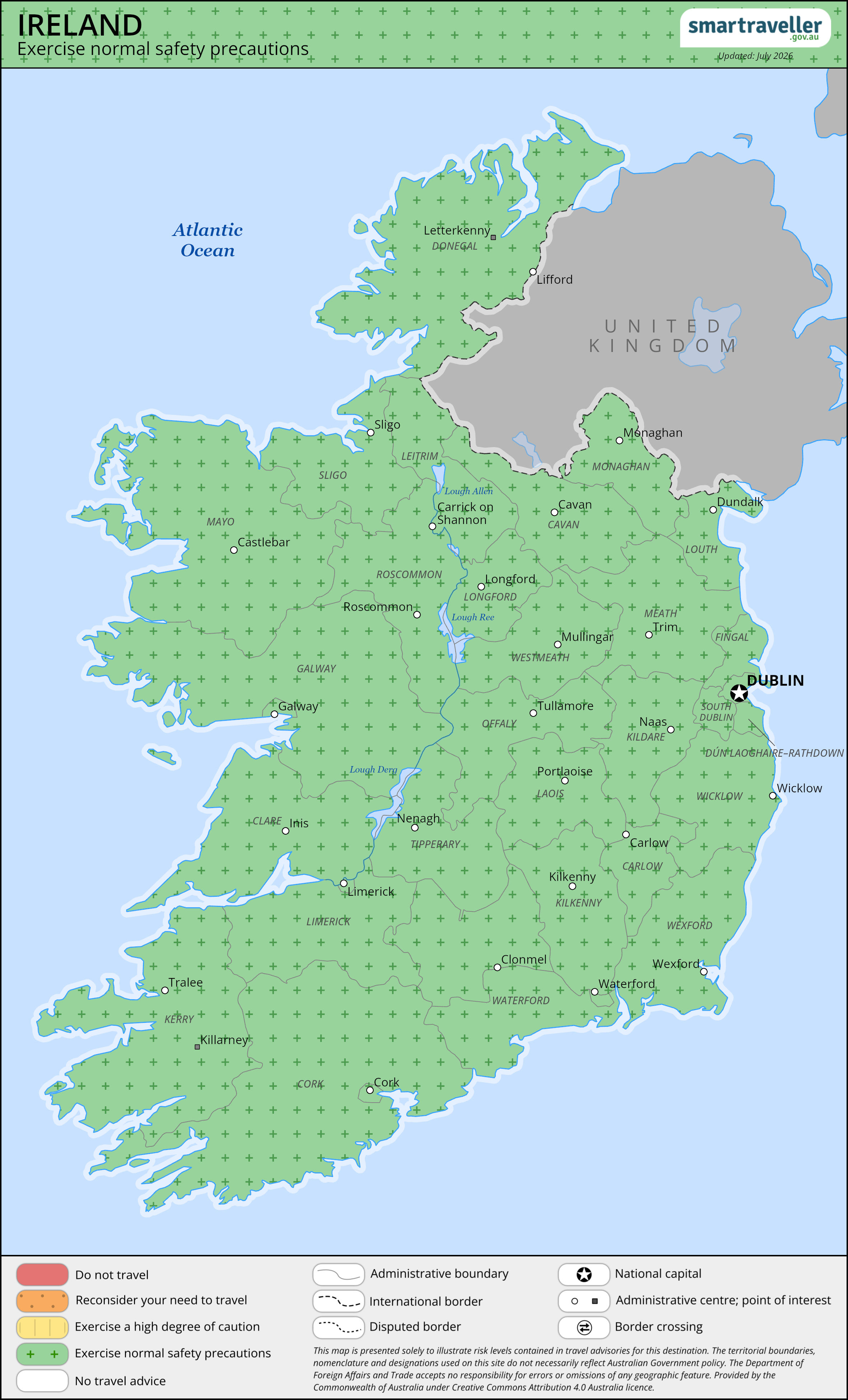
Fire and rescue services
Call 112.
Medical emergencies
Call 112.
Police (locally know as Garda)
Call 112 or contact the nearest police station.

Full travel advice: Safety
Full travel advice: Health
Full travel advice: Local laws
Full travel advice: Travel
Full travel advice: Local contacts
Petty crime is common, particularly in city centres like Dublin. Risks include bag snatching and pickpocketing.
Thieves target areas popular with tourists.
Car theft and break-ins are increasing. Thieves target rental cars, especially in tourist areas. Use secure carparks when possible and keep your luggage and valuables out of sight.
There's a moderate risk of serious violent crime, including sexual offences, public order and assault. Watch your belongings on public transport and in crowded places.
Avoid secluded parks, and low lit areas.
Check local media for news on crime.
Credit card fraud and ATM scams are becoming more common.
Don't use ATMs that look unusual.
More information:
Large public gatherings and protests can occur in major centres, such as Dublin, and may turn violent.
To stay safe during periods of unrest:
More information:
Terrorism is a threat worldwide. Terrorist attacks could occur anywhere and at any time. Be alert to possible threats, especially in public places.
While there have been no recent terrorist attacks in Ireland, they can still happen.
The terrorist threat level in Northern Ireland is different to Ireland. If you plan to visit Northern Ireland, you should read the UK travel advice.
In recent years, terrorists have attacked some European cities. Targets have included:
European security services have disrupted several planned attacks in recent years.
To stay safe:
If there's a terrorist attack:
If there’s a terrorist incident, leave the area if it’s safe to do so and follow the instructions of local authorities.
More information:
Severe weather can disrupt your travel plans.
Monitor local media for updates.
If you visit somewhere that's had severe weather:
Health risks are similar to those in Australia.
Ask your doctor about health risks and vaccines before you go.
More information:
The standard of health care is similar to that in Australia.
Australia and Ireland share a reciprocal healthcare agreement. This means you can get emergency medical treatment at public hospitals in the same way Irish people can.
However, the agreement doesn't:
Although Australia and Ireland share a reciprocal healthcare agreement, you'll still need travel insurance. If you're hospitalised, you may be caught out with non-medical related expenses, such as the costs of your delayed or assisted travel home.
More information:
When you travel to another country, you must follow their laws. Even if they seem strict compared to Australia's. Before you go, learn about the local laws in that country.
The Australian Government is limited in how and when we can help if you're arrested overseas. We can't get you out of trouble or out of jail. Understand our limits. Read the Consular Services Charter.
Possessing even a small amount of illegal drugs can lead to a long jail sentence.
Don't carry items for anyone when you enter or leave Ireland.
More information:
Some Australian laws still apply even if you’re in another country. You could be charged in Australia if you break these laws overseas.
More information:
You don't need to apply for a tourist visa before departing Australia. A tourist visa of up to 90 days will be issued on arrival, as determined by the immigration officer.
At least one blank page in your passport is required for entry.
When you arrive, immigration authorities may ask for details of your:
If they don't believe you're a genuine tourist, they may:
You'll need a visa for longer visits or if you want to work or study. You'll need to apply for your visa before you leave Australia.
Ireland isn't a part of the Schengen area and doesn't accept Schengen visas.
If you're travelling to the UK (including Northern Ireland) from Ireland or transiting the UK on your way to Ireland, you should review the Travel Section of the travel advice for the United Kingdom for information on entry requirements.
Entry and exit requirements can change at short notice. For details about visas, customs and quarantine conditions, contact either:
If you plan to work, you'll need an employment permit.
Use the Employment Permits Online System (EPOS) to choose the right permit.
More information:
Immigration authorities have strict entry requirements for children aged under 18 years.
Authorities may ask the child, or adults accompanying them, for additional supporting documentation.
More information:
The local currency is the Euro.
Ireland is a member of the European Union (EU). If you're travelling between Ireland and any non-EU country, you must declare amounts over 10,000 euros or equivalent. This covers all forms of currency, not only cash.
You'll have to pay a fine when you enter or leave Ireland if you:
You don't need to declare currency if you're travelling between EU countries.
ATMs are widely available. Ask your bank before you leave if your card will work in Ireland.
Contact your provider with any complaints about tourist services or products.
If you're not satisfied with the response, contact the Irish Tourist SOS for support and advice.
You can use your Australian driver's licence for up to 12 months. After this, you'll need to get an Irish licence.
Ireland and Australia have a driver's licence exchange for car and motorcycle licences, meaning that if you have an Australian licence, you can apply for an Irish licence without sitting any tests. You must apply for a Personal Public Service (PPS) Number before exchanging your licence.
When hiring a car, check with your hire car provider whether you need an International Driving Permit. The electronic version of your driver's licence won't be accepted.
Conditions on major roads and in urban areas are good. However, hazards in country areas include:
You face serious penalties for drink driving, including heavy fines and jail sentences.
If you plan to drive:
More information:
Check if your travel insurance policy covers you when riding a motorbike.
Always wear a helmet.
Ireland has several authorised taxi and limousine services.
Ireland has well-developed networks of buses, trains and ferries.
However, public transport may be disrupted by:
More information:
Many international cruise lines stop over in Ireland.
More information:
Check Ireland's air safety profile with the Aviation Safety Network.
More information:
Depending on what you need, contact your:
Call 112.
Call 112.
Call 112 or contact the nearest police station.
Always get a police report when you report a crime.
Your insurer should have a 24-hour emergency number.
If you're a victim of a crime, police may refer you to the Irish Tourist SOS.
Irish Tourist SOS can:
The Australian Government aims to provide high quality consular assistance. There are limits to what we can do. Read the Consular Services Charter to understand how we can assist you overseas.
You can get consular help from the Australian Embassy in Dublin.
3rd Floor
47-49 St Stephen's Green
Dublin 2, D02 W634
Ireland
Phone: +353 1 664 5300
Fax: +353 1 678 5185
Email: austremb.dublin@dfat.gov.au
Website: ireland.embassy.gov.au
Facebook: Australian Embassy, Ireland
Twitter: @AusEmbIre
Make an appointment to get help from the embassy.
Check the Embassy website for details about opening hours and any temporary closures.
In a consular emergency, if you can't contact an embassy, call the 24-hour Consular Emergency Centre on:
Be the first to know official government advice when travelling.