Fire and rescue services
Call 912.
Medical emergencies
Call 913.
Police
Call 911.

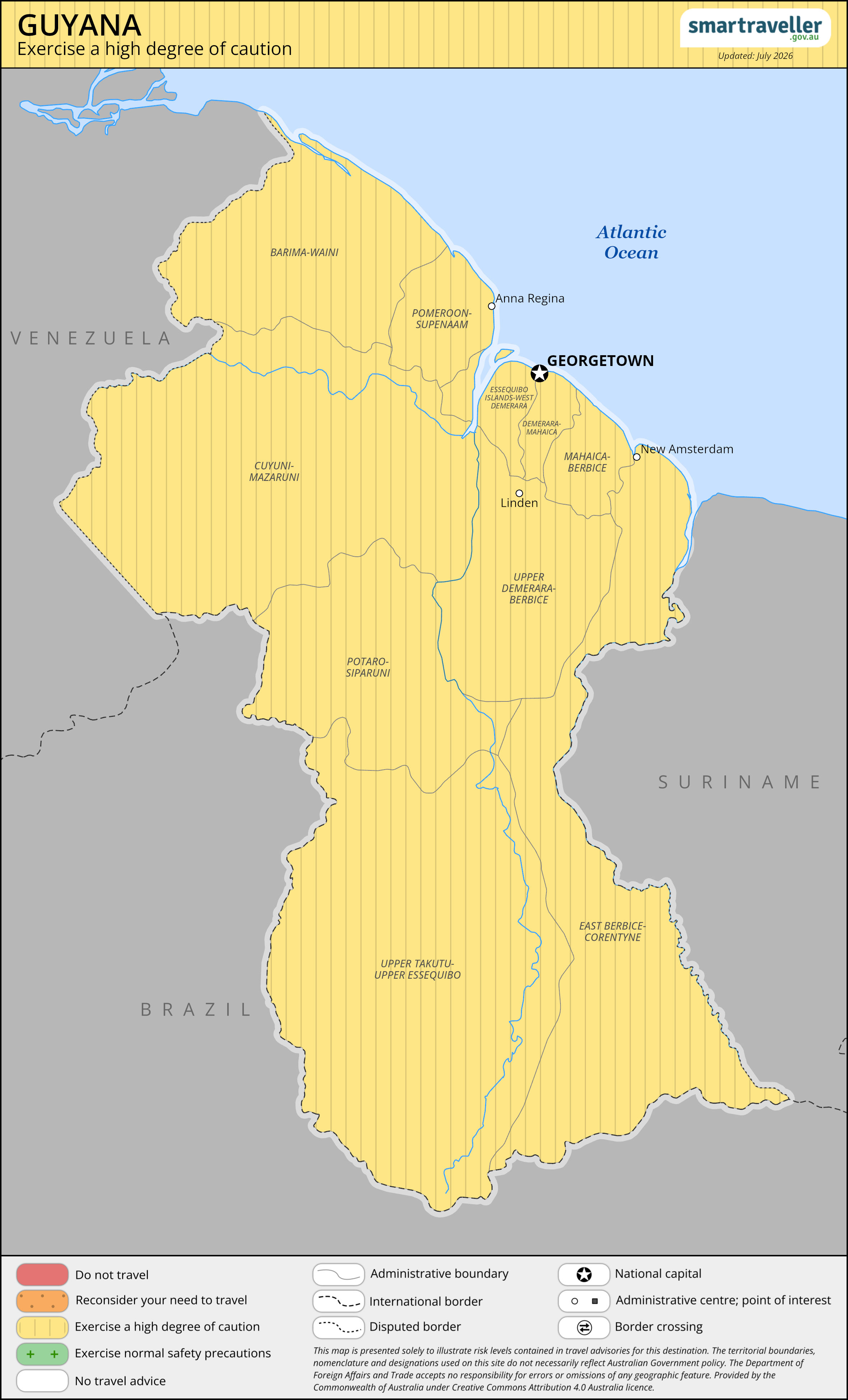
Exercise a high degree of caution in Guyana.
Exercise a high degree of caution in Guyana due to the threat of violent crime.
See Safety
Full travel advice: Safety
Full travel advice: Health
Full travel advice: Local laws
Full travel advice: Travel
Full travel advice: Local contacts
Violent crime resulting in serious injury or death is a problem, particularly in Georgetown. Incidents include:
Armed robberies and assaults can occur in:
Law enforcement is generally cooperative but can't respond effectively to serious crimes.
Hotspots for crime include:
To protect yourself from crime:
Avoid travelling or walking alone.
Security risks increase after dark. Be careful:
Muggings and shootings have occurred in these areas.
To protect yourself in case of an emergency, if you stay at a hotel in Georgetown:
Kidnapping can happen anywhere, even in places that seem safe.
While kidnapping is not common in Guyana, incidents have occurred, including in Georgetown. Armed pirate attacks against ships and fishing boats have occurred in and around the waters of Guyana.
The Australian Government's longstanding policy is that it doesn't make payments or concessions to kidnappers. You’re responsible for your own safety.
More information:
There's ongoing tension between Guyana and Venezuela. The security situation may deteriorate in the area near the Venezuelan border.
If you choose to travel in this area, you should:
Avoid protests, large public gatherings, crowds and demonstrations. These can turn violent.
Monitor local media for news on possible civil unrest. Follow the advice of local authorities.
More information:
Terrorism is a threat worldwide. Terrorist attacks could occur anywhere and at any time. Be alert to possible threats, especially in public places. Terrorists may target tourist areas or other places frequented by foreigners and where large crowds may gather.
More information:
Guyana has 2 rainy seasons:
Serious flooding can occur, particularly in low-lying coastal areas. River levels can rise very quickly. Roads may not be safe.
If severe weather occurs:
Insect-borne diseases are also widespread. These include:
Risk of these diseases increases during the wet seasons
To protect yourself from disease:
HIV/AIDS is common. Take precautions before you do anything that exposes you to the risk of infection.
Waterborne, foodborne and other infectious diseases are common. These include:
More severe outbreaks sometimes occur.
To protect yourself from illness:
If you're bitten or scratched by an animal, get medical help straight away.
Seek urgent medical help if you have a fever or diarrhoea.
Medical facilities in Guyana are very limited, and even more so in remote areas. They lack trained specialists and medical equipment. Hygiene standards are poor.
If you become seriously ill or injured, you'll be evacuated to a place with better facilities, such as the US. Medical evacuation can be very expensive.
Penalties for drug offences are severe and include long prison sentences in local jails.
Prison conditions are harsh. Pre-trial detention can last for years.
More information:
Guyana doesn't recognise same-sex marriage.
You'll have no legal protection from discrimination based on:
Same-sex relationships are illegal. If convicted, you'll face up to 10 years in prison.
More information:
Serious crime, such as murder, may attract the death penalty.
Guyana has an online Immigration and Customs form for entry and exit. Visit the Guyana online Immigration and Customs portal to complete the form within 48 hours prior to travel.
Australians visiting Guyana don't require a visa to enter.
Visitors are generally given 30 days to remain in Guyana, and extensions can be requested from the Ministry of Foreign Affairs and International Cooperation in Georgetown. The Guyanese authorities are very severe on visitors who overstay or abuse the conditions of their stay.
Entry and exit conditions change regularly. Contact the High Commission of Guyana for details about visa, currency, customs and quarantine rules.
Departure tax is incorporated into your ticket, so you are no longer required to make this payment at the airport.
You'll need a valid yellow fever vaccination certificate to enter Guyana. Some airlines may want to see one when you leave.
Find out about returning to Australia after exposure to yellow fever.
If you travel through the US, you must meet US entry or transit requirements.
Check our US travel advice for entry conditions.
If you transit or travel via Canada by air, you'll need a Canadian eTA (electronic Travel Authorisation).
Check our Canada travel advice for entry conditions.
The Guyanese dollar is the official currency of Guyana. Cash is mostly used in Guyana. Not all ATM machines accept international cards.
Do not exchange money in the street with informal money changers.
Declare money you're carrying if it's more than US$10,000, or equivalent. Do this on arrival and departure. This covers all forms of currency, not only cash.
The interior regions of Guyana can be dangerous. Hazards include:
Take safety gear if travelling to interior regions. This may include:
Border disputes take place along:
If you need to cross the Guyana border:
You're more likely to be killed in a motor vehicle accident in Guyana than in Australia.
Driving in Guyana can be dangerous. Hazards include:
Pedestrians are often killed on roads.
Crime increases at night on the road from Georgetown to Cheddi Jagan International Airport. This includes armed robbery.
If you plan to drive in Guyana:
More information:
Taxis are generally safe if you use a reputable company.
Ask airport and hotel staff about official taxi services.
Don't hail taxis from the roadside. Robberies and assaults have occurred.
Buses are often overcrowded and poorly maintained.
Avoid using minibuses. They:
More information:
It's illegal to use an independent boater to enter Suriname. You may be fined, detained or deported.
Piracy occurs on Guyana's coastal waters.
To protect yourself while travelling by sea:
More information:
Check Guyana's air safety profile with the Aviation Safety Network.
More information:
Depending on what you need, contact your:
Call 912.
Call 913.
Call 911.
Always get a police report when you report a crime.
Your insurer should have a 24-hour emergency number.
The Australian Government aims to provide high quality consular assistance. There are limits to what we can do. Read the Consular Services Charter to understand how we can assist you overseas.
Australia doesn't have an embassy or consulate in Guyana. Consular assistance is available from the Australian High Commission in Trinidad and Tobago.
18 Herbert Street, St. Clair
Port of Spain
Trinidad and Tobago
Phone: +1 868 235 7950
Website: trinidadandtobago.highcommission.gov.au
Email: ahc.portofspain@dfat.gov.au
Facebook: AusHighComTT
Check the High Commission website for details about opening hours and any temporary closures.
In a consular emergency, if you can't contact an embassy, call the 24-hour Consular Emergency Centre on:
Be the first to know official government advice when travelling.