Fire and rescue services
Call 112.
Medical emergencies
Call 112.
Police
Call 112.
Full travel advice: Safety
Full travel advice: Health
Full travel advice: Local laws
Full travel advice: Travel
Full travel advice: Local contacts
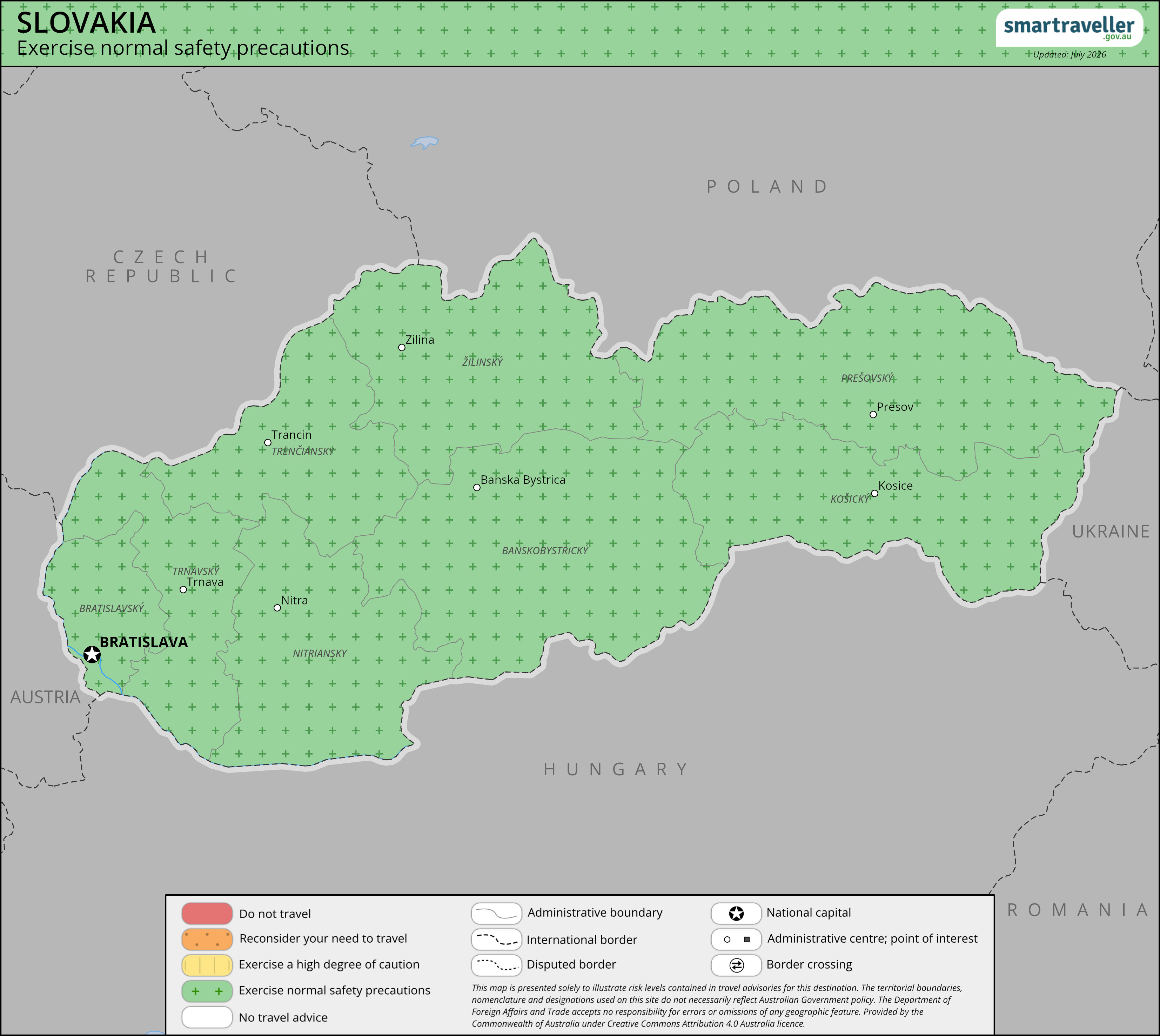
Do not travel from Slovakia to Ukraine. The Russian invasion of Ukraine is ongoing. The security situation continues to be volatile.
Terrorism is a threat worldwide. Terrorist attacks could occur anywhere and at any time. Be alert to possible threats, especially in public places.
Possible targets include:
To stay safe:
If there’s a terrorist incident, leave the area if it’s safe to do so and follow the instructions of local authorities.
More information:
Demonstrations and events that draw large groups of people are generally peaceful but can turn violent.
They can also disrupt traffic and public transport.
To stay safe:
More information:
Petty crime happens, especially around:
Pickpockets often:
To protect yourself from crime:
Thefts and break-ins happen, including theft from cars.
Criminals sometimes slash tyres so they can offer to help. After distracting their victim, they then steal items.
To protect yourself from theft:
Bars and restaurants sometimes overcharge travellers. Disputes about overcharging can lead to violence.
Always check the price of food and drinks before ordering. Be wary of invitations to restaurants and bars from strangers.
More information:
Sexual assault and harassment can happen anywhere, to anyone. It's never the victim's fault. Read our advice on sexual assault before you travel.
More information:
Slovakia experiences severe weather events and natural disasters, such as:
Weather in mountain regions is unpredictable and can change suddenly.
If you're visiting mountain regions:
Before you travel:
Skiing outside prepared skiing areas (off-piste) is dangerous and may void your insurance. Stick to marked slopes and trails.
Hiking or mountain climbing without appropriate footwear (hiking boots) is dangerous. Stick to marked trails.
Check your travel insurance covers all your planned activities especially if you plan to undertake adventure sports.
More information:
Register with the Global Disaster Alert and Coordination System to receive alerts on major disasters.
If you need help from the Slovak Mountain Rescue Service, you'll need to pay up to EUR 1,000. Make sure your insurance includes rescue costs. Anyone ignoring or violating HZS rules or instructions will get a fine of up to EUR 3,320.
Bears and wolves are occasionally encountered in mountain areas. You should take particular care if you're in an area where bears have been sighted.
West Nile virus (WNV) cases have been reported. There's no vaccine to prevent WNV.
Tick-borne encephalitis is a risk in forest areas.
Ticks are common in country areas and active from March to November.
To protect yourself from illness:
Outbreaks of foodborne and other infectious diseases can occur. These include:
To reduce your risk of illness:
Ask your doctor about health risks and vaccines before you go.
More information:
There’s no agreement between Australia and Slovakia for free healthcare. Tourists must pay for all medical care, even if they need to stay in hospital or be evacuated. This can be very expensive. Make sure your travel insurance covers you. The Australian Government won't pay for these costs.
Medical treatment standards are reasonable. Hospitals and other medical facilities are improving but vary in quality.
In rural and border regions, facilities can be limited.
Some doctors speak English, but other hospital staff rarely do.
Doctors and public hospitals usually expect you to pay cash up-front.
More Information:
Don't use or carry illegal drugs.
Penalties for drug offences are severe. Possessing even small amounts of illegal drugs can lead to prison sentences.
More information:
It's illegal to drink alcohol in the street in Bratislava Old Town. Doing so can result in a fine.
There may be exceptions for:
It's illegal to take photos of:
Fines for minor driving infringements are heavy.
You need to pay these fines on the spot. If you don't, officials may take your licence.
Penalties for serious driving offences can include prison sentences.
Local authorities can ask to see identity documents at any time.
Always carry your passport with you.
Register with the police if you plan to stay longer than 3 days in Slovakia.
Same-sex relationships are legal but aren't widely accepted. Public displays of affection may attract unwanted attention.
More information:
Slovakia is part of the Schengen area, which means that you can sometimes enter the country without a visa.
Entry and exit conditions can change at short notice. Contact the nearest embassy or consulate of Slovakia for the latest details.
Make sure you meet all entry and exit conditions. If you don't, the Australian Government can't help you.
You may be subject to random checks by Slovak authorities and authorities of neighbouring countries. Make sure you carry your passport when crossing borders, including within the Schengen area.
See the EU Notifications of Temporary Reintroduction of Border Controls for more information.
More information:
Children aged under 18 years who travel alone or with one parent may need a letter of consent from the non-travelling parents. Check with an embassy or consulate of Slovakia for details.
More information:
Slovakia's official currency is the Euro.
Declare more than EUR 10,000 or equivalent funds if you're travelling between Slovakia and a non-EU country. This covers all forms of currency, not just cash. Failure to do so will result in fines.
You don't need to declare cash if you're travelling to or from another EU country.
ATMs may be rare in mountain areas or small villages.
You can drive on your Australian driver’s licence for up to 6 months.
Some car hire agencies may need you to have a current International Driving Permit (IDP). Get your IDP before you leave Australia.
Roads are generally safe.
Driving in poor weather, particularly on rural roads, may be dangerous.
When driving, you must:
Check your rental car is fitted with the required equipment.
The blood alcohol limit for drivers is 0%.
You must purchase an electronic permit (vignette) to drive on motorways. You can buy these online, at some petrol stations or border crossings.
More information:
Check whether your travel insurance policy covers you when using a motorcycle, quad bike or similar vehicle.
Always wear a helmet.
Use only clearly marked taxis. Check that the meter is running at the beginning of your trip to avoid being overcharged.
If using rideshare apps, make sure you enter the vehicle with the same plate number and name shown in the app.
Slovakia has a well-developed and reliable public transportation system. This includes trains that run to all major towns. Take care of your personal belongings, particularly on trains and in major transport hubs. Don't leave bags unattended on trains, even briefly.
More information:
If you plan to join a Danube river cruise, read the health and travelling by boat pages.
Make sure you consider border crossings and travel with your passport.
Check the Slovakia air safety profile with the Aviation Safety Network.
More information:
Depending on what you need, contact your:
Your insurer should have a 24-hour emergency number.
Call 112.
Call 112.
Call 112.
Always get a police report when you report a crime.
For non-urgent criminal issues, contact the nearest police station.
The Australian Government aims to provide high quality consular assistance. There are limits to what we can do. Read the Consular Services Charter to understand how we can assist you overseas.
Australia doesn't have an embassy or consulate in Slovakia.
For consular help, contact the Australian Embassy in Austria.
The Icon, Gertrude-Fröhlich-Sandner-Str. 2
1100 Vienna
Phone: +43 1 506 740
Email: consular.vienna@dfat.gov.au
Website: austria.embassy.gov.au
X: @AusAmbVIE
Facebook: @AusEmbassyVie
Check the Embassy website for details about opening hours and any temporary closures.
In a consular emergency, if you can't contact an embassy, call the 24-hour Consular Emergency Centre on:
Be the first to know official government advice when travelling.