Fire and rescue services
Call 110.
Medical emergencies
Call 110.
In Colombo, you can also call +94 11 269 1111.
Police
Call 118 or 119 or go to your local police station.
Tourist police
Call +94 11 242 1052 or +94 11 238 2209.

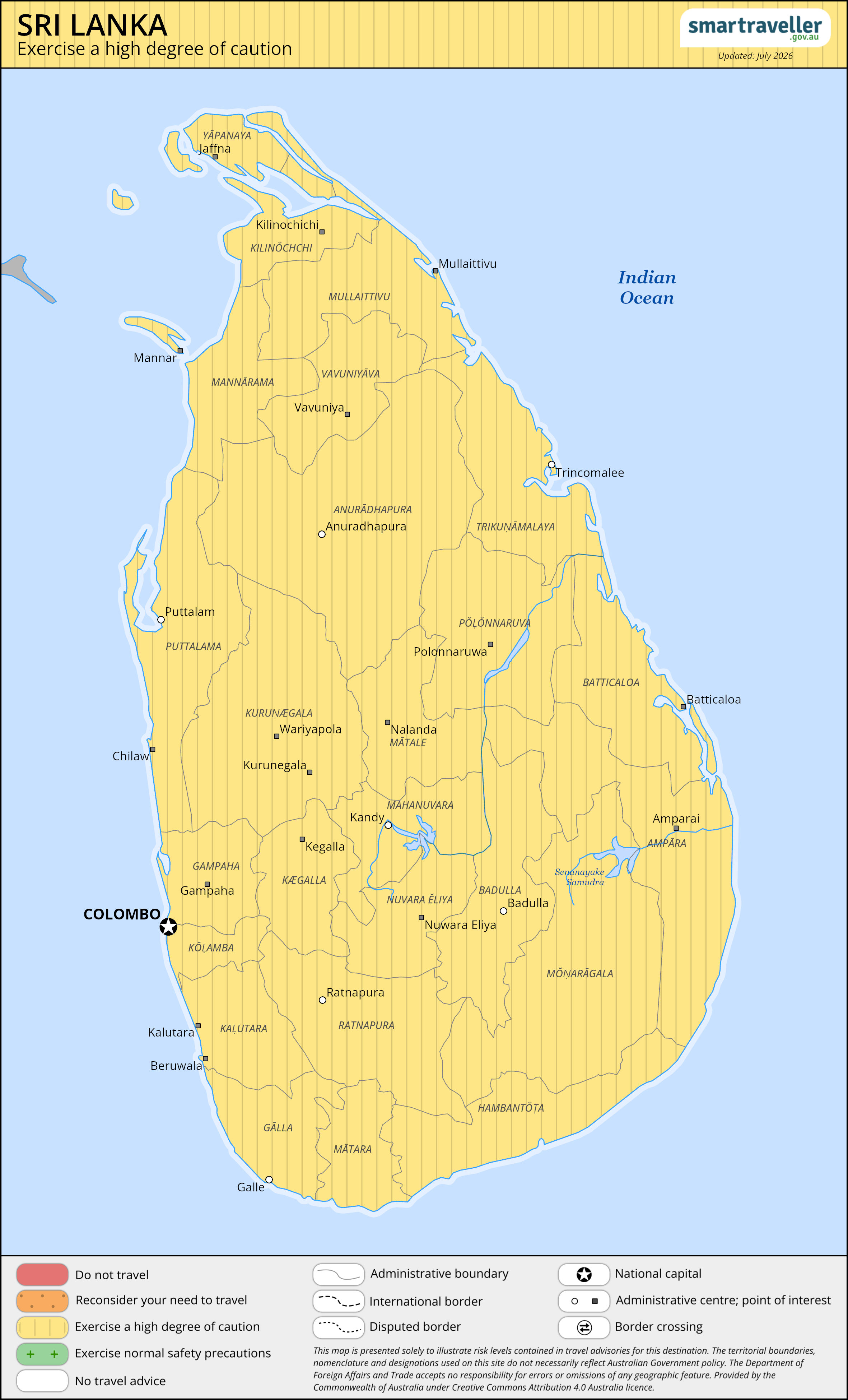
Exercise a high degree of caution in Sri Lanka due to the threat of public demonstrations and security risks.
Full travel advice: Safety
Full travel advice: Health
Full travel advice: Local laws
Full travel advice: Travel
Full travel advice: Local contacts
There is an ongoing risk of terrorist attacks. Terrorists may target areas popular with foreigners and tourists, including in regional and coastal towns.
The ongoing conflict in the Middle East could lead to an increased threat of attacks against Israeli interests in other regions.
Terrorism is also threat worldwide.
Terrorism can occur anywhere at any time. Be alert to possible threats. Take official warnings seriously. Terrorists may target areas popular with foreigners and/or visited by tourists.
To reduce your risk of being involved in a terrorist attack:
A terrorist attack on 21 April 2019 targeted prominent hotels and churches in the cities of Colombo, Negombo and Batticaloa. Over 250 people were killed, and more than 450 injured.
When you're travelling:
If there’s a terrorist incident, leave the area if it’s safe to do so and follow the instructions of local authorities.
More information:
Public demonstrations can occur throughout Sri Lanka and may become violent. Tear gas and water cannons may be used.
Demonstrations can lead to disruptions to traffic and public transport. Follow the advice of local authorities and check media for updates.
Public Emergencies can be declared, and curfews imposed at short notice. Carry relevant travel and photo identification documents with you at all times.
To stay safe during periods of unrest:
If you're detained, ask to contact the Australian High Commission (see 'Local contacts').
Security forces are visible, particularly in the Northern and Eastern provinces.
Military and police have wide-ranging powers and may:
Authorities may apply travel restrictions for foreigners without notice.
More information:
Marked and unmarked minefields and unexploded weapons remain in some areas. Most are in the Northern and Eastern Provinces. Most of the Eastern Province has been cleared but some isolated areas remain uncleared.
There are marked and unmarked minefields and unexploded weapons in the Northern Province and parts of the Eastern Province. Stay on main roads. Pay close attention to landmine warning signs.
Pickpocketing, bag snatching, and other petty crime are risks. Be careful of theft in crowds and these locations:
Avoid unlit areas and places away from crowds, including city streets, village lanes and beaches.
Crimes can include:
To protect yourself:
Women may experience:
Take care in:
If you’re a victim or survivor of sexual assault, try to move to a safe place and find someone you know and trust to support you. You may need urgent medical care.
If you want to report the assault, you should contact the Sri Lankan police immediately. You can also call the Australian High Commission in Colombo for consular help (see ‘Local contacts’). The Australian High Commission can't make a police report on your behalf, but can speak to the police once you have made a report and can follow up on your case.
If you choose to report the assault, make a statement at a local police station before you depart Sri Lanka. You may wish to seek consular help before you visit. Police may not take your statement if you’ve already returned to Australia. Statements from you and witnesses can be used as evidence in criminal court proceedings.
More information:
Scams and fraud are a problem, such as:
Ask your credit card provider how to prevent credit card fraud.
Kidnapping can happen anywhere, even in places that seem safe.
The Australian Government’s longstanding policy is that it doesn’t make payments or concessions to kidnappers.
More information, including advice on how to reduce your risk of kidnapping:
Transport and tour operators don't always follow safety and maintenance standards. This includes adventure activities, such as water sports.
If you plan to do an adventure activity:
If you don't see proper safety gear or you're not sure about the company's safety, choose another provider or don't do the activity at all.
Swimming conditions at some beaches are unsafe, and there can be strong rips.
Lifesaving services are rare and not to the same standard as Australia.
Take appropriate precautions.
Saltwater crocodiles are present in some locations in Sri Lanka, and attacks have occurred where people have died. Get local advice before you swim. Don't swim in rivers or lagoons.
Sri Lanka experiences severe weather, including flooding and landslides.
Cyclone Ditwah in November 2025 caused significant damage across Sri Lanka, particularly in central mountain areas. Most of the affected areas have been cleared and tourist destinations are operating as usual. However, work to repair damaged infrastructure, including rail routes, bridges and areas affected by landslides, will continue for some time. Check conditions with local authorities or your travel provider before you travel by road or rail to all central mountain districts, including Kandy, Nuwara Eliya, Ella, surrounding regions, and the Mahaweli River Valley. Follow instructions of local authorities.
Tsunamis can occur. There is minimal tsunami evacuation route signage, and many tsunami warning towers are not operational.
If there's a tsunami:
If a natural disaster occurs:
More information:
Ask your doctor about health risks and vaccines before you go. Make sure your vaccinations are up to date.
Dengue fever is a risk. Outbreaks of dengue occur in all regions.
The risk of insect-borne illnesses increases during the wetter months (December to March in the northeast and May to October in the southwest).
If you have a fever, get medical help.
Refer to the Ministry of Health's Epidemiology Unit for the latest information on dengue cases in Sri Lanka.
Outbreaks of other insect-borne diseases often occur, including:
To protect yourself from disease:
Foodborne, waterborne and other diseases sometimes occur, including:
To protect yourself:
Rabies is found in animals in Sri Lanka. It's 100% fatal. Avoid direct contact with animals, including dogs, cats, monkeys, bats and other mammals. Seek urgent medical care if an animal bites or scratches you.
More information:
Medical services and care in Colombo are below Australian standards. Outside of Colombo, facilities are extremely limited, especially for mental health and emergency services.
Mental health services are limited and below Australian standards.
There’s no agreement between Australia and Sri Lanka for free healthcare. Private hospitals will ask you to pay a deposit or prove you have insurance coverage before treating you. Public general hospitals are free for Sri Lankan nationals. Tourists must pay for all medical care. This can be very expensive. Make sure your travel insurance covers you. The Australian Government won't pay for these costs.
Facilities are limited for scuba diving injuries. The only working decompression chamber is at the Sri Lanka Navy Base in Trincomalee.
If you become seriously ill or injured, you'll need to be evacuated to a place with better facilities. Medical evacuation can be very expensive.
Legal proceedings are often lengthy. You may not be permitted to depart the country while legal proceedings are ongoing. This may also apply when you are the victim of a crime.
In certain cases, Sri Lankan law permits:
Penalties for carrying or using illegal drugs are severe and include the death penalty.
More information:
Authorities may apply the death penalty for murder or rape.
The legal drinking age is 21 years.
Always carry official photo ID. If you don't, you could be detained.
It's illegal to:
You must not take photos, record video or operate a drone in High-Security Zones (HSZ), including:
Some HSZs may not be signposted.
It's illegal to mistreat Buddhist images, including:
You must have legal authorisation to export certain items, such as antiquities. Contact the Sri Lankan Department of Archaeology for details.
More information:
Standards of dress and behaviour are conservative. Respect religious traditions and objects.
Respect local restrictions and observances around religious holidays.
Take care not to offend.
Full moon (Poya) days are celebrated once a month. Authorities ban the sale and purchase of alcohol and fresh meat on these days.
Get local advice before you take photos of places of worship and nearby areas. You may cause offence.
To enter Sri Lanka, you'll need a valid visa or an approved Electronic Travel Authorisation (ETA). You should do this before you travel, as you can no longer obtain an ETA on arrival at Colombo's Bandaranaike International Airport.
The ETA is free for Australian passport holders travelling to Sri Lanka for tourism. It allows you to stay for up to 30 days. If you plan to stay longer than 30 days, you must apply for a visa extension and pay the relevant fees.
If you engage in activities that breach your visa conditions, you could be detained or deported.
Entry and exit conditions can change at short notice.
Check the Sri Lanka ETA website or contact the High Commission of Sri Lanka for details about visas, currency, customs and quarantine rules before you travel.
Check when your visa expires. You could receive a large fine if you overstay.
If you're travelling from a country with yellow fever or cholera you need to show evidence that you've received the relevant vaccines.
You need a yellow fever vaccination certificate if you've travelled to, or transited an affected country in the 9 days before you travel to Sri Lanka. Babies under one year old are exempt.
Border authorities and airlines may request evidence of vaccinations. All travellers should carry proof of vaccination status in English.
Find out about returning to Australia after exposure to yellow fever.
More information:
The local currency is the Sri Lankan Rupee (LKR).
You can change Australian dollars for LKR at:
Most major towns and cities have ATMs. Some ATMs don't accept international cards.
You can withdraw cash from Visa and MasterCard cards at most major banks.
Hotels and major shops will accept credit cards.
Before you travel, ask your bank if your cards will work in Sri Lanka.
Check your statements, as credit card fraud and card skimming occur.
If you're carrying more than USD 10,000 or equivalent in cash in foreign currency, you may be required to declare this on arrival and departure. If you're carrying more than USD 15,000 in foreign currency in total in the form of cash, bank drafts, cheques, and travel cards, you must also declare this on arrival and departure. You may bring into or take out of Sri Lanka up to LKR 20,000 in Sri Lankan Rupees. Check with the Sri Lanka Customs Passenger Services Directorate for more information.
Full travel advice: Travel
You must get approval from the Ministry of Defence to:
Limit travel in High Security Zones and near military and government installations.
Be ready to present your approval documents at roadblocks and checkpoints.
To drive in Sri Lanka, you need either:
To apply for a local licence, you must pay the fee and provide:
If you drive without an IDP or Sri Lankan driver's licence, you may not be covered by your travel or vehicle insurance.
Demonstrations in Sri Lanka can lead to disruptions to traffic and public transport.
Driving in Sri Lanka is hazardous. Road accident injuries and deaths are common.
Driving standards are poor. Vehicles aren't well maintained.
If you plan to drive in Sri Lanka:
More information:
Ask your travel insurer if your policy covers you for riding a motorbike.
Always wear a helmet.
If you have a local SIM card, ridesharing apps are available in major cities. Vehicle standards vary.
Demonstrations in Sri Lanka can lead to disruptions to public transport.
Safety standards on buses and trains may be lower than in Australia.
There are a high number of road deaths and injuries, especially on intercity buses. There have also been fatal accidents on railways in recent years.
Take care of your belongings because theft occurs. See Safety.
More information:
Piracy occurs in the coastal areas of Sri Lanka.
The International Maritime Bureau (IMB) issues weekly piracy reports.
More information:
Curfews and other security measures could affect domestic travel, including flights.
Check Sri Lanka's air safety with the Aviation Safety Network.
More information:
Depending on what you need, contact your:
Call 110.
Call 110.
In Colombo, you can also call +94 11 269 1111.
Call 118 or 119 or go to your local police station.
Call +94 11 242 1052 or +94 11 242 1451.
Always get a police report when you report a crime.
Your insurer should have a 24-hour emergency number.
The Australian Government aims to provide high quality consular assistance. There are limits to what we can do. Read the Consular Services Charter to understand how we can assist you overseas.
For consular assistance, contact the Australian High Commission in Colombo.
21, Srimath R. G. Senanayake Mawatha (formerly Gregory's Road)
Colombo 7, Sri Lanka
Phone: +94 11 246 3200
Fax: +94 11 268 6453
Email: consular.colombo@dfat.gov.au
Website: srilanka.embassy.gov.au
X: Australia in Sri Lanka
Facebook: Australia in Sri Lanka
Check the High Commission website for details about opening hours and any temporary closures.
In a consular emergency, if you can't contact an embassy, call the 24-hour Consular Emergency Centre on:
Be the first to know official government advice when travelling.