Fire and rescue services
Call 911.
Medical emergencies
Call 911.
Police
Call 911.

Exercise normal safety precautions in Samoa.
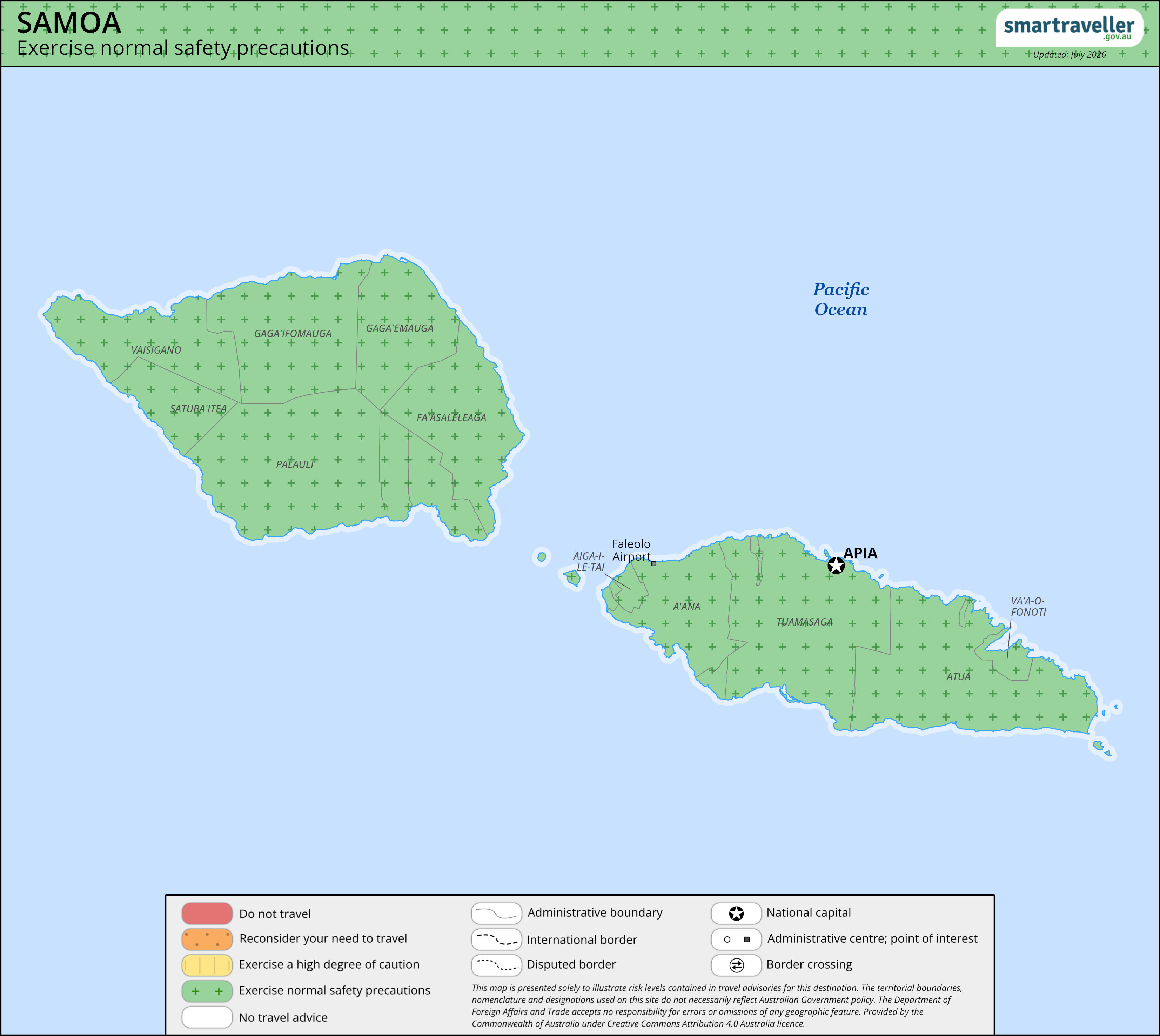
Exercise normal safety precautions in Samoa.
Full travel advice: Safety
Full travel advice: Health
Full travel advice: Local laws
Full travel advice: Travel
Full travel advice: Local contacts
Crime occurs in Samoa but the crime rate is not high.
Crimes you could experience include robbery, violent assault and sexual assault.
You're most at risk:
Petty crime is common, including theft from vehicles and accommodation.
Violent house break-ins can occur.
Samoa has experienced widespread power outages which can impact street lighting. Avoid dimly lit areas where possible.
To protect yourself from crime:
Civil unrest and politically motivated violence is rare. Political demonstrations and peaceful protests can occur in the lead up to elections particularly around the period of the formation of Government. Elections can be emotive and draw large groups of people. Avoid demonstrations and follow the advice of local authorities.
To protect yourself during periods of unrest:
More information:
Terrorism is a threat worldwide. Terrorist attacks could occur anywhere and at any time. Be alert to possible threats, especially in public places. Terrorists may target tourist areas or other places frequented by foreigners and where large crowds may gather.
More information:
Beaches are not patrolled in Samoa. Swimmers have died because of strong tides and powerful lagoon currents.
Risks are even higher when:
If you plan to spend time in or on the water:
Ask local residents and tour operators about safe areas for swimming.
Coconut trees often fringe beach areas. Avoid resting under coconut trees, particularly on windy days, as falling coconuts can result in injury.
Stray and poorly controlled dogs are common. Dog attacks on people in suburban areas and on beaches are common.
Don't approach or touch dogs. Be mindful of stray dogs if walking or exercising.
Businesses may not meet Australian safety or maintenance standards, including transport and tour operators, as well as adventure and water sports providers. Research providers carefully, follow all safety instructions, and ensure activities and services are appropriate for your needs, abilities and experience. Don't assume your travel insurance covers adventure or high-risk activities. Check your policy carefully, as you may not be covered for medical treatment, evacuation or other costs.
More information:
Samoa experiences severe weather, including:
Monitor weather updates and warnings via:
If a natural disaster happens:
If your arrival in Samoa is after a natural disaster or during cyclone season, ask your tour operator if services have been affected.
Cyclone season is from November to April. However, tropical storms and cyclones can happen any time of year.
Storms and cyclones can cause flooding and gale-force winds and disrupt services.
The direction and strength of tropical cyclones can change with little warning.
If there's a cyclone or severe tropical storm:
Roads can be cut off. It may take time for services, such as electricity, to be restored.
Monitor:
If a cyclone or severe storm is approaching:
Earthquakes and aftershocks happen often in Samoa.
Ask your host or hotel about what to do if there's an earthquake.
If there's an earthquake:
After an earthquake:
Samoa has a Tsunami Warning System as Tsunamis can happen, and signage indicating evacuation routes is often present in coastal, populated areas.
Move immediately to high ground if you:
Don't wait for official warnings.
Once on high ground, monitor local media.
More information:
There's a dengue outbreak in Samoa. Healthcare systems are facing pressures with the increasing number of cases.
Outbreaks of insect-borne diseases can happen, mostly in the wet season. Diseases include:
To protect yourself from disease:
If you're pregnant, the Australian Department Health, Disability and Ageing recommends you:
Find out about zika virus-affected countries on the Department of Health and Aged Care's website.
More information
Make sure your vaccinations are up to date before you go and your travel insurance covers all overseas medical costs, including medical evacuations.
More information:
You could be at risk from waterborne, foodborne and other infectious diseases, including:
Serious outbreaks sometimes occur.
To protect yourself from illness:
Get medical advice if you have a fever or diarrhoea.
We don't provide a comprehensive list of health risks, diseases or outbreaks for every destination. Before you travel, check the latest health advice from the Australian Centre for Disease Control (CDC) and the World Health Organization (WHO).
Hospital and medical facilities are very limited.
All foreigners are required to pay for health services in Samoa. Doctors and hospitals normally expect cash payment before carrying out any treatment.
There's no emergency helicopter service.
Blood supplies are often limited.
You may need to bring your own bedding and towels to hospital.
If you experience a medical emergency or become seriously ill or injured, evacuation by air to Australia or New Zealand is likely to be the only option for treatment. Medical evacuation can be very expensive, and evacuations may be delayed if you use commercial airlines. Flights are heavily booked in New Zealand and Australian school holiday periods.
Make sure your travel insurance covers medical evacuations.
There are no hyperbaric (decompression) chambers on any of the islands. If you need treatment for decompression sickness, you'll be evacuated to the nearest treatment centres, possibly in Nadi, Fiji, depending on flight availability. If transport to Nadi is not possible, evacuation may be arranged to Brisbane.
Registered dive companies carry basic treatment equipment to meet Professional Association of Diving Instructors (PADI) standards.
Penalties for carrying or using illegal drugs, including cannabis, may include a jail sentence.
By law, you must not own drug-related equipment in Samoa.
If police suspect a drug offence, they may detain you while they investigate.
More information:
The legal drinking age is 21 years.
Prostitution is illegal.
Same-sex relationships aren't recognised in Samoa and consensual sex between men is illegal. Penalties include a jail sentence. Public displays of affection should be avoided.
Sunday activities are extremely limited and alcohol can't be sold. Most businesses are closed except for few shops and restaurants are open while hotels and resorts operate normally.
Outside of tourist areas, the dress code in Samoa is conservative. Dress respectfully when visiting village areas.
Dress and behaviour standards are modest. Take care not to offend.
Ask for local advice if you're unsure of any customs.
More information:
You can apply for a 90 day Visitor Permit on arrival using the passenger arrival card if you:
If you remain in Samoa and are unable to depart prior to the expiry of your permit you must contact Samoa Immigration to make arrangements to validate your residential status until you can depart.
For other situations and for Business Visitor Permits, see the Samoa Immigration - Ministry of the Prime Minister and Cabinet.
Entry and exit conditions can change at short notice. Contact your airline or your nearest High Commission/Embassy or Consulate of Samoa for details about the latest visa and entry requirements.
For information on entry requirements, check the Government of Samoa website.
More information:
The local currency is the Samoan Tala (WST).
Declare amounts over WST 20,000 when you arrive and depart. This covers all forms of currency, not only cash.
You can change money and find ATMs at the airport on arrival and in the major centres.
Credit cards can be used at most resorts and large shops. Not many small businesses accept credit cards.
You need a temporary Samoan driver's licence to drive.
Get a temporary licence from:
You'll need to show your valid Australian licence and pay a fee.
More information:
Driving in Samoa is hazardous, especially at night.
Hazards include:
Samoa switched to driving on the left-hand side of the road in 2009. However, many vehicles still have the driver's seat on the left.
If you plan to drive:
More information:
Check if your travel insurance policy covers you when riding a motorbike.
Always wear a helmet.
Use only registered taxis and authorised transport providers. Arrange these through your hotel or other trusted sources.
Most taxis only accept cash. Authorised transport providers may accept payment by credit card. Taxi services that are available are not metered and pricing is often fixed. Ask for a price list.
Samoa has a small and irregular bus network. Buses are usually crowded and poorly maintained. Accidents involving buses are common. Travelling on buses should be given careful consideration.
Bus schedules are limited on Sundays.
Petty crime can happen on buses. Take care of your belongings.
More information:
Samoa's inter-island ferries may not meet Australian safety standards. They may:
Emergency safety procedures may not work.
If you need to travel by ferry:
If you aren't given safety equipment, or it's not in usable condition, use another provider.
More information:
Check Samoa's air safety profile with the Aviation Safety Network.
More information:
Depending on what you need, contact your:
Call 911.
Call 911.
Call 911.
Always get a police report when you report a crime.
Your travel insurer should have a 24-hour emergency number.
The Australian Government aims to provide high quality consular assistance. There are limits to what we can do. Read the Consular Services Charter to understand how we can assist you overseas.
For consular help, contact the Australian High Commission in Apia.
47 Beach Road
Apia, Samoa
Phone: +685 23 411
Website: samoa.highcommission.gov.au
Facebook: Australian High Commission, Samoa
Check the High Commission website for details about opening hours.
In a consular emergency, if you can't contact an embassy, call the 24-hour Consular Emergency Centre on:
Be the first to know official government advice when travelling.