Fire and rescue services
Call 910.
Medical emergencies
Call 911.
Police
Call 917.
Always get a police report when you report a crime.
Your travel insurer should have a 24-hour emergency number.

Full travel advice: Safety
Full travel advice: Health
Full travel advice: Local laws
Full travel advice: Travel
Full travel advice: Local contacts
Crime that occurs in Fiji includes:
Most crime is opportunistic and is exacerbated by cost of living pressures and rising drug use in local communities.
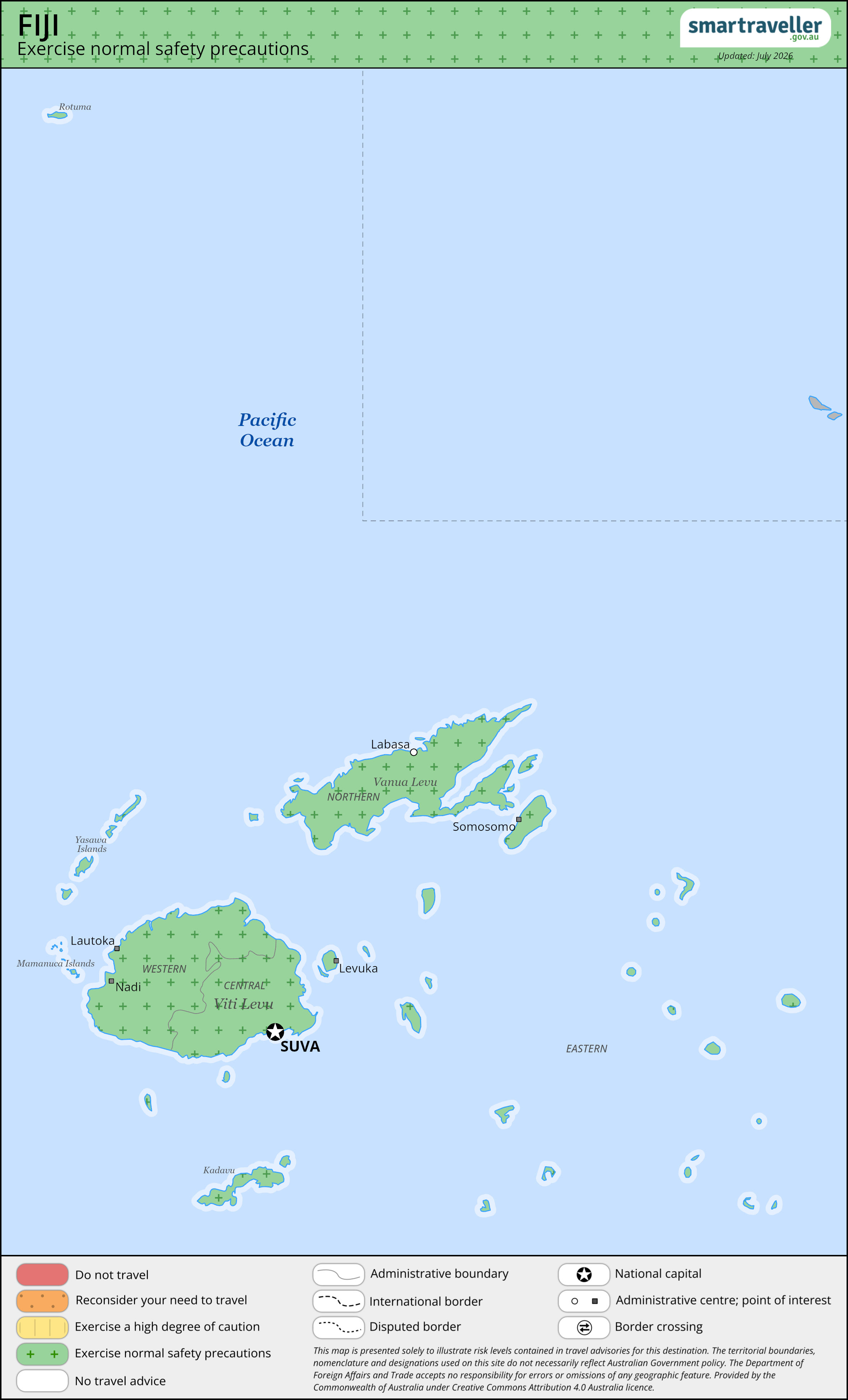
You're most at risk in urban areas and at night, including popular tourist areas located in and around Suva and Nadi.
Be careful when visiting tourist attractions, including Colo-i-Suva, and other parks and nature trails. Be aware of your surroundings and keep your personal belongings secure.
Credit card fraud and use of skimming devices occurs.
To reduce your risk of becoming a victim:
If you're a victim/survivor of sexual assault, you may need urgent medical care. You may also want to report the crime to local police. You can call the Australian High Commission in Fiji for advice and consular assistance in seeking medical care and contacting police (see 'Local contacts').
If you choose to report the assault, go to the local police station in person to make a statement before you depart Fiji (you may wish to seek consular assistance before you visit). Police may not take your statement if you’ve returned to Australia. Statements from you and witnesses can be used as evidence in criminal court proceedings.
Police will usually start to investigate while you're in Fiji. In most cases, you need to be in Fiji for the trial.
You may want to talk about what happened and get help from an experienced counsellor. If you need to speak to a counsellor:
They can connect you to counselling hotlines and services.
More information:
Avoid any protests, demonstrations, rallies, public gatherings and areas with military activity.
Although rare, public protests and events that draw large groups can turn violent.
Follow the instructions of local authorities and monitor the media for updates.
Local authorities sometimes erect checkpoints and close roads. Follow their advice.
More information:
Terrorism is a threat worldwide. Terrorist attacks could occur anywhere and at any time. Be alert to possible threats, especially in public places. Terrorists may target tourist areas or other places frequented by foreigners and where large crowds may gather.
More information:
Fiji experiences natural disasters and severe weather, including:
Severe weather may affect regional sea ports.
In the event of severe weather or a natural disaster:
For details of weather conditions, including cyclones, check Fiji Meteorological Service.
More information:
November to April is cyclone season, but cyclones may occur at other times.
A tropical cyclone's direction and strength can change quickly.
During and after a cyclone:
If a cyclone is approaching, find your local shelter. In some areas, it may be hard to find sturdy cover. Follow the advice of local authorities.
For cyclone updates, check:
Flooding is common, especially in downtown Nadi and on the Coral Coast.
Flooding and landslides can disrupt infrastructure and essential services.
Floods can cut off road access, including access to the airport.
Monitor road closures on the Fiji Roads Authority Facebook page.
Earthquakes and tsunamis can occur.
Be alert to warnings. A tsunami can happen within minutes of a nearby tremor or earthquake.
If authorities issue a tsunami warning (by siren and/or news announcements), check with your accommodation provider about evacuation plans.
Move immediately to high ground if advised by local authorities or if you:
Don't wait for official warnings. Once on high ground, monitor local media and follow local authorities' advice.
More information:
Stay informed by monitoring the Ministry of Health and Medical Services website and Facebook page for updates on current health risks and declared outbreaks. Ensure your vaccinations are up to date before traveling.
Fiji is prone to outbreaks of mosquito-borne illnesses, including:
If you're pregnant, consult your doctor before travelling and avoid affected areas. Keep an eye on local news for health updates.
To protect yourself against mosquito bites:
Get medical help if you have a fever, muscle pain, rash or severe headache.
The rates of HIV/AIDS infections are rising. The Fiji Government declared a HIV outbreak in 2025, and the outbreak remains ongoing. Take precautions if you engage in activities that may expose you to the risk of infection including unprotected sexual activity and sharing needles or syringes.
Cases of typhoid and leptospirosis have been reported. To stay safe, avoid flooded rivers or creeks and wear footwear outdoors.
Fiji has experienced an outbreak of measles in the past. Make sure your vaccinations are up-to-date before you go.
Meningococcal disease can often be fatal. Get vaccinated before you travel. If you notice a high fever, sensitivity to light or nausea, get medical treatment straight away.
Kava (also known as ‘yaqona’), a traditional Pacific region drink, can be a health risk. It can be dangerous if it reacts with alcohol, prescription medication, including antidepressants.
Waterborne, foodborne and other infectious diseases are common. These include:
To protect yourself against illness:
Get medical advice if you have a fever or diarrhoea.
More information:
Eating seafood can be a hazard.
Naturally occurring seafood toxins can make you ill, including:
Get urgent medical care if you suspect poisoning.
More information:
Medical care standards aren't as high as in Australia and are limited.
Hospitals and medical facilities can lack:
Many hospitals provide only basic care.
Antibiotic-resistant bacteria outbreaks can occur in health facilities.
Rescue and emergency services aren't as wide-ranging as they are in Australia.
Ambulance services are limited. Adverse weather and road conditions may affect your ability to access medical services.
In medical emergencies, hotels and resorts use public health facilities.
Before they admit patients, hospitals usually need:
If you become seriously ill or have an accident, you may need to be evacuated to Australia. Medical evacuation can be very expensive. Ensure your travel insurance covers this.
More information:
Fiji has two hyperbaric (decompression) chambers located at the Colonial War Memorial Hospital in Suva and the Pacific Specialist Healthcare in Nadi.
You should dive well within safety limits.
Make sure your travel and health insurance covers you for diving-related costs and for medical evacuation.
Court proceedings can go on for a long time. The Australian Government can't influence the time this takes.
The police and military have detention, arrest and search powers.
You can go to jail for possession of any quantity of illegal drugs. This includes if you are:
You can be arrested for being drunk and disorderly, including while you’re at an airport or on a plane. You can be fined and detained if you cause damage to property or assault others, including first responders.
Abortion is only legal in certain circumstances. Research local laws and consult your doctor before making any decisions about your medical care.
Fiji recognises dual nationality. Always travel on your Australian passport.
If you're a dual national and authorities arrest or detain you, ask to contact the Australian High Commission.
However, we may only be able to assist you in exceptional circumstances.
More information:
Outside of tourist areas, the dress code is conservative. Dress respectfully when visiting village areas.
Same-sex relationships are legal, but some locals have conservative attitudes towards them. Open displays of affection could offend locals, particularly in rural areas.
Take care not to offend.
More information:
If you’re travelling from certain countries, including Australia, you don't need a tourist visa for Fiji. If your stay is less than 4 months, authorities will issue a visa when you arrive.
To get a visa on arrival, you must show proof of booked accommodation and a return ticket.
Before travelling, check Tourism Fiji's frequently asked questions about travelling to Fiji page. If you have a previous criminal record, you may be denied entry into Fiji.
Entry and exit conditions can change at short notice. Contact the nearest embassy or consulate of Fiji for details about visas, currency, customs and quarantine rules.
You may need a visa if you travel for other reasons. Contact the Fiji High Commission for more details.
More information:
Strict customs rules apply for importing items, such as:
More information:
The local currency is the Fiji Dollar (FJD). ATMs are common in urban areas and large resorts. Carry cash when you travel to villages or remote areas. Local banks and ATMs will charge fees for cash withdrawals.
Not all retail outlets will accept credit cards. Those that do will charge a fee between 2-5%.
You can easily exchange Australian dollars for FJD.
You must declare:
This covers all forms of currency, not only cash.
Severe weather can affect tourist services, including roads and flights in and out of Fiji.
More information:
Monitor the Fijian Government Facebook page for information and updates about any restrictions or curfew hours.
More information:
Transport and tour operators may not follow safety precautions. They may also not maintain their equipment to the standards you'd expect.
This includes operators of:
Sometimes boats, rafts and kayaks don't have enough life jackets.
If you plan to do a tour or adventure activity:
If you aren't given safety gear, or it's not in usable condition, use another provider.
Always carry your Australian driver's licence (digital driver’s licences may not be accepted).
You can hire vehicles and drive using your Australian driver's licence for the first 6 months after your arrival. After that, you'll need to apply for a Fijian driver's licence at a local Land Transport Authority office.
If you want to ride a motorbike, check if your licence and insurance covers you for this. Driving without the correct licence can void your insurance.
If you want to drive a boat, check if your licence covers you for this.
More information:
If you drive in Fiji, take care. Driving is most risky at night due to:
More information:
Taxi quality varies.
The Land Transport Authority (LTA) licenses taxis.
Only use licensed taxis, which have yellow registration plates. Look out for the LT or LH registrations on the license plate. LT plates are metered taxis. LH taxis have fixed distance rates.
Before you catch a taxi, make sure you have cash (Fiji dollars) for payments and that their meter is turned on. Be aware some taxis only have a seatbelt in the front passenger seat. You may need to plan ahead to book a taxi with front and rear seatbelts.
The LTA licenses some, but not all, minibuses. Unlicensed minibuses may not have insurance.
Only use those with yellow number plates that have been LTA-approved.
More information:
Before boarding any boat or ship, check the operator's credentials and ensure that safety equipment is in place.
Make sure your insurance policy covers sea travel.
Avoid travelling on a vessel that is over capacity.
Always check the weather forecast before departing.
Plan to depart early so that you can arrive early. Don't travel by sea after dark.
More information:
Check Fiji's air safety profile with the Aviation Safety Network.
More information:
Depending on what you need, contact your:
Fire and rescue services
Call 910
Call 911
Call 917
Always get a police report when you report a crime.
Your travel insurer should have a 24-hour emergency number.
The Australian Government aims to provide high quality consular assistance. There are limits to what we can do. Read the Consular Services Charter to understand how we can assist you overseas.
37 Princes Road
Tamavua
Suva, Fiji
Phone: +679 338 2211
Website: fiji.embassy.gov.au
Facebook: Australia in Fiji
X: @AusHCFJ
Check the High Commission website for details about opening hours and any temporary closures.
In a consular emergency, if you can't contact the Australian High Commission, call the 24-hour Consular Emergency Centre on:
Be the first to know official government advice when travelling.