Medical emergencies
Call 113.

Do not travel to Haiti.
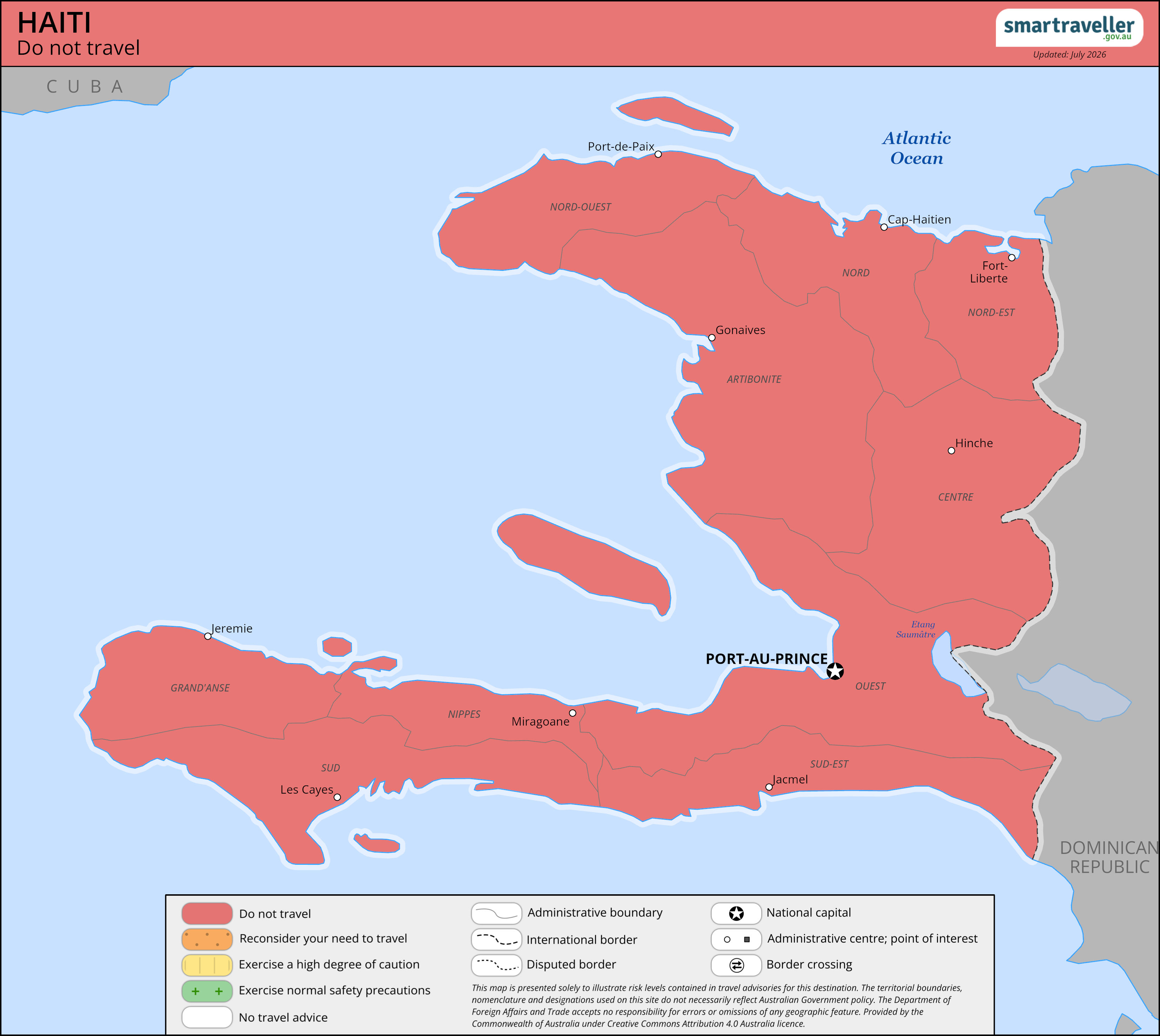
Do not travel to Haiti due to the dangerous security situation, threat of violent crime, kidnapping and severe shortages of basic necessities including fuel, water and food.
Full travel advice: Safety
Full travel advice: Health
Full travel advice: Local laws
Full travel advice: Travel
Full travel advice: Local contacts
There's a State of Emergency in effect in the departments of Ouest, Artibonite and Centre in response to gang violence.
Toussaint-Louverture International Airport resumed operations, but many airlines have limited their flights in and out of Port-au-Prince until further notice. Gang violence has affected travel across Port-au-Prince, including to and from the airport.
The security situation remains volatile.
Violent crime is common, including against tourists and expats. Incidents include:
Your risk increases at night and in isolated areas.
Police have very limited resources to respond and help.
Gang violence has spread beyond the capital, Port-au-Prince and extends to the Artibonite region. Gangs are increasingly attacking residential neighbourhoods and kidnapping groups of people. Armed gangs control most of Port-au-Prince.
Hotspots for violent crime include:
Thieves target travellers who've just arrived in the country. They may try to distract you to steal your passport and valuables.
Criminal gangs have roadblocked areas around Port-au-Prince and on national highways to steal from car passengers.
To protect yourself from crime:
Armed robberies regularly occur in Pétion-Ville. If you're attacked or robbed, don't resist. Criminals are often armed, and you can be seriously injured or killed.
If you're a victim of violent crime, especially sexual assault, get immediate medical help. The risk of HIV/AIDS infection is high.
People leaving banks are targets for thieves on motorcycles. Avoid withdrawing or carrying large amounts of money.
Public transport is unsafe. Avoid:
Be careful dealing with strangers or people you've just met. Be wary of people hanging around near your hotel.
Photography can look suspicious, especially in remote areas. Some travellers have been assaulted for taking photos. Ask for permission before you take someone's photograph.
The political situation is very unstable. There's a constant risk of violence and social unrest.
Limit your movements. Monitor local media to stay informed on the evolving situation. Avoid areas where demonstrations and large gatherings are taking place. Follow the instructions of local authorities.
There are ongoing violent protests, roadblocks, and food and fuel shortages.
Local authorities, including the police, may be unable to control the developing situation or to help you.
Carry your proof of identity and documents for your vehicle in case you pass a security checkpoint.
Roadblocks are common, particularly in Port-au-Prince and on major highways.
To protect yourself during periods of unrest:
More information:
Kidnapping occurs across the world with political, ideological, and criminal motives. Foreigners, including Australians, have been kidnapped overseas whilst travelling. Kidnaps can happen anywhere, anytime, including in destinations that are typically at lower risk.
Kidnappings are common in Haiti. We continue to advise that you do not travel to Haiti due to the very high levels of kidnapping. Haiti has one of the highest per capita kidnap rates globally. There is an increase in reported kidnappings for ransom in Port-au-Prince, particularly in the Delmas area. There have been incidents of kidnappers posing as police officers.
Hundreds of foreign nationals have been abducted. Victims have included missionaries, aid workers and children and are often selected based on perceived wealth. Most of the victims have been released in exchange for ransom. In some cases, victims have disappeared or been killed. Locals and foreign nationals have been targets of mass kidnappings in public transport including buses. Conflicts between criminal groups will continue to drive kidnap-for-ransom incidents in Port-au-Prince. Express kidnapping is a problem in urban areas.
Be careful in the waters around Haiti. You risk piracy and assault in these areas.
If despite our advice, you travel to an area with a high risk of kidnapping our ability to provide assistance in these destinations is extremely limited.
The Australian Government's longstanding policy is that it doesn't make payments or concessions to kidnappers. Ransom payments to kidnappers have funded further terrorist attacks and criminal activity. Ransom payments to terrorist groups are likely to contravene Australian counter-terrorism financing laws.
More information:
Terrorism is a threat worldwide. Terrorist attacks could occur anywhere and at any time. Be alert to possible threats, especially in public places. Terrorists may target tourist areas or other places frequented by foreigners and where large crowds may gather.
More information:
Haiti experiences natural disasters and severe weather, such as:
Emergency services can't deal with major disasters. Be ready to leave at short notice. Keep your travel documents current.
To protect yourself if a natural disaster is approaching:
More information:
The hurricane season is from June to November. Tropical storms and hurricanes can happen any time of year.
Heavy rainfalls can cause flooding, landslides and mudslides, disrupting essential services and infrastructure.
If you're travelling during hurricane season, ask your tour operator if tourist services at your destination have been affected. Check for updates from the US National Hurricane Center. The direction and strength of hurricanes can change suddenly.
If there's a hurricane or severe storm:
Severe weather may also affect:
If a hurricane is approaching:
More information:
Haiti is in an earthquake zone. Earthquakes may happen. Get information from the United States Geological Survey.
Infrastructure from a 2010 earthquake is still damaged, including:
Damaged water and sewerage systems have increased disease outbreaks.
Tsunamis may occur in Haiti. A tsunami can arrive within minutes of a tremor or earthquake. Be alert to warnings.
Register with the Global Disaster Alert and Coordination System to receive tsunami alerts.
If you're near the coast, move immediately to high ground if advised by local authorities, or if you:
The rate of HIV/AIDS infection is high. Use protection if you participate in activities that put you at risk of infection.
Illnesses spread by insects are common, especially during the wet season from June to December.
Disease risks include:
Zika virus is widespread. If you're pregnant, the Australian Department of Health recommends you:
To protect yourself from disease:
Get medical advice if you have a fever, muscle pain, rash or bad headache.
More information:
Waterborne, foodborne and other infectious diseases are common. These include:
Serious outbreaks sometimes occur.
Cholera is an ongoing risk in parts of Haiti. Cholera causes diarrhoea and vomiting. It can be fatal if left untreated.
To protect yourself from illness:
If you're bitten or scratched by an animal, get medical help immediately.
Get medical advice if you have a fever or diarrhoea.
Medical facilities are scarce and well below Australian standards.
Medicine and medical resources are hard to find.
Public sanitation is not fixed and causes disease outbreaks.
Private medical care can be expensive. Payment by credit card is not always available. Doctors and hospitals will often ask you to pay cash before treating you.
If you become seriously ill or injured, you may need to be evacuated to a place with suitable facilities. Medical evacuation can be very expensive.
Penalties for drug offences are severe. They include fines and long prison sentences in local jails. Prison conditions in Haiti are very poor.
More information:
Same-sex relationships are legal. No laws restrict the rights of LGBTQIA+ people or groups, but anti-LGBTQIA+ attitudes exist.
LGBTQIA+ travellers may face:
More information:
More information:
You're required to spend 21 days in a third country not affected by Ebola if you have travelled from the Democratic Republic of the Congo or Uganda.
Entry and exit conditions can change at short notice. You should contact the nearest embassy or consulate of Haiti for the latest details.
You'll need to pay an arrival fee at Toussaint Louverture International Airport.
You won't have to pay the fee if you're:
If you plan to do volunteer work in Haiti, arrange a placement before you arrive. You'll be unlikely to find a placement when you get there.
If you're travelling to Haiti through the US, you must also meet US entry or transit requirements.
Check your visa requirements with a US embassy or consulate before travelling.
More information:
You may need a valid yellow fever vaccination certificate to enter Haiti. Some airlines may want to see one when you leave.
Find out about returning to Australia after exposure to yellow fever.
More information
The basic currency is the Gourde (HTG). US dollars are also widely accepted.
Exchange US dollars or traveller's cheques at established banks. Some banks accept other foreign currencies.
Don't change money on the street.
Toussaint-Louverture International Airport resumed operations, but many airlines have suspended flights in and out of Port-au-Prince until further notice. Gang violence has affected travel across Port-au-Prince, including to and from the airport.
You can drive in Haiti with your:
You must get your IDP before leaving Australia.
Road travel is dangerous in Haiti.
Hazards include:
Avoid taking public transport or driving after dark. You may be forced to make a detour into a dangerous area.
Avoid driving during bad weather, even in the city.
Keep your fuel tank at least half full. Fuel supply is often disrupted.
Carry a mobile phone and emergency contact numbers with you. Roadside assistance services are lacking. Mobile phone coverage is patchy in rural areas.
Land, sea and air borders remain closed between Haiti and the Dominican Republic.
Sometimes, criminals dressed as police officers carjack vehicles close to the border on Dominican roads. See Safety
More information:
If you take the ferry, keep an eye on your belongings.
Don't board a vessel that looks overloaded or unsafe.
More information:
Check Haiti's air safety profile with the Aviation Safety Network.
More information:
Depending on what you need, contact your:
Always get a police report when you report a crime.
Your insurer should have a 24-hour emergency number.
Police – Call 114
Ambulance - Call 116
There are limits to what consular assistance we can provide in high-risk locations. Read the Consular Services Charter to understand how we can assist you overseas.
Australia doesn’t have an embassy in Haiti. The Canadian Embassy in Port-au-Prince provides consular help for Australians under the Canada-Australia Consular Services Sharing Agreement.
Passport services are provided by the Australian High Commission in Trinidad and Tobago. You can also get consular help from the Australian High Commission in Trinidad and Tobago.
Delmas Road between Delmas 75 and 71
Port-au-Prince
Haiti
Phone: (+11 509) 2812 9000
Email: prncecs@international.gc.ca
Website: https://www.international.gc.ca/country-pays/haiti/port_au_prince.aspx?…
Check the Canadian High Commission website for details about opening hours and any temporary closures.
18 Herbert Street, St Clair
Port of Spain
Trinidad and Tobago
Phone: +1 868 235 7950
Email: ahc.portofspain@dfat.gov.au
Website: trinidadandtobago.highcommission.gov.au
Facebook: AusHighComTT
Check the High Commission website for details about opening hours and any temporary closures.
In a consular emergency, if you can't contact an embassy, call the 24-hour Consular Emergency Centre on:
Be the first to know official government advice when travelling.