Call 112 for emergency assistance, or:
Fire and rescue services
Call 112.
Medical emergencies
Call 112 or go to a hospital.
Police
Call 112 or go to the local police station.

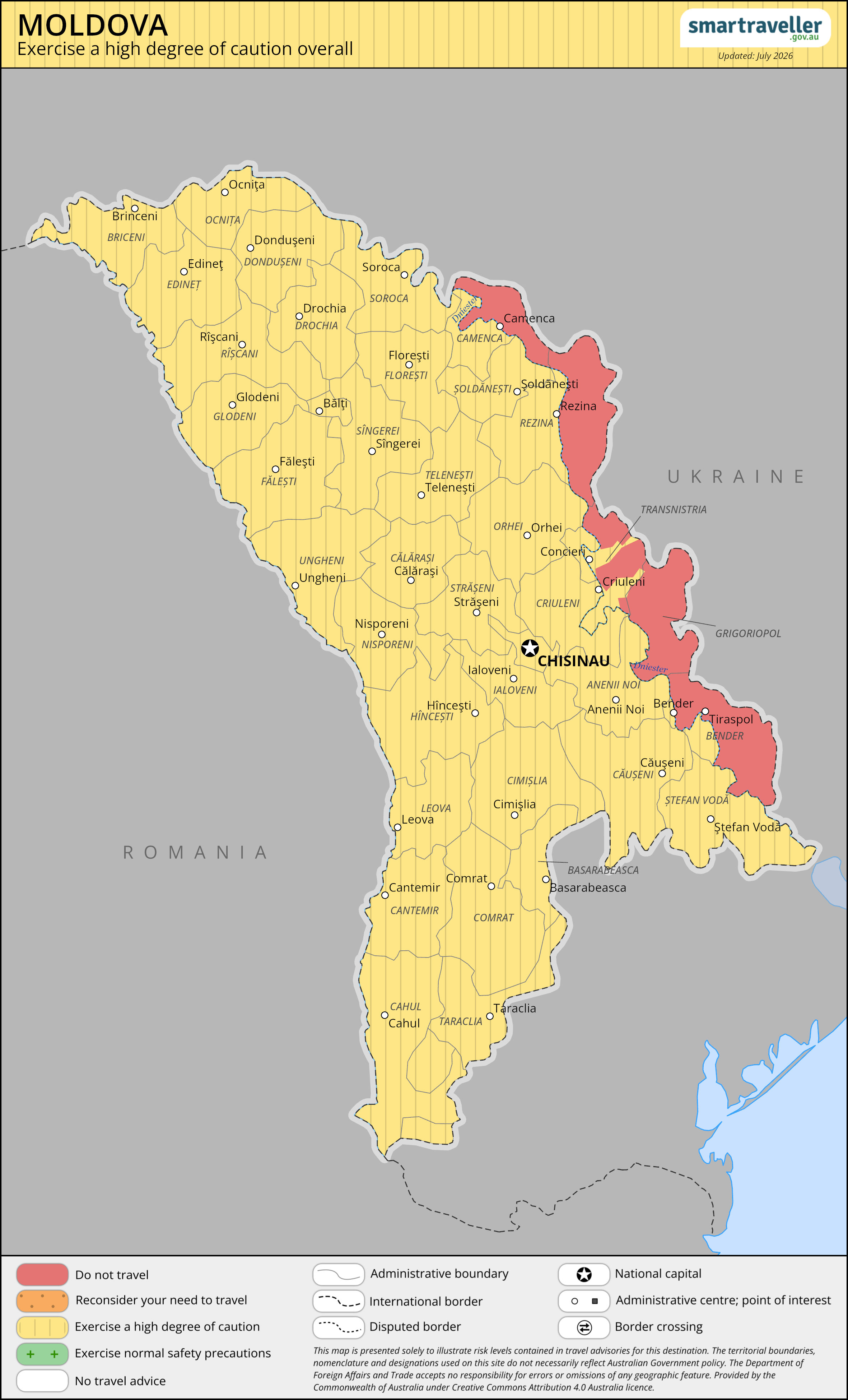
Exercise a high degree of caution in Moldova overall due to the volatile security situation and the impacts of military conflict in neighbouring Ukraine.
Do not travel to Transnistria (a region outside the control of the Moldovan authorities) due to the volatile security situation and the impacts of Russia's invasion of Ukraine.
Full travel advice: Safety
Full travel advice: Health
Full travel advice: Local laws
Full travel advice: Travel
Full travel advice: Local contacts
Debris from missiles and drones fired by Russia at targets in neighbouring Ukraine has landed in Moldova on a number of occasions.
Large political protests have occurred in Chișinău and other places. Public protests and events that draw large groups of people can turn violent. Local street disturbances can start with little warning. Protests can attract a heavy police presence. You should monitor the media for information on political developments that might affect protest activity.
To stay safe:
More information:
Unexploded ordnance and landmines remain in parts of Moldova, including from World War II and the 1992 Transnistrian conflict.
These may be present in agricultural fields, forests and areas near the Dniester (Nistru) River, including in districts close to Transnistria and parts of central Moldova.
Areas that may contain unexploded ordnance or landmines may be marked with a red downward-pointing triangle, a skull and crossbones, and the word 'Mine'. Do not touch or approach suspicious objects. Leave the area and follow the advice of local authorities.
Pickpocketing, bag snatching and other petty crimes are common, particularly in Chișinău. Criminals target trains and hotel rooms. Organised crime occurs, with criminal groups often operating inside casinos and nightclubs. Extortion and corruption may occur, including with foreign businesses.
Police officers, or people posing as police officers, may ask for bribes, including in tourist areas.
Kidnapping can happen anywhere, anytime, including in destinations that are typically at lower risk.
The Australian Government’s longstanding policy is that it doesn’t make payments or concessions to kidnappers.
More information:
Internet fraud can originate in Moldova, including some dating and marriage scams.
To reduce the risk of being a target for crime:
If police stop you and ask you to pay a fine:
Terrorism is a threat worldwide. Terrorist attacks could occur anywhere and at any time. Be alert to possible threats, especially in public places.
In recent years, bomb threats have been made against the international airport, shopping centres and other official buildings in the capital, Chișinău. Disruptions and delays are likely to occur as authorities respond to any threats – even if threats are hoaxes, Moldovan authorities take time to assess the situation thoroughly.
While there have been no recent terrorist attacks, they can still happen.
In recent years, terrorists have staged attacks in European cities.
To stay safe:
If there’s a terrorist incident, leave the area if it’s safe to do so and follow the instructions of local authorities.
More information:
Moldova is in an earthquake zone. Register with the Global Disaster Alert and Coordination System to receive alerts on major disasters.
Extreme weather, including heavy snow and wind, may cause power outages.
If a natural disaster happens:
Do not travel to Transnistria due to the volatile security situation.
Events in Ukraine have led to political tension in Transnistria. The security situation is volatile and could deteriorate at short notice.
Transnistria is not under Moldovan government control.
If you're in Transnistria, monitor your personal security plans and leave when it's safe to do so.
If, despite our advice, you choose to travel to Transnistria:
Our ability to provide consular assistance is severely limited if you're in Transnistria.
Tick-borne encephalitis and other tick-borne diseases are a risk, especially in forest areas.
Ticks are common in forested areas from spring to autumn: April to October.
To protect yourself from disease:
Waterborne and foodborne diseases are common.
Other common infectious diseases include:
Serious outbreaks sometimes occur.
To protect yourself from illness:
Get medical advice if you suspect food poisoning or have a fever or diarrhoea.
Ask your doctor about health risks and vaccines before you go.
More information
There’s no agreement between Australia and Moldova for free healthcare. Tourists must pay for all medical care, even if they need to stay in hospital or be evacuated. This can be very expensive. Make sure your travel insurance covers you. The Australian Government won't pay for these costs.
Medical facilities are limited, especially outside major cities. They often don't have enough medical supplies.
If you become seriously ill or injured, you'll need to evacuate to somewhere with proper care. Medical evacuation can be very expensive.
Moldova has severe penalties for possessing, using or trafficking illegal drugs. These include long sentences in local jails and heavy fines.
More information:
Strict regulations cover the export of antiques, artworks and items of historical significance, including modern art and posters, if they're rare or valuable.
If you want to export these items, seek approval from the Moldovan Department of Monuments.
You'll need to provide evidence of approval to export when you leave. You may also need receipts of purchase.
Moldovan customs authorities must process all goods for entry into Ukraine. Businesses based in Transnistria could face difficulties importing or exporting goods if the business isn't registered in Moldova.
You must always carry identity documents. This could be a copy of your passport.
If you can't produce identity documents for police when asked, they can detain and fine you.
It's illegal to:
Businesses need to register with the State Registration Chamber of the Ministry of Informational Development. It's illegal to operate a business without first registering it. This also applies to businesses in Transnistria.
More information:
Dual nationality is legally recognised in Moldova.
If you're an Australian national but also a citizen of Moldova, our ability to offer you consular services may be limited. You may also be subject to different entry/exit requirements.
More information:
Same-sex relationships are legal but aren't widely accepted. Avoid public displays of affection.
More information:
If you're visiting for up to 90 days within a 6-month period, you won't need a visa.
For longer stays, you'll need a visa.
Entry and exit conditions can change at short notice. Contact an embassy or consulate of Moldova, or visit the Moldova Government website for the latest information. They'll tell you about visas, currency, customs and quarantine rules.
Record your entry date, and check your visa dates carefully. If you overstay your visa, authorities may deport you.
You need to register at your port of entry.
Passport control authorities at border crossings automatically register your entry unless you're entering through Transnistria.
Do not enter or exit Moldova through Transnistria.
If you enter through Transnistria, your passport will not show a valid entry stamp. This may create problems when you try to leave the country.
Several checkpoints exist along the routes into and out of Transnistria. These are not official border or immigration control points. Upon entry to Transnistria, you will be required to complete two copies of a migration card, one of which you need to retain to present upon departure.
All border crossings between Ukraine and Transnistria have been closed since February 2022.
The local currency is the Moldova Leu (MDL).
You can easily change euros and US dollars for MDL at banks and licensed money changers. You can rarely exchange Australian dollars.
Although parts of Moldova have a largely cash-based economy, major hotels – especially in Chișinău – widely accept traveller's cheques and credit cards.
Some major hotels accept traveller's cheques and credit cards.
Always keep your credit card in sight. Fraud is a risk.
You'll find very few ATMs outside the capital. Take care at ATMs. People have reported unauthorised withdrawals after using electronic banking.
Use ATMs in controlled areas like banks, shops and shopping centres.
Transnistria uses a separate currency, the Transnistrian ruble. Moldovan Leu are not accepted in Transnistria. Banks and services in Transnistria do not accept foreign credit or debit cards.
More information:
Always carry your passport when you cross borders.
Monitor local media and ask transport providers for up-to-date information on border conditions.
You'll need an International Driving Permit (IDP) to drive in Moldova.
Get your IDP before you leave Australia.
Roads are poorly maintained, and street lighting is rare.
More information:
Check with your travel insurer whether your policy covers you when riding a motorbike.
Always wear a helmet.
Use only official taxis and limousines. Book these through your hotel.
Unofficial taxis may overcharge. They may also not comply with safety standards.
Taxis that look official can still be unlicensed.
Don't share a taxi with strangers.
Buses connecting Chișinău with other major cities are frequent.
Standards aren't the same as in Australia. Minibus accidents are common. Many buses are old and overcrowded.
More information:
Check Moldova's air safety profile with the Aviation Safety Network.
More information:
Depending on what you need, contact your:
Call 112.
Call 112 or go to a hospital.
Call 112 or go to the local police station.
Always get a police report when you report a crime.
Your insurer should have a 24-hour emergency number. Write it down before you go and keep it on your person.
The Australian Government aims to provide high quality consular assistance. There are limits to what we can do. Read the Consular Services Charter to understand how we can assist you overseas.
If you've arrived in Moldova from Ukraine and need assistance, contact the Consular Emergency Centre on 1300 555 135 in Australia or +61 2 6261 3305 outside Australia.
You can email the Australian Embassy for advice on consular and passport information: Consular.Kyiv@dfat.gov.au
Website: ukraine.embassy.gov.au
Facebook: Australian Embassy, Ukraine
X: @AUinUA
In a consular emergency, if you can’t contact an embassy, call the 24-hour Consular Emergency Centre on:
Be the first to know official government advice when travelling.