Fire and rescue services
Call 112.
Medical emergencies
Call 112.
Police
Call 112.

Call 112.
Call 112.
Call 112.
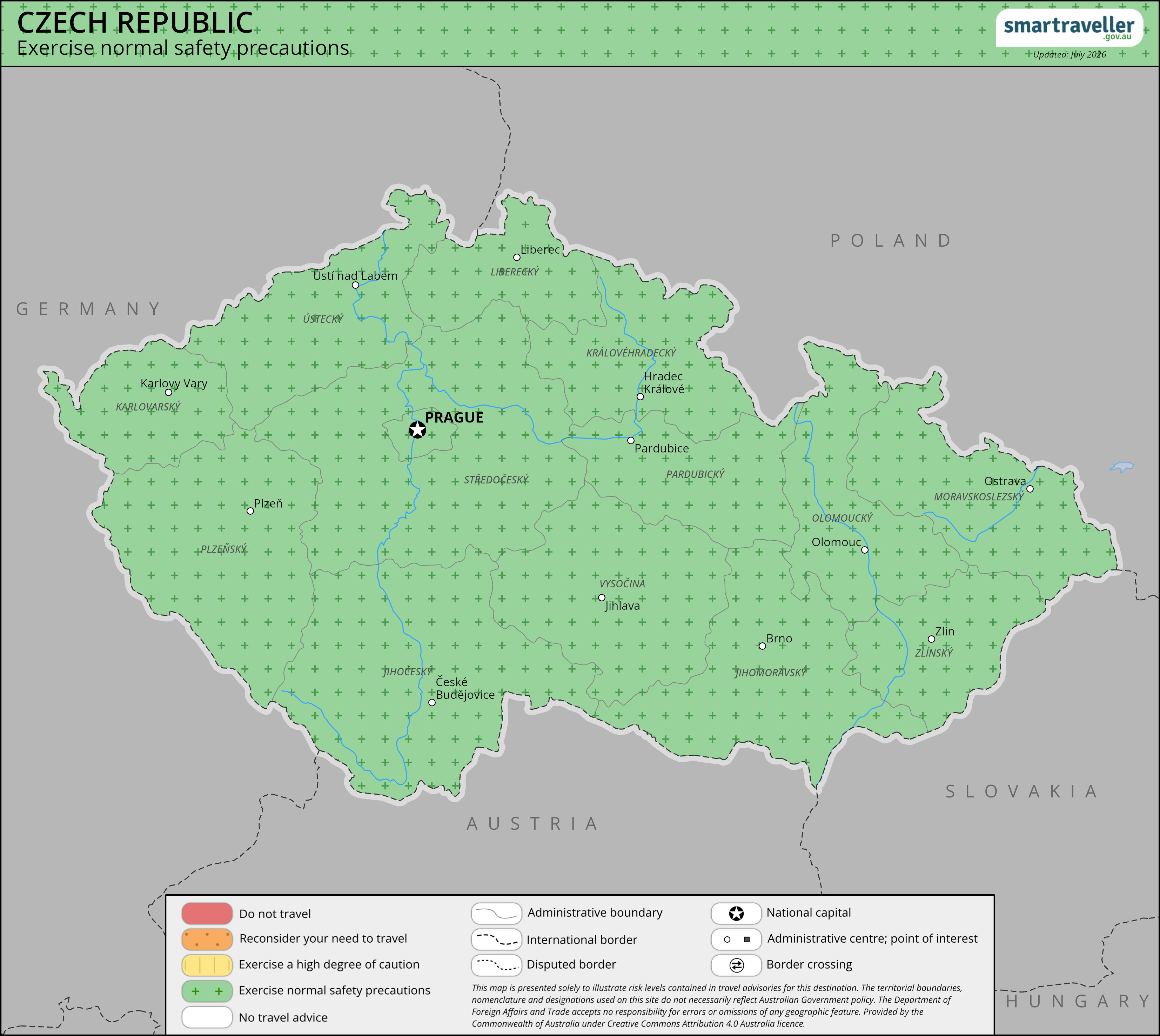
Exercise normal safety precautions in the Czech Republic.
Full travel advice: Safety
Full travel advice: Health
Full travel advice: Local laws
Full travel advice: Travel
Full travel advice: Local contacts
Pickpocketing is common. It happens on the road to Prague Castle, at tourist sites and on public transport.
Passport and car theft is also common, particularly during the summer, from June to August.
Travellers have been robbed in nightclubs, bars and restaurants. This includes fast-food shops in the centre of Prague.
Be careful of strangers who offer help. Travellers have had bags stolen at Prague's main railway station. Do not leave your bags unattended while on public transport.
Travellers have been robbed or assaulted after drinking a spiked drink.
Only use ATMs in secure places, such as banks, shops and shopping centres.
Always carry ID, for example, a copy of your Australian passport.
To stay safe in the Czech Republic:
Report any thefts in person to the Czech police within 24 hours and get a police report crime number. Prague police station (Jungmannovo namesti 9, Prague 1, nearest metro stop is Mustek) is open 24 hours and has English translators. You can also get a police report from the police station at the airport.
Every lamppost in Prague has a 6-digit number posted at eye level. These codes will help you tell the police where you are if you can't give an exact address.
Criminals using fake police ID may ask to check the authenticity of your foreign currency and passport. These criminals often operate near ATMs. However real police officers can ask for ID at any time.
If you think you're dealing with a criminal posing as a police officer, either:
Public protests and events that draw large groups of people can turn violent.
To protect yourself during periods of unrest:
More information:
Terrorism is a threat worldwide. Terrorist attacks could occur anywhere and at any time. Be alert to possible threats, especially in public places.
While there have been no recent terrorist attacks in the Czech Republic, they can still happen.
If there’s a terrorist incident, leave the area if it’s safe to do so and follow the instructions of local authorities.
More information:
If there's flooding or severe weather:
Other natural disasters are rare but could happen.
Register with the Global Disaster Alert and Coordination System to receive alerts on major disasters.
There's currently a Hepatitis A outbreak in the Czech Republic, including many cases in Prague.
To reduce your risk of illness:
More information:
Ticks are common in country areas. They're generally active from March to November.
If you're in forest or country areas, you're at risk of tick-borne diseases, such as tick-borne encephalitis.
Ask your doctor about health risks and vaccines before you go.
More information
There’s no agreement between Australia and the Czech Republic for free healthcare. Tourists must pay for all medical care, even if they need to stay in hospital or be evacuated. This can be very expensive. Make sure your travel insurance covers you. The Australian Government won't pay for these costs.
Medical facilities are of Western standards. The quality of care in the Czech Republic is generally good, with private facilities usually being of a higher standard than public ones.
Healthcare providers often request payment in advance for services, including emergency care.
When you travel to another country, you must follow their laws. Even if they seem strict compared to Australia's. Before you go, learn about the local laws in that country.
The Australian Government is limited in how and when we can help if you're arrested overseas. We can't get you out of trouble or out of jail. Understand our limits. Read the Consular Services Charter.
Penalties for drug offences are severe and may include long jail terms
More information:
You may be arrested or fined for drunken or offensive behaviour.
Police may take you to ‘sober-up’ facilities for a temporary period, and you will have to pay for your stay. These facilities are intended to protect individuals who are heavily intoxicated and considered vulnerable.
It is a criminal offence in the Czech Republic to place a child into the hands of another for profit or gain. Seek independent legal advice.
The Australian Embassy can't provide:
More information:
It's illegal to photograph some buildings, including indoor shopping centres.
These buildings usually have signs banning photos.
If in doubt, ask local authorities before you take a photo.
Some Australian laws still apply even if you’re in another country. You could be charged in Australia if you break these laws overseas.
More information:
Entry and exit conditions can change at short notice.
The Czech Republic is a part of the Schengen Area, along with many other European countries. This may allow you to enter the Czech Republic without a visa in some situations, such as short tourism stays.
Contact the nearest embassy or consulate of the Czech Republic for details about visas, currency, customs and quarantine rules.
See the Ministry of the Interior Immigration Portal for information on entering and staying in the Czech Republic.
Since September 2024, Germany and Austria have temporarily put in place border checks on their land borders, including with the Czech Republic.
More information:
Children travelling alone must have a letter of consent from a parent. If a child is travelling with one of their parents, a letter of consent isn't needed.
Contact the nearest embassy or consulate of the Czech Republic for more information.
If you're staying in private accommodation for more than 3 days, you must register with the local Foreigner's Police Branch. If you don't register, you could be fined.
To register, take your:
Check if registration is part of the check-in process at your paid accommodation.
The currency of the Czech Republic is the Koruna (CZK). Payments by card are common and accepted in most places.
Change money at official marked exchange offices such as banks and exchange bureaus.
Declare any foreign currency valued at 10,000 euros or more if you're travelling between the Czech Republic and any non-EU country. This covers all forms of currency, not only cash.
If you don't declare, or if you give wrong information, authorities will fine you.
You should check with local authorities in the countries you are leaving, entering or passing through whether you must declare higher amounts of currency.
Carry your passport when crossing borders, even within the Schengen Area.
To stay up to date on border conditions:
You need to be at least 18 years old to drive.
To drive, you'll need either:
Check if your licence is valid with the Ministry of Transportation (Czech).
Speed is the main cause of road accidents and road deaths.
Roads in rural areas may be poorly maintained.
Always keep car headlights on.
You need a motorway sticker (vignette) for your car to travel on major highways. You can buy the sticker at petrol stations.
More information:
Always wear a helmet.
Only use a motorbike if you have a motorcycle licence.
Check with your travel insurer to see if your policy covers motorcycles.
Some taxi drivers refuse to use taxi meters and can overcharge.
Don't hail taxis on the street.
Use a Fair Place Taxi stand or call for an official taxi. Confirm with the driver that the taxi meter is running.
Keep your ticket until the end of your journey. Show it to the inspector if asked.
More information:
You must buy a ticket that is valid for your whole journey. Tickets can be purchased online or at the stations. If you board without a ticket, you may be fined.
Check the Czech Republic's air safety profile with the Aviation Safety Network.
More information:
Depending on what you need, contact your:
Call 112.
Call 112.
Call 112.
Always get a police report when reporting a crime.
Emergency operators will often speak English and other languages.
Your insurer should have a 24-hour emergency number.
The Australian Government aims to provide high quality consular assistance. There are limits to what we can do. Read the Consular Services Charter to understand how we can assist you overseas.
Australia has an Honorary Consulate in the Czech Republic headed by an Honorary Consul. The consulate provides consular and limited passport services by appointment.
The consulate cannot issue emergency passports. If you lose your passport in the Czech Republic, contact the Consulate in Prague to discuss your options.
Klimentska 10
110 00 Prague 1, Czech Republic
Phone: +420 221 729 260
Website: https://www.austrade.gov.au/cs/consulate-en
Email: prague@austrade.gov.au
Rondo ONZ 1
8th floor
00-124 Warsaw, Poland
Phone: +48 22 521 3443
Website: poland.embassy.gov.au
Email: ambasada.australia@dfat.gov.au
Facebook: Australia in Poland, Czech Republic and Lithuania
X: @AusAmbPoland
Instagram: ausembpoland
Check the Embassy website for details about opening hours and any temporary closures.
In a consular emergency, if you can't contact an embassy, call the 24-hour Consular Emergency Centre on:
Be the first to know official government advice when travelling.