Fire and rescue services
Call 112.
Medical emergencies
Call 112.
Police
Call 112.

Full travel advice: Safety
Full travel advice: Health
Full travel advice: Local laws
Full travel advice: Travel
Full travel advice: Local contacts
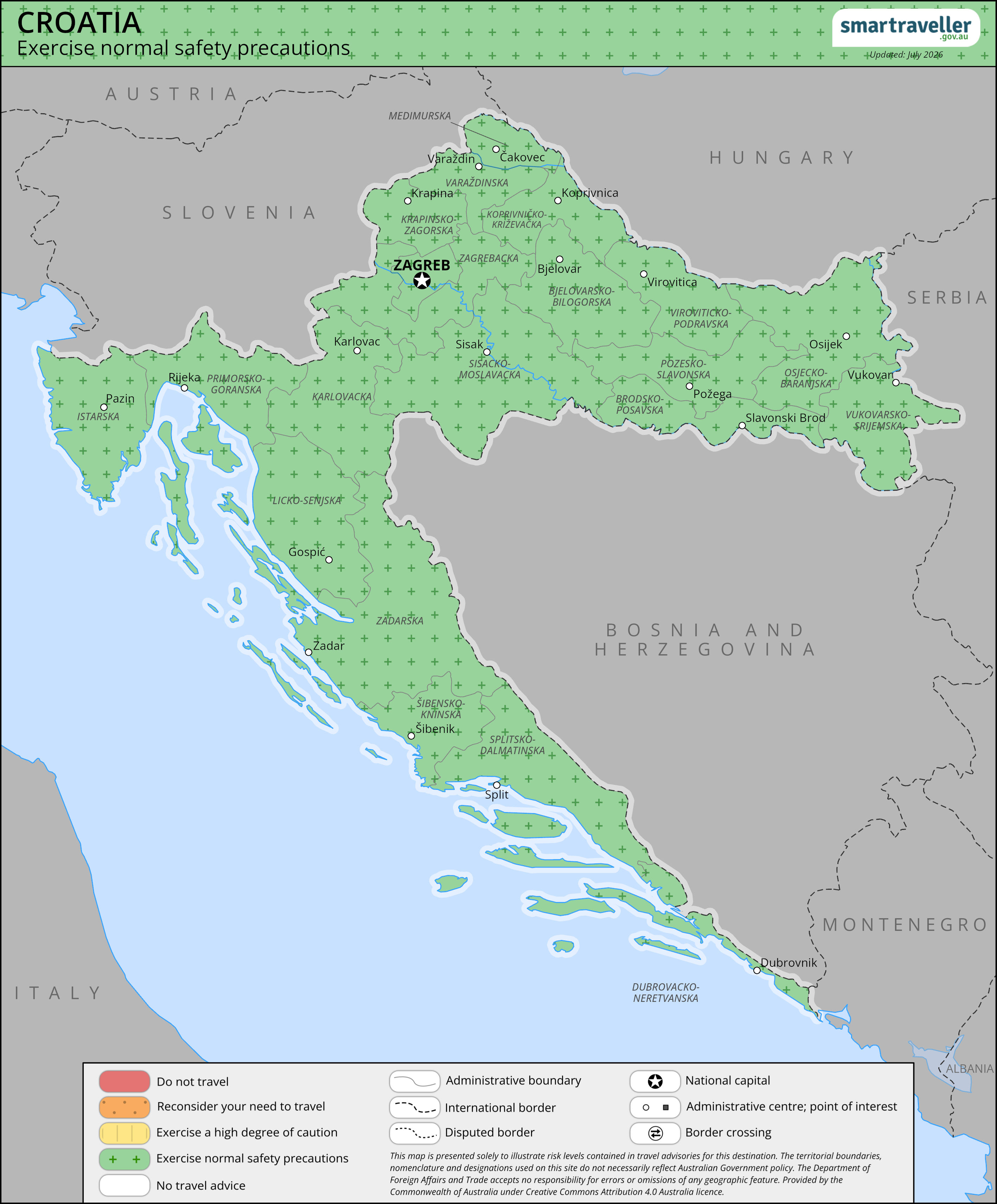
Terrorism is a threat worldwide. Terrorist attacks could occur anywhere and at any time. Be alert to possible threats, especially in public places.
While there's been no recent terrorist attacks in Croatia, they can still happen.
There's been an increasing number of bomb threats against public areas, such as shopping malls, government offices and schools. Monitor the media for developments and follow the advice of local authorities.
In recent years, terrorists have staged attacks in European cities. Targets have included:
Security services have stopped some planned attacks.
To protect yourself from terrorism:
Report any suspicious behaviour or items to the police.
If there’s a terrorist incident, leave the area if it’s safe to do so and follow the instructions of local authorities.
More information:
Petty crime, such as pickpocketing, is common. Take extra care:
Gentlemen's clubs in coastal centres have been known to overcharge tourists. They may threaten violence and use security guards to make you pay. Check prices before ordering.
Report incidents of extreme overcharging and related threats or violence to local police.
While violent crime is rare, isolated attacks may occur, including at sporting events.
Public protests and events that draw large crowds can turn violent, including at sporting events.
Be aware that rivalries at some high-profile soccer matches can result in potential violence and crowd unrest.
These matches often require increased police presence and security measures, at stadiums and in the city, to manage crowd behaviour.
To protect yourself during periods of unrest:
More information:
Croatia is a popular party destination, but partying carries safety, legal and financial risks.
Accidents have occurred on party boats, resulting in serious injuries. The safety standards may be different to Australia. Nightclub fires, balcony collapses and crowd crushes can occur.
Uniformed and plain-clothed police patrol music festivals. Drug and other antisocial behaviour-related arrests are common.
Locals don't like rowdy and drunken behaviour in public places.
Being drunk or under the influence of drugs may void your travel insurance.
Dress codes apply in some popular tourist areas. Police may fine you if you're shirtless or wearing swimwear in towns with signs banning this.
More information:
Jumping off rocks and cliffs into the sea along the coast of Croatia can cause injuries. Warning signs aren't always in place.
Many accidents occur in Split, Dubrovnik and in the Dalmatian Islands.
Your travel insurance may not cover you if you:
Tourists often need rescue in the Croatian mountains due to lack of preparation.
If you intend to trek or rock climb:
More information:
Croatia experiences natural disasters and severe weather.
The country is in an active earthquake zone.
Forest fires are common in the dry, hot coastal areas and on the islands from June to September. Avoid affected areas.
Flooding can happen throughout the year, triggering landslides, and damaging buildings, roads and other infrastructure. This can disrupt road travel.
To protect yourself if there's a natural disaster or severe weather:
Safety barriers aren't always in place in some tourist areas. Care should be taken when walking on uneven, slippery surfaces, including old cobblestone streets.
Register with the Global Disaster Alert and Coordination System to receive alerts on major disasters.
Tick-borne encephalitis is a risk in forested areas.
Ticks are most common in country areas. They're active from spring to autumn.
Cases of West Nile virus have occurred. There's no vaccine for it.
To protect yourself from illness:
To reduce your risk of tick-borne disease:
If you're travelling during extreme hot weather, plan your days to avoid being outside during the hottest part of the day. If you go out in the heat, rest often and stay in the shade as much as possible.
Drink plenty of water, even if you're not thirsty. Avoid alcohol.
Avoid strenuous outdoor activities such as hiking or biking in extreme hot weather.
Hemorrhagic Fever with Renal Syndrome (HFRS), commonly known as 'mouse fever', is a risk in forested areas. It's caused by hantaviruses. Hantaviruses are carried and transmitted by rodents and are more common in warmer months.
To reduce the risk of mouse fever:
Ask your doctor about health risks and vaccines before you go.
More information:
There’s no agreement between Australia and Croatia for free healthcare. Tourists must pay for all medical care, even if they need to stay in hospital or be evacuated. This can be very expensive. Make sure your travel insurance covers you. The Australian Government won't pay for these costs.
The standard of health care on the mainland is generally good, but services on the islands are limited.
Public hospital facilities may not be to the same standard as Australian hospitals.
Private hospitals and clinics have facilities for some services but often cost more.
Dubrovnik, Split, Rijeka and Pula have decompression chambers.
You'll be evacuated to a regional centre for treatment if you're injured or become seriously ill on an island or remote area.
Dual nationals are not automatically covered by the Croatian health insurance system or entitled to free access to health services through the Croatian Healthcare fund. Prior registration and monthly contributions/payments are required to gain access and coverage.
Possessing, using or trafficking illicit drugs is illegal.
If you're arrested for a drug offence, police may detain you while they investigate.
Penalties include imprisonment.
More information:
Police issue on-the-spot fines for some minor offences, including traffic violations. They may detain you and/or hold your passport if you:
Foreigners buying property have been involved in lengthy disputes about the validity of property titles. Seek independent legal advice before signing any contracts.
You must carry an ID, such as your passport, at all times.
You must register your stay with the local police within 48 hours of arrival. If you're staying at a hotel or a tourist facility, the accommodation provider will register you.
Drinking alcohol in public areas, outside bars and restaurants, and in popular tourist areas such as Split and Dubrovnik is prohibited.
Signs warning of prohibited behaviours, including drunken and disorderly behaviour, have been put up, and on-the-spot fines are issued. Dress codes apply. Police may fine you if you're shirtless or wearing swimwear in towns with signs banning this.
Court staff take holidays over the summer. If you're detained at that time, you may face delays in having your case processed. You may not be able to leave Croatia until the matter is finalised.
Croatia recognises dual nationality and treats dual nationals as Croatian citizens.
If you're an Australian-Croatian dual national and intend to stay for over 3 months, you may need to provide evidence of your Croatian citizenship.
More information:
If you're a male dual Australian-Croatian national, you need to report to the defence authorities of Croatia and may be subject to military service. Failure to do so may attract fines.
Check your obligations regarding compulsory military service with the Ministry of Defence or the nearest Croatian diplomatic or consular mission before you travel.
More information:
Same-sex relationships are legal, but attitudes towards LGBTQIA+ travellers can vary, particularly outside tourist areas. Avoid public displays of affection.
More information:
Croatia is a part of the Schengen Area. Get a clear stamp on your passport when you enter the Schengen Area for the first time.
Entry and exit conditions can change at short notice. Contact the nearest embassy or consulate of Croatia for details about visas, currency, customs and quarantine rules.
Croatia's currency is the euro (EUR).
If you're travelling to or from any non-EU country, declare cash of more than 10,000 euros or equivalent. This covers all forms of currency, not only cash.
If you fail to declare it or give wrong information, you'll be fined and the funds may be confiscated.
You don't need to declare currency if you're travelling to or from another EU country.
Delays at land border crossings with Bosnia and Herzegovina, Montenegro and Serbia may occur, especially in the European summer. Allow extra time if you're travelling by road.
There's been an increase in the number of migrants and refugees entering Europe, including through irregular migration routes.
Unexploded landmines and remnants from past conflicts posed a major risk in areas of Croatia that were previously affected by war.
Early in 2026, following decades of clearance operations, the Croatian Government declared Croatia free of landmines.
If you plan to hike in regional areas, it’s recommended that you stay on designated, clearly marked walking tracks and roads.
To drive a vehicle, you'll need both:
Driving without an IDP could void your travel and vehicle insurance.
If you plan to live in Croatia, you must exchange your Australian driver's licence for a Croatian one within 12 months of arrival. You can do this at the local police station.
Driving can be hazardous, and traffic accidents are common.
In winter, severe weather can make roads icy and slippery.
According to local road rules, you must:
Motor vehicles must carry a fluorescent vest. You must wear this vest while attending to a breakdown.
Police may fine drivers and cyclists involved in accidents, even when no third parties are involved.
More information:
Check with your travel insurer if your policy covers you riding a motorcycle, quad bike or similar vehicle.
Always wear a helmet.
Only use registered taxis and authorised car services.
Avoid flagging down taxis on the street.
Always confirm the price before entering the taxi, especially if it is not a pre-booked or an independent taxi service, as you may be overcharged.
Bus and rail services operate throughout Croatia.
Take care of your belongings on public transport, as petty crime does occur.
More information:
Several accidents and serious injuries have occurred on party boats.
Ensure proper safety equipment is on board before travelling on a ferry or other sea vessel.
The Croatian Ministry of the Sea, Transport and Infrastructure recognises some Australian boating licences issued by state authorities. You should check the requirements with the Ministry before your travel to Croatia.
All skippers must have an International Certificate of Competence (ICC) or hold a valid recognised Australian boating licence.
More information:
Check Croatia's air safety profile with the Aviation Safety Network.
More information:
Depending on what you need, contact your:
Call 112.
Call 112.
Call 112.
Always get a police report when you report a crime.
Your insurer should have a 24-hour emergency number.
The Australian Government aims to provide high quality consular assistance. There are limits to what we can do. Read the Consular Services Charter to understand how we can assist you overseas.
For consular assistance, contact the Australian Embassy in Zagreb.
Grand Centar
Fifth Floor, Hektoroviceva 2
10000 Zagreb, Croatia
Phone: +385 1 489 1200
Email: austemb.zagreb@dfat.gov.au, consular.zagreb@dfat.gov.au
Website: https://croatia.embassy.gov.au
Facebook: Australia in Croatia
X: AusAmbCroatia
Check the Embassy website for details about opening hours and any temporary closures.
In a consular emergency, if you can't contact an embassy, call the 24-hour Consular Emergency Centre on:
Be the first to know official government advice when travelling.