Fire and rescue services
Call 123.
Medical emergencies
Call 124.
Police
Call 122.
Call 123.
Call 124.
Call 122.
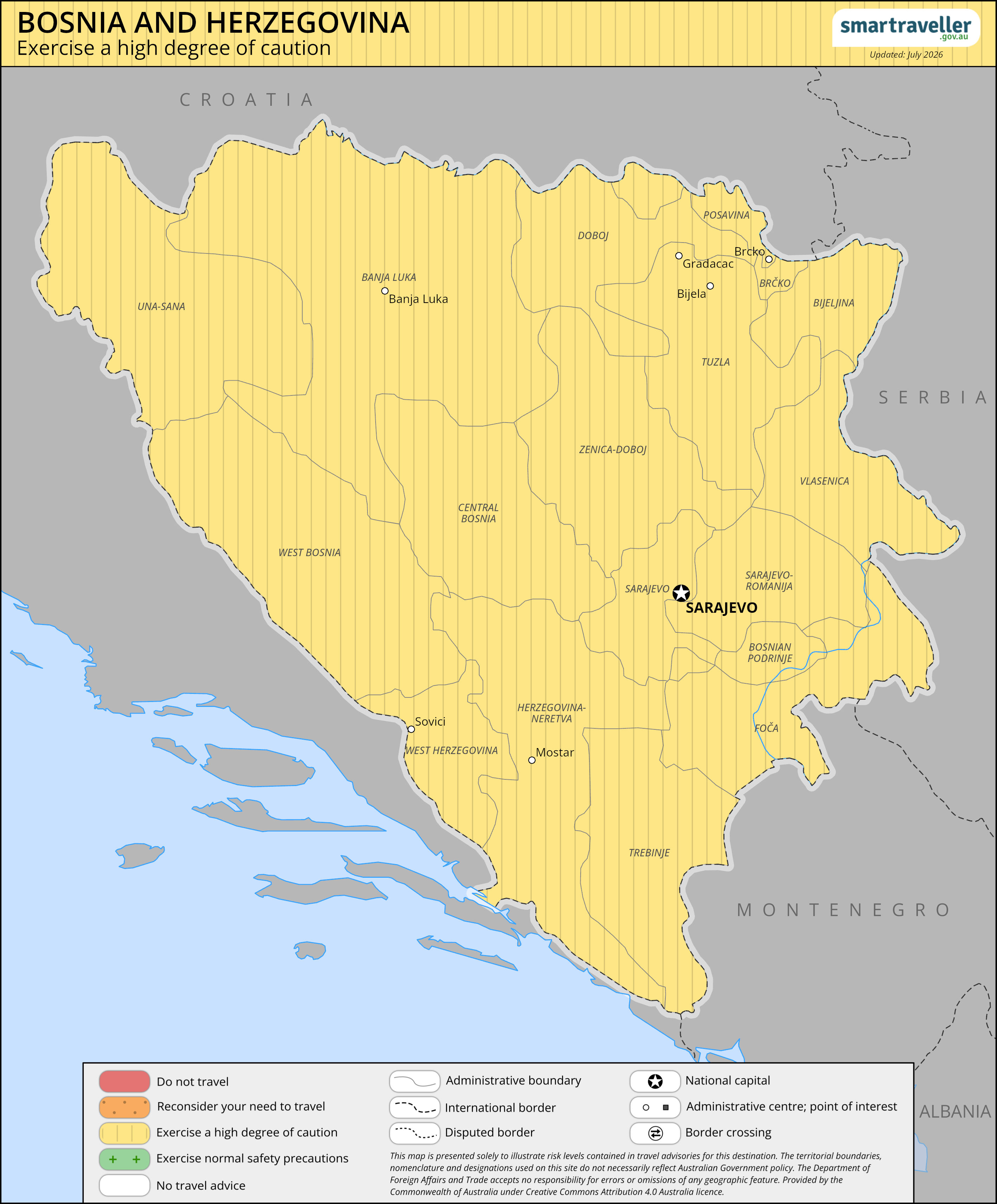
Exercise a high degree of caution in Bosnia and Herzegovina due to the risk of landmines.
Full travel advice: Safety
Full travel advice: Health
Full travel advice: Local laws
Full travel advice: Travel
Full travel advice: Local contacts
Terrorism is a threat worldwide. Terrorist attacks could occur anywhere and at any time. Be alert to possible threats, especially in public places.
While there have been no recent terrorist attacks, possible targets include:
To stay safe:
If there’s a terrorist incident, leave the area if it’s safe to do so and follow the instructions of local authorities.
More information:
Public protests and events that draw large groups of people can turn violent.
Ethnic and religious tensions may result in demonstrations or conflict.
Incidents can happen with little or no warning and may target foreigners.
To stay safe during periods of unrest:
More information:
The crime rate is moderate. Home and vehicle break-ins are common, particularly in Sarajevo. Pickpocketing and bag snatching is common. Take extra care in crowded tourist areas and on public transport.
Firearms are widely available. Travellers may not be targets, but you risk being in the wrong place at the wrong time, especially late at night.
To protect yourself from crime:
More information:
Kidnapping can happen anywhere, anytime, including destinations that are typically at lower risk.
The Australian Government's longstanding policy is that it doesn't make payments or concessions to kidnappers.
More information:
Unexploded and unmarked landmines remain dangerous, particularly in the countryside and isolated mountainous areas.
To protect yourself:
More information:
Bosnia and Herzegovina experiences natural disasters and extreme weather, including:
Weather in mountainous regions is unpredictable. It can change suddenly.
If you're visiting a mountainous area:
Before you travel:
Skiing outside of prepared skiing areas (off-piste) is dangerous and may void your insurance. Stick to marked slopes and trails. Hiking or mountain climbing without appropriate footwear (hiking boots) is dangerous. Stick to marked trails.
Check your travel insurance covers all your planned activities especially if you plan to undertake adventure sports.
Fires can happen during summer but are usually limited to uninhabited areas.
To protect yourself if there's a natural disaster:
If you can, access the Global Disaster Alert and Coordination System.
Visitors in mountain areas occasionally encounter bears and wolves. Take care if you’re in an area where bears have been sighted.
Ensure you know what may void your policy’s coverage, such as consuming alcohol or driving a class of vehicle you aren’t licensed to drive.
For specific information on bringing medication into Bosnia and Herzegovina, visit the Embassy or consulate of Bosnia and Herzegovina website.
We don't provide a comprehensive list of health risks, diseases or outbreaks for every destination. Before you travel, check the latest health advice from the Australian Centre for Disease Control (CDC) and the World Health Organization (WHO).
West Nile virus (WNV) cases have been reported. There's no vaccine to prevent it.
Tick-borne encephalitis is a risk in forested and rural areas.
They're active from spring to autumn.
To protect yourself from illness:
Measles cases can routinely occur. Bosnia and Herzegovina has experienced significant outbreaks in the past. Make sure your vaccinations are up-to-date before you travel.
More information:
Outbreaks of foodborne and other infectious diseases sometimes occur. These include:
If you're bitten or scratched by an animal, seek medical help straight away.
Get medical advice if you develop symptoms.
Ask your doctor about health risks and vaccines before you go.
More information:
There’s no agreement between Australia and Bosnia and Herzegovina for free healthcare. Tourists must pay for all medical care, even if they need to stay in hospital or be evacuated. This can be very expensive. Make sure your travel insurance covers you. The Australian Government won't pay for these costs.
Medical facilities may not be to the same standard as Australia , especially outside of major cities.
More information:
When you travel to another country, you must follow their laws. Even if they seem strict compared to Australia's. Before you go, learn about the local laws in that country.
The Australian Government is limited in how and when we can help if you're arrested overseas. We can't get you out of trouble or out of jail. Understand our limits. Read the Consular Services Charter.
Don't use or carry illegal drugs. Penalties for drug offences are severe. Possessing even small amounts of illegal drugs can lead to prison sentences. This includes marijuana.
More information:
You must carry your ID at all times.
It's illegal to photograph military and police:
Some Australian laws still apply even if you’re in another country. You could be charged in Australia if you break these laws overseas.
More information:
Bosnia and Herzegovina recognises dual nationality only in certain circumstances.
If you're a dual national, this limits the consular services we can give if you're arrested or detained.
Always travel on your Australian passport.
Contact the nearest embassy or consulate of Bosnia and Herzegovina for advice on:
More information:
Same-sex relationships are legal but aren't widely accepted. Avoid public displays of affection with someone of the same sex.
More information:
Make sure you meet all entry and exit conditions. If you don't, the Australian Government can't help you.
You don't need a visa for stays of up to 90 days within a six-month period.
You'll need a temporary residence permit if you plan to stay longer.
Entry and exit conditions can change at short notice. Contact the nearest embassy or consulate of Bosnia and Herzegovina for details about visas, currency, customs and other travel requirements.
Ensure your passport is stamped when you enter the country. If it isn't stamped, you could face difficulties leaving.
For a stay of 3 days or more, you must register with the local police within 48 hours of arrival. Hotels can organise this for you and will confirm when you check in.
Children aged younger than 18 years old travelling alone or with one parent may need to produce the following:
Check with an embassy or consulate of Bosnia and Herzegovina before you travel.
More information:
The currency of Bosnia and Herzegovina is the Bosnia and Herzegovina convertible mark (KM or BAM).
You'll find ATMs in major centres.
Credit and debit card use is increasing, you may still need cash in some areas.
More information:
You can drive on your Australian driver's licence for up to 6 months. You'll need both:
Driving without an IDP could void your travel and vehicle insurance. Get your IDP before departing Australia.
The minimum age for driving is 18 years old.
You must always have your headlights on (even during the day).
Black ice, fog and landslides can make roads hazardous in winter and spring.
From 1 November to 1 April, you must use winter tyres or tyres with snow chains.
You must pay a toll for some roads in Bosnia and Herzegovina.
Avoid driving off-road in rural areas due to the risk of landmines.
Police can collect traffic fines on the spot.
More information:
Check with your travel insurer if your policy covers you for riding a motorbike, quad bike or similar vehicle.
Always wear a helmet.
You need the correct insurance cover to enter Bosnia and Herzegovina in a vehicle. If you don't, border police will direct you to an insurer at the border crossing to buy insurance.
If travelling by car, research and prepare before entry.
Not all border crossings have an insurer's office, and credit card payments aren't always possible.
Taxis are available in most towns and for inter-city travel.
Use only registered taxis with licence plates beginning with 'TA'.
Ensure the meter is running throughout your trip. Pay particular attention at the airport.
Public transport is usually reliable but can be crowded, and standards vary. Be wary of pickpockets.
More information:
Check Bosnia and Herzegovina's air safety profile with the Aviation Safety Network.
More information:
Depending on what you need, contact your:
Call 123.
Call 124.
Call 122.
Call 1282/1285/1288.
For non-emergency criminal issues, contact the local police.
Always get a police report when reporting a crime.
Your insurer should have a 24-hour emergency number.
The Australian Government aims to provide high quality consular assistance. There are limits to what we can do. Read the Consular Services Charter to understand how we can assist you overseas.
Australia has a consulate in Sarajevo headed by an Honorary Consul. The office provides some consular assistance but can't issue emergency passports or perform notarial acts.
Get in contact before you visit.
Strossmayerova 1/1
71000 Sarajevo
Bosnia and Herzegovina
Email: auconsulate.bih@gmail.com
The Icon, Gertrude-Fröhlich-Sandner-Str. 2
1100 Vienna, Austria
Phone: +43 1 506 740
Email: consular.vienna@dfat.gov.au
Website: austria.embassy.gov.au
X: @AusAmbVIE
Facebook: @AusEmbassyVie
Check the embassy website for details about opening hours and any temporary closures.
In a consular emergency, if you can't contact an embassy, call the 24-hour Consular Emergency Centre on:
Be the first to know official government advice when travelling.