Fire and rescue services
Call 199.
Medical emergencies
Call 1669 for medical emergencies and rescue services.
Call 1724 for an ambulance in Bangkok.
Police
Call 191 for police.
Call 1155 for the tourist police.
We advise:
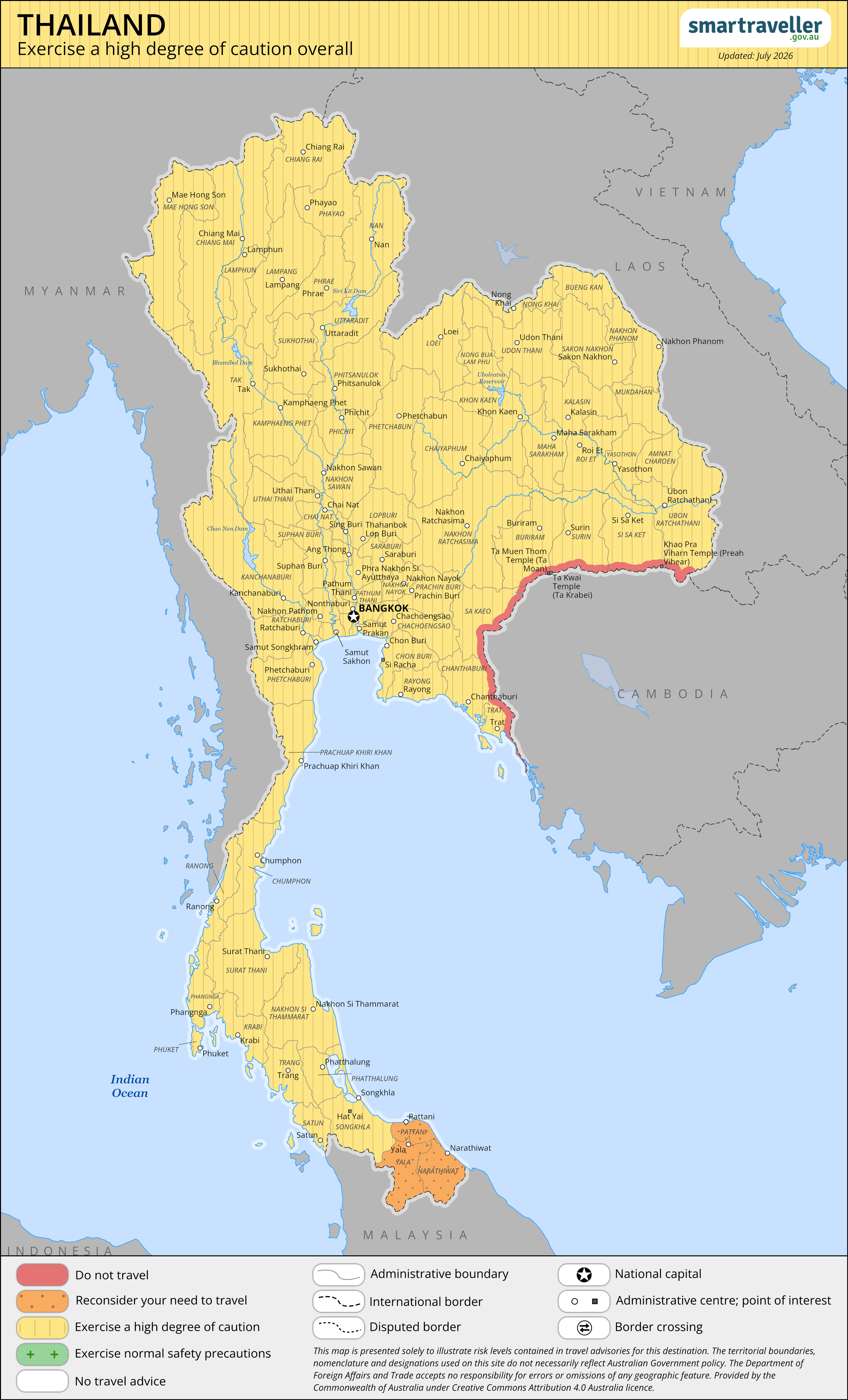
Exercise a high degree of caution in Thailand overall due to security and safety risks.
Higher levels apply in some areas.
We advise:
Exercise a high degree of caution in Thailand overall due to security and safety risks.
Higher levels apply in some areas.
Exercise a high degree of caution in Thailand overall due to security and safety risks.
Do not travel to areas within 50 kilometres of the Thailand-Cambodia land border in the provinces of Sa Kaeo, Buriram, Si Saket, Surin, Ubon Ratchathani, Chanthaburi and mainland Trat due to recent armed conflict between Thai and Cambodian forces, which included military strikes and violence, and the presence of landmines.
Reconsider your need to travel to:
due to ongoing risks of low-level insurgent activity, including terrorism.
Full travel advice: Safety
Full travel advice: Health
Full travel advice: Local laws
Full travel advice: Travel
Full travel advice: Local contacts
Terrorism is a threat worldwide.
Attacks, including bombings and shootings, are possible anytime. They can happen anywhere, including Bangkok and Phuket.
Popular tourist areas may be the target of terrorist attacks.
Thai authorities have warned of possible attacks on symbolic dates or holidays.
Possible targets for future attacks include:
Other targets may include public buildings, public transport, airports and sea ports.
To reduce your risk of being involved in a terrorist attack:
If there's an attack:
Gun-related violence can occur at any time.
In October 2023, 3 people were killed and 4 injured in a shooting at the Siam Paragon Mall in Bangkok.
In October 2022, 36 people were killed in a shooting and stabbing incident in Nong Bua Lamphu province.
Since 2004, over 7500 people have been killed and many more injured in the southern border provinces of Thailand (Yala, Pattani, Narathiwat).
More information:
The security situation along the Thailand-Cambodia border remains unpredictable.
Due to the recent ongoing armed clashes along the Thailand-Cambodia border which has included military strikes and violence, and the presence of landmines, we continue to advise do not travel to areas within 50 kilometres of the Thailand-Cambodia land border throughout the provinces of Sa Kaeo, Buriram, Si Saket, Surin, Ubon Ratchathani, Chanthaburi and mainland Trat.
Follow the advice of local authorities, including when navigating maritime areas near the maritime borders, monitor local media for updates and pay close attention to your personal security.
The following temples, popular with tourists, now fall in the do not travel area:
All border crossing points along the Thailand-Cambodia border are currently closed. Monitor local media for updates and follow the advice of local authorities.
Fighting and armed theft can occur along the Thailand-Myanmar border. This includes:
Armed clashes between the Myanmar military forces and armed groups inside Myanmar may lead to border closures.
If you try to cross the border illegally, you may be detained and deported.
Bandits may target you if you travel through national parks in this border region.
If you travel to this region:
Reconsider your need to travel to or from the three most southern provinces:
Violence includes attacks and bombings, with deaths and injuries. Since 2004, over 7500 people have been killed and many more injured in these provinces.
Bombings are often coordinated to target people who respond to the first explosion and then secondary bombings occur.
Over the past few years, multiple coordinated explosions have occurred in the southern border provinces, and low-level insurgent activity continues.
If you travel to or stay in these provinces, you could get caught up in violence directed at others.
Attacks can happen at any time.
The security situation in Thailand can be unpredictable. Large protests have occurred in Bangkok and other areas. In previous years, large political protests and government crowd control operations have resulted in violence.
To stay safe during periods of unrest:
More information:
Travellers may experience sexual assault, other assault and robbery.
Be extra careful in tourist spots such as Khao San Road and Sukhumvit in Bangkok, as well as the night-time entertainment areas in Bangkok, Pattaya and Phuket.
Don't leave food or drinks unattended. They may be contaminated with drugs or other toxic substances. You're at higher risk of sexual assault and theft if you get drugged.
Stay with people you trust at parties, in bars, nightclubs and taxis. Be cautious if you're leaving a venue with someone you've just met. Even if it's just as friends. You're more vulnerable when separated from people you know.
Get urgent medical attention if you think you or someone else has been drugged.
If you're a victim of violent crime, including rape, get immediate medical attention.
Under Thai law, courts will only accept the results of a medical examination from some government hospitals. After you've been examined by a government hospital, you can receive medical attention at a private hospital. Please contact the Australian Embassy Thailand, Australian Consulate-General in Phuket, or Consular Emergency Centre in Canberra for assistance.
More information:
Money and passports have been stolen from budget hotel and hostel rooms, and from bags on public transport. Thieves also target luggage stored on trains and below buses.
Bags have been snatched by thieves on motorcycles or sliced open with razor blades.
To reduce your risk of theft:
You could face cyber threats in any country, anyone is a target. Your devices and data can be stolen, especially when using public Wi-Fi, computers, or Bluetooth. Criminals can use stolen information to conduct scams or to resell your personal information.
The Australian Cyber Security Centre has advice on how to protect yourself online.
Social media can also be risky in places with social or political tensions or strict laws. People have been arrested for what they posted online. Check the laws of the destination you’re travelling to and think about what you post on social media. The Australian Government can’t get you out of trouble if you’re accused of breaking the law.
More information:
Thailand has strict defamation laws. Travellers have been arrested for things they have said on social media, including for posting negative reviews.
Kidnapping can happen anywhere, even in places that seem safe.
The Australian Government’s longstanding policy is that it doesn’t may payments or concessions to kidnappers.
More information:
Drink spiking can happen anywhere. Be alert, don’t leave your food or drinks alone. Watch when your drink is being mixed. If you feel unwell, tell your friends immediately and get to a safe place. Keep an eye on your friends - if they feel unwell, stay with them. Get medical help if needed.
People have died or become very sick from poisoned drinks overseas. This includes Australians. Methanol is highly toxic. As little as one shot can be fatal. Methanol can be added or accidentally created during poor quality alcohol production. Only drink branded, sealed drinks. Get urgent medical help if you think you’ve been poisoned.
More information:
Transport and tour operators don't always follow safety and maintenance standards. This includes for:
Thailand has introduced stricter regulations regarding scuba diving and snorkelling activities. You cannot touch or move marine life, including coral, stir up sediment or feed fish. You must also wear a life vest when snorkelling. You may be reported to local authorities for not following regulations.
If you plan to do an adventure activity or sport:
If proper safety equipment isn't available, use another provider.
Thailand experiences natural disasters and severe weather, including:
Severe weather events are likely to disrupt transport, electricity and communications.
To stay safe during severe weather:
If there is a natural disaster:
Severe storms and widespread seasonal flooding can occur without warning. This includes flash floods.
The wet season in north and central Thailand is from May to October.
In Koh Samui and the south-east of the peninsula, the wet season is from November to March.
More information:
Earthquakes occur in Thailand.
Tsunamis are more likely in Thailand because of the risk of earthquakes.
Check with the Indian Ocean Tsunami Information Centre for further information.
If you're near the coast, move to high ground straight away if advised, or if you:
Don't wait for official warnings such as alarms or sirens. Once on high ground, monitor local media.
More information:
Get comprehensive travel insurance before you leave.
It must cover all medical costs overseas, including evacuation. The Australian Government will not pay for these costs.
If you can’t afford travel insurance, you shouldn’t travel. This is true for everyone, even if you are healthy and fit.
If you don’t have insurance, you might have to pay thousands of dollars up front for medical care.
Before you travel, check your policy, make sure:
- you know what activities and medical care your insurance covers, including evacuations
- your insurance covers you for your whole trip, including any stopovers
- you know any exclusions – for example, you might need to pay extra for activities like motorcycling, snow sports or bungee jumping.
More information:
Think about your health before you travel, especially if you have any medical conditions.
See your doctor or a travel clinic to:
- get a basic check-up
- ask if your travel plans might affect your health
- find out what vaccinations you need.
If you're concerned about your mental wellbeing, or someone else's, read more about mental health support overseas.
More information:
Medicines you buy in Australia may not be available in Thailand. Some may even be illegal or restricted. You may need a permit.
Not all medications available in Australia are accessible in other countries. Some medicines may be illegal, even if prescribed by an Australian doctor.
Ensure your medication is legal overseas. Take enough for your whole trip.
Carry a copy of your prescription and a letter from your doctor stating:
- medication names
- your required dosage
- that the medications are for your personal use.
More information:
If you plan to bring medication, check if it's legal in Thailand by contacting the Royal Thai Embassy in Australia. Take enough legal medicine for your trip.
Get medical advice before buying medicine in Thailand. Travellers have been arrested for carrying medicine they bought at a Thai pharmacy without a prescription.
Outbreaks of insect-borne illnesses occur, and are common during the rainy season:
Insect-borne illnesses include:
To protect yourself from disease:
More information:
Other health risks are common. They include:
To protect yourself from illness:
Ask your doctor about health risks and vaccines before you go.
More information:
Thailand has high levels of air pollution. It can reach hazardous levels. Bangkok and Chiang Mai can be particularly bad.
Air pollution can make bronchial, sinus or asthma conditions worse.
Smoke haze is an issue across the north and north-east of Thailand from March to April.
Check air quality levels on the World Air Quality Index.
Get advice from your doctor before you travel.
There’s no agreement between Australia and Thailand for free healthcare. Tourists must pay for all medical care, even if they need to stay in hospital or be evacuated. This can be very expensive. Make sure your travel insurance covers you. The Australian Government won't pay for these costs.
In an emergency, contact an ambulance on:
The standard of medical facilities varies.
Private hospitals in major cities have high standards of medical care. Services can be limited in other areas of Thailand.
Hospitals and doctors often need to confirm your insurance before they'll treat you, even in an emergency. Otherwise, you may need to pay cash up-front. Costs can be very high.
Hospitals in Bangkok and other large cities can treat serious illnesses and accidents. In other areas, you may need to be moved to a place with better facilities. Medical evacuation can be very expensive.
Decompression chambers are located near popular dive sites in:
Medical tourism, including for cosmetic and sex-change operations, is common.
Make sure your travel insurance covers complications and medical evacuation.
Standards at discount and uncertified medical establishments can be poor. Serious and life-threatening complications can result.
Some hospitals and clinics have refused to provide compensation for patients:
Do your research. Choose your medical service providers with care.
Don't use discount or uncertified medical service providers.
When you travel to another country, you must follow their laws. Even if they seem strict compared to Australia's. Before you go, learn about the local laws in that country.
The Australian Government is limited in how and when we can help if you're arrested overseas. We can't get you out of trouble or out of jail. Understand our limits. Read the Consular Services Charter.
Penalties for drug offences are severe. They include the death penalty.
Possession of even small quantities of drugs for recreational purposes can lead to long jail sentences and deportation.
Thai authorities may conduct spot-checks for illegal drugs at airports and in tourist areas.
Travellers have been targeted for narcotic tests. Under Thai law, authorities have the right to demand urine samples from people suspected of taking illegal drugs.
If you're asked to submit a urine sample, ask to do it at a police station. You can also ask to contact the Tourist Police on 1155 and request English-speaking officers.
The use of cannabis is limited to medicinal purposes only. The content of Tetrahydrocannabinol (THC) must be below 0.2% in weight and you must have a prescription from a locally recognised professional.
Cannabis use in public places remains illegal, and smoking outside is considered a public nuisance. Offenders risk fines and arrest.
Prescribing cannabis or its by-product for recreational use in establishments, selling cannabis online or through a vending machine, as well as advertising for commercial purpose is prohibited.
Be aware that in the next destination you're travelling to, including when transiting, illicit drugs including cannabis may be illegal. This may include residual amounts of illicit drugs in your system (such as in your blood or saliva) or on items you're carrying.
Follow directions from local authorities.
More information:
Commercial surrogacy is illegal in Thailand. If you break the law, authorities may arrest and jail you.
More information:
The legal age for buying and drinking alcohol is 20 years old.
It may be illegal to buy, sell or consume alcohol at certain times of the day and at certain locations. Follow the instructions of local authorities. Fines may apply if you don't comply.
E-cigarettes, e-brake, e-cigars, other vaporisers (vapes) and refills are illegal, even for personal use.
Producing, importing, transferring or selling these items is illegal. You face either 10 years of imprisonment or a fine up to Thai Baht (THB) 1 million, or both.
Concealing, disposing, purchasing or receiving these items is also illegal. You face either 5 years of imprisonment, a fine of up to THB 500,000, or both.
Penalties for breaking the law can be severe.
These penalties can also apply to anyone aged under 18 years who is subject to Thai juvenile judicial processes. Penalties can include detention in a juvenile or adult prison.
The death penalty can apply to:
Insulting the monarchy, or defacing images of the monarchy - including on a bank note bearing the King's image - can lead to prison terms of up to 15 years.
Take care not to cause offence when posting, commenting or liking items about the monarchy, including on social media.
In Thailand, it's illegal to:
It is also illegal to smoke on beaches in tourist areas.
Some Australian laws still apply even if you’re in another country. You could be charged in Australia if you break these laws overseas.
More information:
Thai-Australian dual nationals may be required to complete military conscription.
If you're a dual national, contact the nearest embassy or consulate of Thailand before you travel.
More information:
Respect local customs and take care to not offend. Deliberately ignoring local customs can cause grave offence.
Do not show the soles of your feet or touch the top of a person's head. These are insulting in Thai culture.
If in doubt, ask for local advice.
Each country or territory decides its own entry and exit rules. To find out what you need to enter a destination, ask their embassy, consulate or immigration office.
You can get a visa exemption for up to 60 days on arrival in Thailand for tourism and short-term business travel. Your passport must be valid for more than 6 months before entering Thailand.
You must complete a Thailand Digital Arrival Card (TDAC) within three days before arriving in Thailand. The TDAC is free and must be submitted online through the Thailand Immigration Bureau website. Beware of fake websites charging you a fee for the TDAC.
If you require an E-Visa, you can apply through the Official Thai E-Visa website. You can only apply if you're currently not in Thailand and in a country where E-visa services are available, and you're no longer required to submit your passports and supporting documents in person at the Royal Thai Embassy/Consulate-General. After the E-Visa application has been approved, a confirmation email will be sent, which can be printed and presented to airlines and Thai immigration officials when entering Thailand.
You must get an entry stamp from an immigration officer at the point of entry into Thailand. Don't get your visa, visa extension or entry stamp from visa shops or travel agents in Thailand.
A passport that has been altered or that contains counterfeit visas and entry/exit stamps is deemed invalid. You may be arrested, prosecuted and/or deported.
Entry and exit conditions can change at short notice. Contact the nearest Embassy or consulate of Thailand, the Royal Thai Embassy Canberra or Royal Thai Consulate-General Sydney. See the official website of the Tourism Authority of Thailand for the latest details about visas, currency, customs and quarantine rules.
If you overstay your visa, you'll need to pay a fine before you can leave. You can also be:
Thai authorities can blacklist you, which means you can never return to Thailand.
Penalties for not paying the fine include long prison sentences. Conditions at Immigration Detention Centres are harsh.
More information:
You may be subject to biometric screening at points of entry. Clarify entry requirements with your airline, International Air Transport Association (IATA) or your nearest Thai Embassy.
Travellers from Yellow Fever-endemic countries and those with Mpox outbreaks should pre-register through the Thai Health Pass digital platform before checking in with the airline at the country of origin.
Foreign passengers must present their passport for domestic flights within Thailand. You may be refused boarding if you are unable to present your passport.
Travellers should refer to the relevant airline or travel provider for information about departing Thailand.
More information:
Many countries require your passport to be valid for at least 6 months before entering or departing. This includes for transit.
If your passport expires too soon, you might not be able to travel.
The Australian Government doesn’t make these rules. Check your passport’s expiry date before you go. If you’re not sure, it’s a good idea to get a new passport.
Your passport is valuable and can be used by others to commit crimes.
Don’t let anyone trick you into giving it to them. Always keep it in a safe place.
If your passport is lost or stolen, tell the Australian Government:
- In Australia: contact the Australian Passport Information Service.
- Overseas: contact the nearest Australian embassy or consulate.
Don't give your passport to third parties - like a jet ski or motorcycle rental businesses - as a guarantee. Companies may hold on to the passport and ask for payment for damages.
Australian passports comply with international standards for sex and gender. If your passport has an 'X' in the sex field, we can’t guarantee your entry or transit to other countries. Ask the embassy or consulate of your destinations if they’ll accept your passport with an 'X' gender marker. Check all transit destinations too.
More information:
The currency of Thailand is the Thai Baht (THB).
You can convert Australian dollars for THB at airports, tourist areas, major cities and towns.
Only exchange money at authorised money changers.
Most hotels, restaurants and higher-end shops accept international credit cards.
ATMs are available in cities and regional centres.
Card skimming occurs.
To drive a car or motorcycle in Thailand, you'll need a valid international driving permit (IDP) and your Australian driver's licence for the type of vehicle you're using. Australian digital driver's licences may not be accepted. If you drive without the correct licence, you could be arrested or jailed.
To drive a motorbike, you'll need a valid motorcycle licence. Some rental companies will tell you otherwise.
Don't drive any vehicles not covered by your Australian licence. In the event of an accident, you may not be covered under insurance.
The Department of Land Transport issues Thai driver’s licences. Contact them to confirm:
The legal driving age in Thailand is 18.
Thailand has one of the highest traffic-related fatality rates in the world. Motorcyclists are most at risk.
Road accidents are common, including in resort areas such as Phuket, Pattaya and Koh Samui.
Driving in Thailand is dangerous due to:
Be extra careful during holidays, such as Songkran (Thai New Year). Alcohol use and congestion are worse during these times.
Don't drink and drive.
If you're walking, use overhead walkways. Look in both directions before crossing streets, even at marked crossways.
More information:
Under Thai law, motorcycle riders and passengers must wear a helmet. However, hire companies or motorcycle taxis rarely provide helmets. You may need to shop around to hire a helmet.
Australians are regularly injured or die in motorbike accidents in Thailand. Alcohol is often involved.
If you're in an accident, police may detain or arrest you until compensation is agreed. This can often cost thousands of dollars.
Many vehicle hire companies don't have insurance.
If you have a motorcycle accident, you could be responsible for any damages, loss or costs associated with injury to others. The embassy can't help you negotiate on compensation demands.
Visit the Australian Embassy Thailand or Australian Consulate-General Phuket websites for a list of lawyers in Thailand.
If you plan to hire a motorbike, make sure:
Don't drink and drive, or drink and ride.
Never give your passport as a deposit or guarantee.
Official, metered taxis are generally safe and convenient. Ensure the driver’s identification card is visible. Be alert to possible scams and safety risks.
Be aware of apparently friendly taxi or tuktuk drivers who offer you cheap tours. They may take you to shops where they receive a commission. You may be overcharged or sold worthless goods or gems.
Before you get in an unmetered taxi, tuktuk or motorcycle taxi, agree on the fare and the route.
If using rideshare apps such as Grab, make sure you enter the vehicle with the same plate number and name shown in the app.
Make sure your bags are secure when you're travelling in a tuktuk or motorcycle taxi.
Never put yourself in danger by confronting a taxi, tuktuk or motorcycle taxi driver. Call the Tourist Police on 1155 if you need help.
Be careful when opening taxi doors. Look out for other vehicles, pedestrians and cyclists.
Ferry and speedboat travel can be dangerous. Serious incidents involving tourists have occurred and people have died.
If you plan on travelling by boat or ferry:
DFAT doesn’t give advice about how safe different airlines or flight paths are.
Safety risks and weather events may cause flight delays and cancellations. Contact your travel agent or airline to confirm your plans.
Check Thailand's air safety profile with the Aviation Safety Network.
More information:

Depending on what you need, contact your:
Call 199.
Call 1669 for ambulance and rescue services.
Call 1724 for an ambulance in Bangkok.
Call 191 for police.
Call 1155 for the tourist police, or contact them through the Thailand Tourist Police App (for tourists without a Thai SIM card).
Always get a police report when you report a crime.
Your insurer should have a 24-hour emergency number.
The Australian Government aims to provide high quality consular assistance. There are limits to what we can do. Read the Consular Services Charter to understand how we can assist you overseas.
181 Wireless Road
Lumphini, Pathumwan
Bangkok, Thailand. 10330
Phone: +66 2 344 6300
Website: thailand.embassy.gov.au
Email: consular.bangkok@dfat.gov.au
Facebook: Australia in Thailand
X: @AusAmbBKK
Check the Embassy website for details about opening hours and any temporary closures.
6th Floor CCM Complex
77/77 Chalermprakiat Rama 9 Road (Bypass Road)
Muang Phuket, Thailand, 83000
Phone: +66 76 317 700
Website: phuket.consulate.gov.au
E-mail: consular.phuket@dfat.gov.au
In a consular emergency, if you can't contact an embassy, call the 24-hour Consular Emergency Centre on:
Be the first to know official government advice when travelling.