Fire and rescue services
Call 995.
Medical emergencies
Call 995 or go to the hospital.
Police
Call 999.

Full travel advice: Safety
Full travel advice: Health
Full travel advice: Local laws
Full travel advice: Travel
Full travel advice: Local contacts
Unauthorised public demonstrations are illegal.
You need a police permit for:
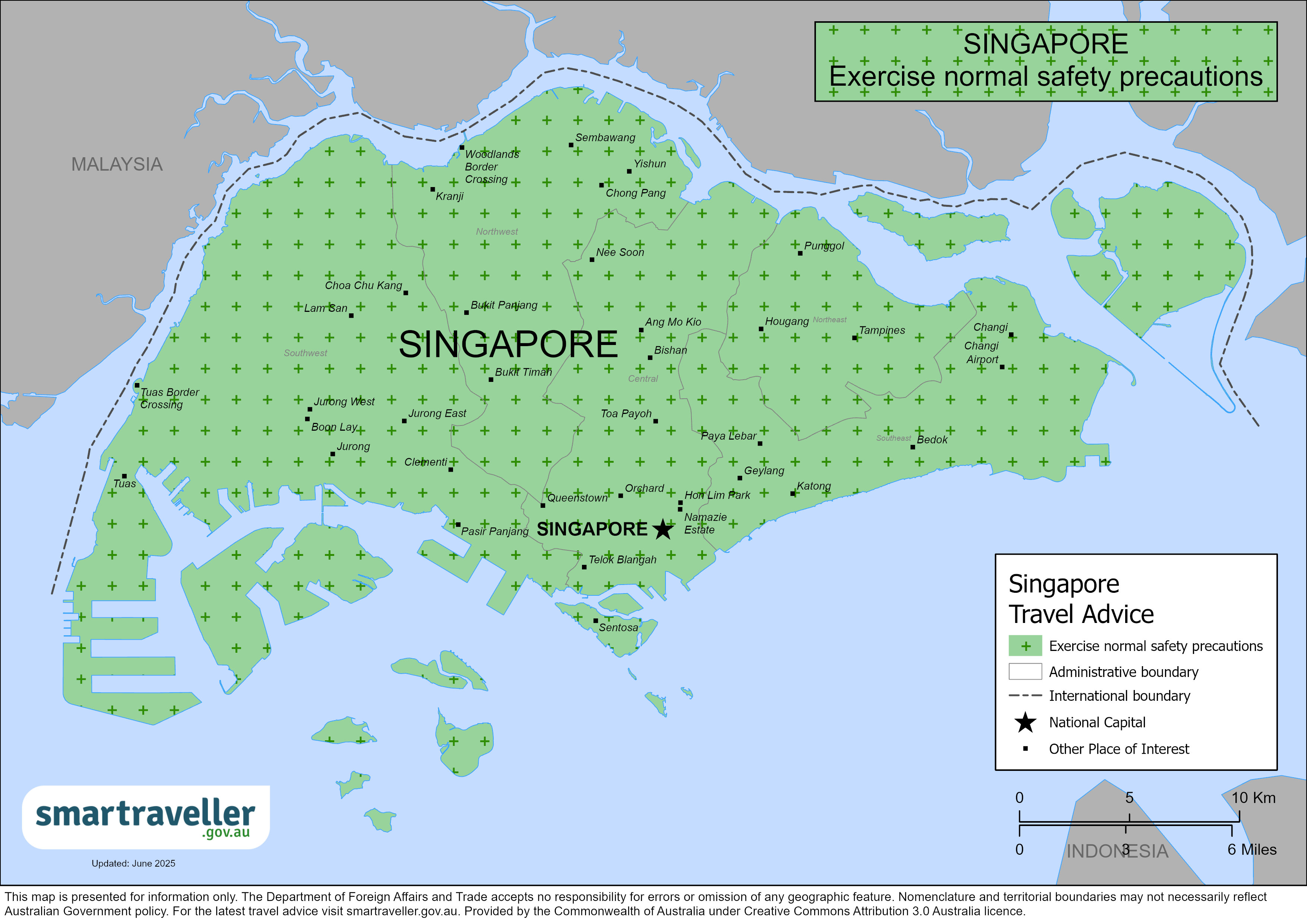
Public demonstrations are only allowed at Speakers Corner in Hong Lim Park. As a foreigner, you also need a police permit to join these (unless you are a permanent resident). Penalties can be severe.
More information:
Violent crime against tourists is rare.
Pickpocketing and street theft can occur at the airport, tourist destinations, hotels and on public transport.
Watch your belongings, especially in tourist areas and on public transport.
Impersonation scams happen regularly.
Scammers are using automated voice calls or text messages or impersonating local government officials (e.g. from the Ministry of Health or Immigration & Checkpoints Authority), bank or telco staff. Calls ask for personal details and often use scare tactics (such as claiming you have committed an offence or have account issues). You should hang up immediately if the caller cannot identify themselves correctly. Always verify the information or request through official websites or call the company/department hotline before offering any personal information. Delete text messages immediately.
Property rental scams happen.
Con artists pretend to be landlords on property websites and offer fake rental properties.
To protect yourself from property scams:
Be wary of dishonest retailers of mobile phones, electrical goods and cameras.
Information about known scams is available on the Scam Alert website.
If you live in Singapore, go to the Consumers Association of Singapore to lodge a complaint.
Kidnapping can happen anywhere, anytime, including in destinations that are typically at lower risk.
The Australian Government’s longstanding policy is that it doesn’t make payments or concessions to kidnappers.
More information:
Terrorism is a threat worldwide. Terrorist attacks could occur anywhere and at any time. Be alert to possible threats, especially in public places.
Singapore has enhanced security measures, including:
Ministers have issued public warnings about the seriousness of the terrorist threat.
The Singapore government has developed the SG Secure app to combat terrorism and alert people to security or other threats.
Possible terrorist targets include businesses and public areas popular with travellers and places associated with the Singapore Government.
If there’s a terrorist incident, leave the area if it’s safe to do so and follow the instructions of local authorities.
More information:
Singapore experiences extreme weather, including severe rainstorms.
The Singapore government's myENV app provides updated weather information and advice on other situations, such as flash floods and earthquakes.
The monsoon seasons are from December to March and June to September. Strong winds and heavy rain happen.
If there's a natural disaster:
Earthquakes in the region can affect Singapore.
Singapore is a major flight hub. Natural disasters in other parts of the world may affect flights. These include volcanic ash plumes.
Contact your airline or travel agent for flight updates.
If you become mentally unwell and become a public nuisance or a danger to yourself or others, you could be detained and hospitalised to receive psychiatric treatment. You may not be able to leave treatment until you are well again or can have someone collect you from the hospital.
Strict rules control the ingredients/composition of medication. Some medications, including ones for ADHD and prescription pain medication, need prior approval before being brought into Singapore. Medicinal marijuana is not permitted. Check the Singapore Health Sciences Authority for a list of controlled substances, including how to apply for approval at least 10 working days before you arrive.
You don't need pre-approval if you don't leave the airport transit zone (without clearing Singapore immigration).
You are not allowed to bring in any chewing gum (including nicotine gum), as well as personal medication that contains prohibited substances, even if you remain within the airport transit zone while travelling through Singapore.
Cannabis, products containing cannabis extracts and cannabis products are not permitted, even in transit. It is illegal to have cannabis or other illegal drugs in your system, even if consumed outside of Singapore. If you take prescribed medicinal cannabis, you should contact the Singapore Health Science Authority to review your situation and consider alternate travel arrangements before you travel.
More information:
To prevent the spread of infectious diseases, you may be subject to medical screening on arrival, including temperature or health checks.
There is some spread of Zika virus. There's no vaccination for it.
If you're pregnant:
Outbreaks of other insect-borne illnesses can happen. These include:
The risk of insect-borne illnesses increases during the wetter months, from December to March and June to September. Follow the National Environment Agency's advice for preventing and identifying dengue and Zika infection. Dengue fever is endemic.
Areas are regularly 'fogged' to stop the spread of insect-borne illnesses. The 'fog' includes toxic chemicals. Don't travel to areas during and/or straight after fogging.
To protect yourself against illness:
Ask your doctor about health risks and vaccines before you go.
More information:
Smoke haze may occur from June to October.
Check for haze and any health warnings the Singapore Government issues. Get medical advice if needed.
Singapore's National Environment Agency gives updates when smoke haze happens. It also has information about public health issues.
There’s no agreement between Australia and Singapore for free healthcare. Tourists must pay for all medical care, even if they need to stay in hospital or be evacuated. This can be very expensive. Make sure your travel insurance covers you. The Australian Government won't pay for these costs.
The standard of medical facilities and care is similar to or higher than Australia.
The cost of medical services is much higher. Get travel insurance before you travel and ensure it covers medical costs and medical repatriation.
You may need to provide up-front payment or a letter of guaranteed payment from your insurer before receiving treatment.
Shoplifting is a serious crime, including for low-value items. You can be sent to jail for a wide range of offences including shoplifting, drink driving and ‘outrage of modesty’.
If you commit a crime and leave before you're caught, you may be arrested and charged the next time you arrive in or transit through Singapore.
Jail sentences will result in the cancellation of your visa/employment pass, and you will be deported from Singapore after you have served your sentence. Your travel plans could be disrupted, and your travel insurance might not cover you. Lawyers are expensive in Singapore. There are some public defence lawyers but only for eligible low-income Singapore nationals and permanent residents.
If you're arrested, authorities may detain you while police investigate. You, including minors, can be legally detained for up to 48 hours, during which time you may not be allowed to speak with anyone, not even a lawyer or the High Commission. The Police are not required to notify anyone of your arrest during this period, including the High Commission. These laws also apply to minors.
Police confiscate your passport if you're under investigation. There is no set timeline for investigations, which can take several weeks or months. For serious offences, investigations and court proceedings can take years. You won't be allowed to leave Singapore until the investigation is completed. You can't get a replacement passport until legal matters are settled. You must be able to support yourself financially during this time.
Drugs are illegal. The penalties for use, possession or trafficking are severe, including the death penalty. It's illegal to have drugs in your system. This includes traces being found in blood, urine and hair tests.
Penalties are severe for drug offences and include the death penalty and caning.
You can be charged for consuming drugs even if you took them outside Singapore and, regardless of if you took them in a country where it was legal to do so.
There have been reports of drug-laced vapes circulating in Singapore. Penalties for possession or trafficking of drug-laced vapes may include imprisonment and caning.
Do not bring medicinal cannabis to Singapore, even during transit. If you take prescribed medicinal cannabis, always carry a letter from your doctor, and you should contact the Singapore Health Science Authority to review your situation.
More information:
Serious crimes, such as drug trafficking, murder, abduction, firearm and weapons offences, can attract the death penalty.
Corporal punishment involving caning is regularly practised. This is a penalty for crimes such as:
Singapore has strict laws regarding 'outrage of modesty' (also known as molestation) and 'insult of modesty.' It is important to avoid any actions that could be interpreted as such.
Penalties include jail, fines, and caning.
Drunk and disorderly conduct in public is an offence.
You could be arrested for:
Penalties include jail, fines, and caning.
Singapore has strict laws and penalties for things that are legal or are minor offences in Australia.
These include:
You are not allowed to bring in any chewing gum (including nicotine gum) even if you remain within the airport transit zone while travelling through Singapore.
Penalties are severe for crimes that affect social, racial or ethnic harmony. These include racial insults and promoting ill-will and hostility between different races or classes.
If you want to speak publicly on racial, communal, religious or political topics, you must apply for a Miscellaneous Work Pass from the Ministry of Manpower.
Serious penalties, including detention or jail, apply for these illegal activities:
Liquor control zones include specified areas in Geylang and Little India. Additional restrictions apply on weekends and public holidays.
Material that is legal in Australia may be illegal. Serious penalties apply, including detention or jail, for bringing:
If you are or have been a Singaporean permanent resident or a dual Australian-Singaporean national under the age of 21, or either of your parents are or have been Singaporean permanent residents or Singaporean nationals when you were a child, know your obligations regarding national service requirements before deciding to travel to, transit through or live in Singapore. There have been instances of people visiting Singapore years after living overseas, being arrested on arrival for not completing national service requirements. Renouncing your citizenship or permanent residency may not result in national service requirements being waived.
If you're a dual national or want permanent residency, know the national service requirements before deciding to travel to, transit or live in Singapore. Failure to complete national service may result in penalties, including custodial sentences.
If you fall into any of the categories above, are already in Singapore and intend to leave for an extended period of time, you may wish to seek legal advice on any possible exemptions you may need to obtain prior to departure.
See Central Manpower Base (CMPB) National Service and OneNS - National Service for further information or seek legal advice before you travel.
Same-sex relationships have been decriminalised, however the law does not recognise same sex partners or marriage. This extends to how same-sex partners are treated under Singapore's visa and immigration policies.
You should be aware of local sensitivities. Behaviour standards are conservative, and public displays of affection may offend.
More information:
Serious penalties, including detention or imprisonment, apply for these illegal activities:
If you're working in Singapore, your work pass may be cancelled if you break the law.
More information:
Behaviour standards are conservative.
Public displays of affection may offend.
When eating at food stalls, locals will "chope" a table by placing an item such as a tissue packet or an umbrella to reserve the table while they are collecting their food. After eating, be sure to tidy your table and return your food tray to a return station. It is against the law not to do so.
Take care not to offend. If in doubt, seek local advice.
Singapore doesn't recognise dual nationality for people aged over 21 years. If a Singaporean national voluntarily acquires citizenship of another country, they are required to renounce their Singaporean nationality. Failure to do so can lead to penalties such as fines and imprisonment.
Male nationals and permanent residents between the ages of 16 and 50 must do 2 years of national service. They must also do further training after completing national service.
If you are or have been a Singaporean permanent resident or a Singaporean national under the age of 21, or either of your parents are or have been Singaporean permanent residents or a Singaporean national when you were a child, know your national service obligations.
More information:
In most circumstances, such as tourism, travel for business meetings or conferences, Australian passport holders do not require a visa for stays up to 90 days. Other passport holders should check with the Singapore Immigration and Checkpoint Authority if they need a visa to enter Singapore. ICA | Check if You Need an Entry Visa
At immigration, you may have to show:
Entry and exit conditions can change at short notice. Contact the nearest high commission, embassy or consulate of Singapore for details about visas, currency, customs and quarantine rules.
If you breach your visa conditions or overstay your visa, authorities may fine, detain, cane and/or deport you.
You'll need to apply for a visa to be employed or study in Singapore. Check work visa information with the Ministry of Manpower.
On arrival, you'll need to show:
More information is available on the ICA | Entering, Transiting and Departing website.
Be careful of scam websites imitating official Singapore Arrival Card website.
See Changi Airport website for more information on transiting.
Do not bring medicinal cannabis to Singapore, even during transit. If you take prescribed medicinal cannabis, you should contact the Singapore Health Science Authority to review your situation.
Check flight schedules directly with your airline. Confirm your arrangements with your airline or travel agent before travelling.
Expect to be screened during your transit. You may be security screened when boarding your flight to Singapore and before boarding your connecting flight. See Changi Airport website for further information on transit requirements.
Check the Immigration & Checkpoints Authority website or Changi Airport for the latest advice.
It's illegal to enter the transit area of Singapore’s Changi Airport for any purpose other than departing Singapore on a flight.
You may need to scan your thumbprints each time you arrive and depart Singapore. Children aged under 6 years don't need to.
The official currency is the Singapore Dollar (SGD).
You can easily exchange Australian dollars for SGD in Singapore.
You must declare amounts over SGD20,000 or the same amount in foreign currency on arrival. This covers all forms of currency, not only cash.
ATMs are available across the country. Hotels, restaurants and shops accept international credit cards.
Food stalls known as 'hawker centres' and small retailers may not accept credit cards. Cash may be required.
More information:
To drive, you must be at least 18 years old and have an Australian driver's licence (digital driver's licences may not be accepted) and an International Driving Permit (IDP).
If you stay longer than 12 months, you'll need a Singaporean licence.
If you're a permanent resident, get a Singaporean licence within 3 months of getting residency.
More information:
Road conditions and driving practices are similar to those found in Australian capital cities.
More information:
You need a licence to drive a motorcycle.
Check if your travel insurance policy covers you when riding a motorcycle.
Always wear a helmet.
Safe, metered taxis are available from official taxi ranks.
Rideshare services are legal and widely used.
Always be respectful to taxi drivers. Penalties for swearing or assaulting drivers can be severe.
Singapore's efficient rail network Mass Rapid Transit (SMRT) runs throughout the island between 5:30am and midnight.
There's also a large network of public and private bus services.
More information:
Piracy occurs in the coastal areas around Singapore.
If you're travelling by boat, take safety precautions.
More information:
Check Singapore's air safety profile with the Aviation Safety Network.
More information:
Depending on what you need, contact your:
Call 995.
Call 995 or go to the hospital.
Call 999.
Always get a police report when you report a crime.
Your insurer should have a 24-hour emergency number.
The Australian Government aims to provide high quality consular assistance. There are limits to what we can do. Read the Consular Services Charter to understand how we can assist you overseas.
For consular assistance, contact the Australian High Commission in Singapore.
25 Napier Road
Singapore 258507
Phone: +65 6836 4100
Website: singapore.highcommission.gov.au
Email: consular.singapore@dfat.gov.au
Facebook: Australia in Singapore
X: @AusHCSG
Check the High Commission website for details about opening hours and any temporary closures.
In a consular emergency, if you can't contact an embassy, call the 24-hour Consular Emergency Centre on:
Be the first to know official government advice when travelling.