Fire and rescue services
Call 101.
Medical emergencies
Call 102 for an ambulance or go directly to the hospital.
Police
Call 100 or visit the nearest police station

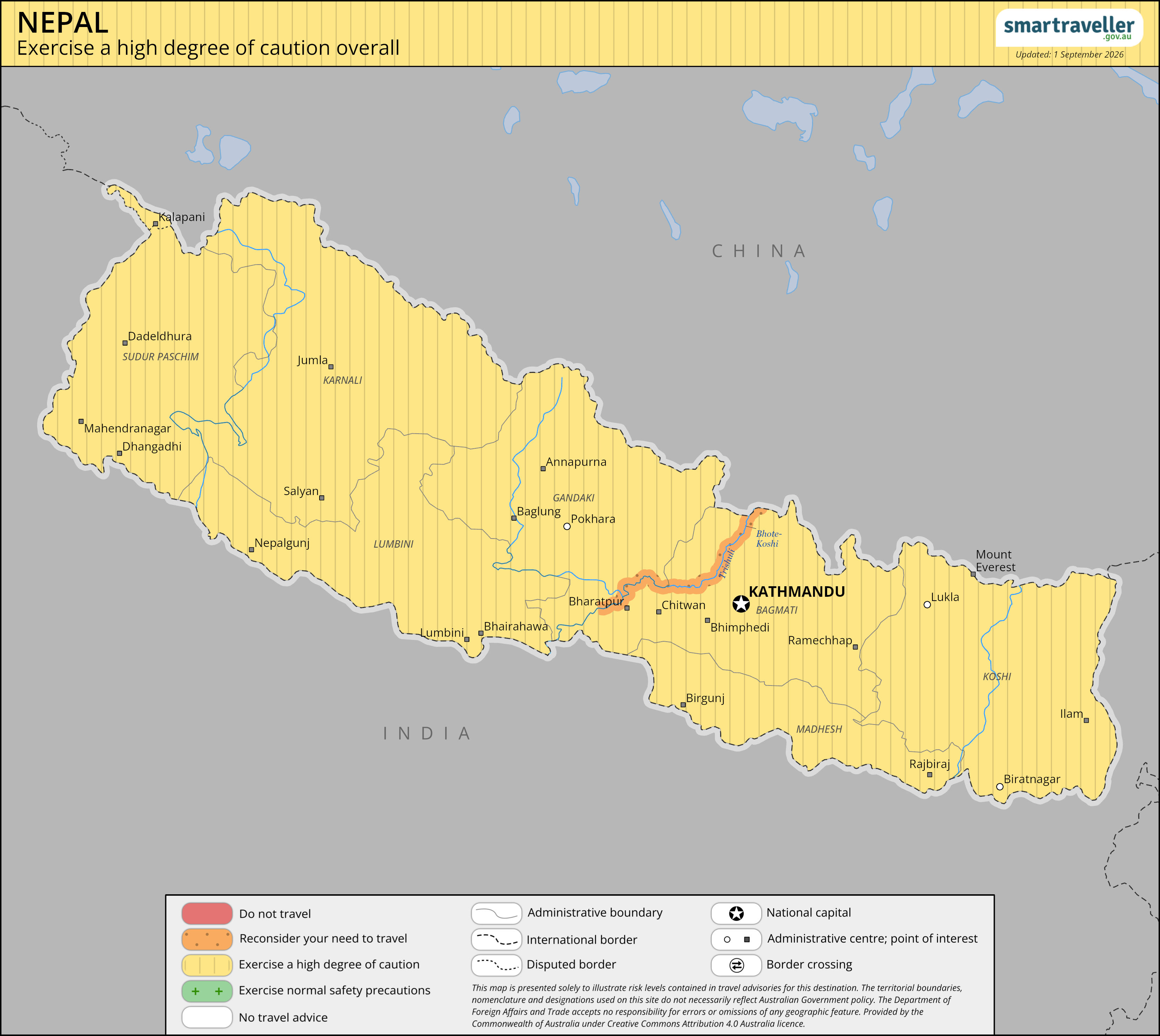
Reconsider your need to travel to flood affected areas in the vicinity of the Bhote-Koshi and Trishuli rivers in Rasuwa, Nuwakot, Dhading, Chitawan, Tanahu, Nawalpur and Gorkha Districts, due to the risk of landslides and further flooding.
Full travel advice: Safety
Full travel advice: Health
Full travel advice: Local laws
Full travel advice: Travel
Full travel advice: Local contacts
Calls for protests, strikes and demonstrations sometimes occur. Violent clashes between protesters and authorities can occur. Avoid visiting government buildings during political unrest.
During protests, strikes, demonstrations or political unrest:
Nepal blocked then reinstated access to certain social media platforms, including Facebook, Messenger and WhatsApp, in September 2025. If you lose contact with a relative or friend who's in Nepal, try alternative means such as phone, text, email or other social media platforms such as Viber.
A small number of incidents involving low-yield Improvised Explosive Devices (IEDs) have occurred, often associated with political events, such as election periods. These attacks have caused deaths and serious injuries. Physical confrontations between rival political organisations can also occur.
These incidents usually don't target travellers, but you could get caught up in violence aimed at others.
Threats have been made against religious organisations. This includes schools.
Illegal roadblocks and enforced national or local strikes can occur. These happen without notice and continue for long periods.
Road travel can be dangerous. Protesters may forcibly stop vehicles, including taxis, or target them with projectiles.
Travel services may also be affected. This includes travel to trekking areas and outside of the Kathmandu valley.
More information:
Pickpocketing and petty theft sometimes occur, especially:
Bag-snatching and 'snatch-and-grab' attacks by thieves riding motorcycles occur. Victims are often injured.
Police have an increased presence in Thamel and Durbar Marg to reduce crime in these areas.
To reduce your risk of petty crime:
Travellers have been victims of armed robberies and assaults, including sexual assaults.
Kidnapping can happen anywhere, even in places that seem safe.
The Australian Government’s longstanding policy is that it doesn’t make payments or concessions to kidnappers.
More information:
Victims of sexual assault often have their drinks 'spiked' before the assault. This happens in popular areas of Kathmandu and Pokhara.
Women are at particular risk, especially when alone and at night.
Terrorism is a threat worldwide. Terrorist attacks could occur anywhere and at any time. Be alert to possible threats, especially in public places.
Possible targets include:
To stay safe:
If there’s a terrorist incident, leave the area if it’s safe to do so and follow the instructions of local authorities.
More information:
Businesses may not meet Australian safety or maintenance standards, including transport and tour operators, as well as adventure and water sports providers for activities such as trekking, paragliding, rafting or kayaking. Research providers carefully, follow all safety instructions, and ensure activities and services are appropriate for your needs, abilities and experience.
Paragliding accidents have caused serious injuries and deaths. Rivers can be unpredictable and dangerous, even for experienced kayakers and rafters.
Mountaineering can be dangerous. Some mountaineering expedition companies may hire inexperienced guides and save on other costs in order to offer cheaper prices, including to climb Mount Everest. Carefully check a company's credentials and experience before you book.
Don't assume your travel insurance covers adventure or high-risk activities. Check your policy carefully, as you may not be covered for medical treatment, evacuation or other costs.
If you plan to do an adventure activity:
If proper safety equipment isn't available, use another provider.
You may require a permit for trekking and mountaineering in certain areas. Permits help authorities locate trekkers in case there's an emergency. You may also need to pay entry fees to enter national parks.
Confirm requirements through:
Special regulations apply to mountaineering expeditions. All expedition members must have permits.
Some trekking companies or guides may offer condensed treks. This is to attract travellers with limited time or budgets.
Find out how long you need to safely complete your trek, especially at high altitudes.
A safe round-trip trek to Everest Base Camp should take 12-14 days from Lukla. Lukla is the start and end point of treks in the Everest region.
Shorter treks may not give you enough time to get used to high altitude. This may cause excessive physical strain and lead to significant health problems or death. See Health.
Make sure you have travel and medical insurance that covers:
Hire a trekking company with a good reputation and professional guides.
Don't trek alone. Solo foreign trekkers are required to have a licensed trekking guide.
Before you travel, check:
Be ready to change your plans.
For more information on trail conditions, check the Himalayan Rescue Association.
Let family or friends know about your plans. Tell them how long your trek will take and your route.
Sometimes trekkers are pressured into taking expensive helicopter evacuations. This can happen at the first mild signs of ill health, without having had a proper medical consultation.
In such cases, insurance companies have previously declined to pay for the evacuation. The trekker must then pay the cost.
Some people have reported cases of dishonest trekking guides deliberately serving contaminated food or water. The aim was to make travellers sick to justify their evacuation.
Individuals who arrange helicopter evacuations sometimes falsely claim to have checked with a trekker's insurance company.
Some travellers have been encouraged to provide false or misleading information to insurance companies about an evacuation.
If you become ill while trekking, confirm if your insurance covers evacuation costs. Do this yourself, if possible, before you agree to a helicopter evacuation.
Telecommunications facilities are limited and can be unreliable, especially outside major cities and towns.
Mobile phone coverage doesn't exist in many rural and remote areas.
Electricity supplies can be unreliable, including in Kathmandu. Unreliability increases during winter and in the lead up to the monsoon season.
Shortages of essential supplies can happen with limited notice especially in remote and high-altitude areas. Essential supplies include:
Shortages can affect businesses, including hotels and guesthouses.
Nepal experiences natural disasters, and extreme weather. Nepal experiences earthquakes, landslides, floods and severe weather.
Major natural disasters can lead to:
Be prepared for a major emergency. Keep an emergency kit that includes:
Know where your travel documents are kept, including your passport.
If a natural disaster occurs:
Register with the Global Disaster Alert and Coordination System to receive alerts on major disasters.
Nepal is in an active earthquake zone. Earthquakes and tremors are common and can cause further damage to already weakened structures.
Landslides and floods resulting in deaths occur regularly. This happens especially during the monsoon season, from June to September.
Major roads and all trekking areas can be affected.
Avalanches can happen at any time of year.
Storms and blizzards can occur with little or no warning, especially in the Himalayas.
More information:
Also, check your insurance policy covers the altitude you'll reach and altitude sickness.
We don't provide a comprehensive list of health risks, diseases or outbreaks for every destination. Before you travel, check the latest health advice from the Australian Centre for Disease Control (CDC) and the World Health Organisation (WHO).
Air quality varies. Some areas, including Kathmandu, experience high levels of seasonal smog and pollution, especially from February to April.
Get medical advice if you're worried about air pollution.
More information:
If you travel to an area higher than 2,500m you might develop altitude sickness.
Altitude sickness can be deadly. It can affect anyone, even if you're very physically fit.
Your risk of altitude sickness increases if you:
If you'll be travelling above 2,500m, get advice from your doctor before you travel.
Malaria is a risk in:
Other insect-borne diseases are becoming more common, including in some areas of Kathmandu. These diseases include:
To protect yourself from disease:
HIV/AIDS is common.
Take precautions if engaging in activities that expose you to the virus.
Waterborne, foodborne, parasitic and other infectious diseases are common. These include:
Serious outbreaks sometimes occur.
Highly contagious eye problems, such as conjunctivitis, are common after the monsoon season.
To protect yourself from illness:
Get medical advice if you have a fever or diarrhoea.
Animals may carry rabies. If a dog, monkey or other mammal bites you:
Ask your doctor about health risks and vaccines before you go.
More information
Medical facilities and ambulances are very limited, especially outside Kathmandu. Hospitals can be crowded and may lack equipment and medicines.
There’s no agreement between Australia and Nepal for free healthcare. Tourists must pay for all medical care, even if they need to stay in hospital or be evacuated. This can be very expensive. Make sure your travel insurance covers you. The Australian Government won't pay for these costs.
In Kathmandu, treatment at high-standard clinics is expensive. Up-front payment is usually needed.
In tourist areas, it's common to be offered to buy drugs.
Penalties for drug offences are severe. Even if you're found with small quantities, authorities can convict and jail you.
More information:
Commercial surrogacy has been illegal since 2015.
More information:
Australian and Nepalese authorities are committed to combating child sex offences. Penalties are severe under both Australian and Nepalese law.
You can be punished either in Nepal or at home under Australian law. Penalties for having sex with anyone younger than 16 years include long jail times.
It's illegal to take photos or videos of:
It's illegal to seek to convert people from their religion. Punishment can include jail.
If authorities suspect you're trying to convert people, you will likely be deported and banned from re-entering Nepal for years.
Same-sex relationships are legal and Nepali LGBTQIA+ people actively advocate for their rights. However, Nepal is a conservative and traditional society, and travellers have reported harassment and discrimination.
Avoid public displays of affection.
More information:
Nepal doesn't recognise dual nationality.
If you're a dual citizen, this limits the consular services we can give if you're arrested or detained.
Always travel on your Australian passport.
More information:
Dress codes are relaxed in tourist areas of Kathmandu and Pokhara. Other parts of the country are more conservative.
Dress modestly to avoid offending locals, especially at religious sites and in rural areas. If in doubt, seek local advice.
You need a visa to enter Nepal. Visas on arrival are available, but travellers should check with the nearest Nepal Embassy for details and conditions.
You need a valid visa in your passport to leave Nepal.
Australians in Nepal may be able to extend their visas. Please consult Nepal's Department of Immigration for updates.
You must have a valid visa in your passport to leave Nepal.
If your visa has expired, extend it at the Department of Immigration before you leave.
If you overstay your visa, authorities can detain you until you pay a fine. The amount of the fine is based on the number of days you overstayed.
Entry and exit conditions can change at short notice. Contact the nearest embassy or consulate for details about visas, currency, customs and quarantine rules.
If you get an emergency passport, you must also transfer your visa to your new passport before leaving Nepal.
To do this, present the following to the Department of Immigration:
The local currency is the Nepalese Rupee (NPR).
Declare all amounts of cash over $US5,000 or equivalent on arrival and departure.
You can change foreign currency for NPR at banks or foreign exchange counters at the airport and in major tourist hubs. You cannot exchange NPR outside Nepal.
Credit cards are accepted at major hotels and commercial places.
ATMs are not common in remote places. Carry enough cash to cover your needs.
The monsoon season generally occurs from June to September but can be unpredictable.
Expect travel disruptions and be prepared to change your plans.
Road travel can be dangerous, including in the low-lying Terai (plains), where the risk of flooding is higher.
Landslides are common in mountainous areas, including the Kathmandu valley.
Airports may close. Air travel disruptions are common.
Monitor Nepal weather information for up-to-date information on conditions. Contact your travel provider about possible disruptions to your travel plans.
Some of Nepal’s land border checkpoints are open to foreign nationals. For information on the entry requirements for India please refer to the Smartraveller India specific travel advice.
Contact the nearest embassy or consulate of India for up-to-date information.
More information:
Generally, only travellers in organised tour groups get visas and permits for the Tibetan region of China.
If you're planning to travel to Tibet:
If you're in Nepal, contact the Embassy of the People's Republic of China in Kathmandu.
To drive, you need both:
Get your IDP before you leave Australia.
Your travel and vehicle insurance could be void if you drive without an IDP.
If you stay for longer than six months, you need a Nepali driver's licence.
The minimum driving age is 18 years.
Driving can be dangerous due to:
Road travel is more dangerous at night, especially in rural areas. Overnight bus travel is especially unsafe due to poor lighting, bad road conditions and the potential for harassment.
Landslides and flooding can damage or block rural roads. This is common during the monsoon season from June to September. Towns or areas are often cut off for days at a time.
Landslides and other disruptions can occur on the Mugling-Narayanghat highway, a section of the road between Kathmandu and Chitwan National Park, and the Prithvi Highway, the road between Kathmandu and Pokhara.
Road travel can be disrupted due to:
Significant delays on major roads within cities and towns, as well as on highways, are common.
Open drains and uncovered manholes are a risk to pedestrians and cyclists.
Nepal law requires those involved in accidents to remain at the scene, but only if it is safe to do so.
Locals often assume foreigners are at fault in car accidents, regardless of the situation. They may demand money. Crowds of onlookers can gather quickly after an accident and may turn hostile.
Car accidents resulting in injuries often lead to confrontations and road closures. Violence against drivers also happens.
If you plan to drive:
If you're involved in a traffic accident and are worried about your safety:
The police often consider larger vehicles at fault over smaller vehicles and pedestrians. If the police determine that you're at fault, you'll be expected to pay for medical and vehicle repair costs.
More information:
Check if your travel insurance policy covers you when using a motorbike, quad bike or similar vehicle.
Always wear a helmet. Helmets bought in Nepal may not meet Australian safety standards.
Taxis are readily available during the day, but far less in the evening. They often don't have rear seat belts.
Taxis are often unmetered and drivers may overcharge travellers. Negotiate a fare with the driver before the trip.
For travel in Kathmandu valley, online ride hailing taxi services such as Uber, Pathao or inDrive, advise of maximum fares up front. Expect to pay cash, even if booking through an app.
Travel on public buses and vans is dangerous. These vehicles are overcrowded and poorly maintained.
There are frequent accidents with multiple deaths involving intercity buses.
Accidents involving private hire cars and jeeps travelling between cities regularly occur and can cause injuries or death. If you are concerned, ask your driver to slow down and drive safely.
Women may be harassed, including sexually, on public buses.
More information:
In normal circumstances, cancellations and delays are common, especially during:
Weather conditions and aviation safety standards may differ from Australia. There have been several air accidents in Nepal in recent history. Research air transport providers carefully, monitor weather conditions and follow all safety instructions.
Bad weather conditions in mountainous and hill regions could further increase the risk to your safety and cause lengthy delays.
Airfields such as Lukla's, in the Solukhumbu (Everest) region, are among the most remote and difficult to land on. These airfields are challenging for even the most technically proficient pilots and well-maintained aircraft.
All carriers from Nepal have been refused permission to operate air services to the EU due to safety concerns.
Check Nepal's air safety profile with the Aviation Safety Network.
More information:
Depending on what you need, contact your:
Call 101.
Call 102.
Call 100.
If you are outside Kathmandu, call the tourist police headquarters in Kathmandu on 01-4247041. They will direct you to the nearest tourist police office.
Always get a police report when you report a crime.
Your insurer should have a 24-hour emergency number.
The Australian Government aims to provide high quality consular assistance. There are limits to what we can do. Read the Consular Services Charter to understand how we can assist you overseas.
For consular assistance, contact the Australian Embassy in Kathmandu.
The Embassy in Kathmandu provides consular, passport and notarial services by appointment only.
300 metres north-east of Narayan Gopal Chowk (Ring Road)
Bansbari, Kathmandu
Phone: +977 1 437 1678
Email: austembassy.kathmandu@dfat.gov.au
Website: nepal.embassy.gov.au
Facebook: Australian Embassy, Nepal
X: @AusAmbNP
Check the Embassy website for details about opening hours and any temporary closures.
In a consular emergency, if you can't contact an embassy, call the 24-hour Consular Emergency Centre on:
Be the first to know official government advice when travelling.