Fire and rescue services
Call 101.
Medical emergencies
Call 103 or go straight to the hospital.
Police
Call 102 or go to your local police station.

Call 101.
Call 103 or go straight to the hospital.
Call 102 or go to your local police station.
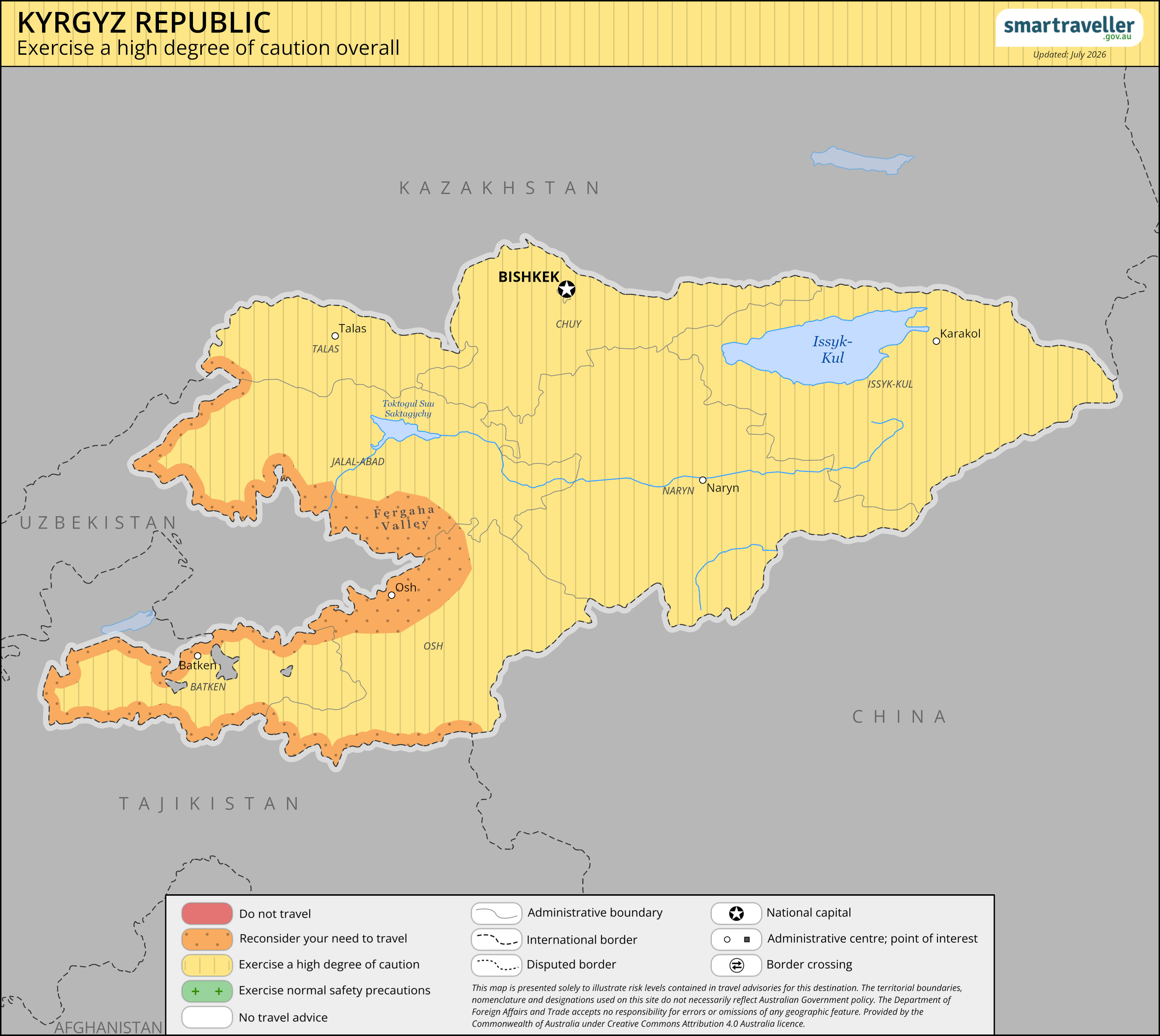
Exercise a high degree of caution in Kyrgyz Republic overall.
Exercise a high degree of caution in Kyrgyz Republic overall due to the risk of civil unrest and the threat of terrorism and violent crime.
(See Safety).
Reconsider your need to travel to the Kyrgyz-Uzbek border area, the Kyrgyz-Tajik border area, and Ferghana Valley.
Reconsider your need to travel to:
due to the security situation including the threat of terrorism and violent crime and the risk of civil unrest and landmines.
See Safety.
Full travel advice: Safety
Full travel advice: Health
Full travel advice: Local laws
Full travel advice: Travel
Full travel advice: Local contacts
Terrorism is a threat worldwide. Terrorist attacks have occurred in the Kyrgyz Republic. Targets include public transport and transport hubs and places popular with foreigners. Terrorist attacks could occur anywhere and at any time.
To stay safe:
If there's an attack, leave the area as soon as it's safe.
If there’s a terrorist incident, leave the area if it’s safe to do so and follow the instructions of local authorities.
More information:
Demonstrations occur regularly in Bishkek and elsewhere across the country and can turn violent without warning. Avoid large crowds and any demonstrations and follow the advice of local authorities.
In March 2025, Tajik, Uzbek and Kyrgyz authorities reached an agreement on their shared borders. Even though there's an agreement, tensions could arise in border areas and the security situation can change at short notice.
Violent crime and civil unrest can occur. There are frequent reports of terrorist activity.
There have been clashes between security forces and militant and criminal groups.
Security forces from the Kyrgyz Republic, Uzbekistan and Tajikistan monitor border areas and often conduct operations there.
If you plan to travel to those regions, read the travel advice for Uzbekistan and Tajikistan.
Landmines are a risk in the Kyrgyz-Uzbek, Kyrgyz-Tajik border areas and Batken Oblast near the Kyrgyz-Tajikistan border.
Crime, including violent crime, occurs often.
Criminals can target foreigners.
The risk of crime increases at night.
Thieves may target you by posing as:
If you think someone is posing as a police officer or official, offer to go with them to the nearest police station. Once there, you can verify their identity and their demands.
Foreigners can get caught up in violent clashes between criminal groups.
If you get into a dispute with locals, it might result in:
To reduce your risk of becoming a victim of crime:
When using taxis:
There have been cases of unauthorised withdrawals after people have used ATMs or EFTPOS machines.
To reduce your risk:
Kidnapping can happen anywhere, even in places that seem safe.
Kidnapping, pickpocketing, muggings and robberies occur in the Kyrgyz Republic. Incidents have been reported near hotels, on public transport and in crowded places, especially where expats gather.
The Australian Government's longstanding policy is that it doesn't make payments or concessions to kidnappers.
More information:
Public protests and events that draw large groups of people can turn violent.
To keep safe:
More information:
The Kyrgyz Republic can experience natural disasters and severe weather.
There's a high risk of earthquakes. Tremors are frequent.
Avalanches and landslides are common in mountainous areas.
People have died in snow-related accidents in recent years, including:
If a natural disaster occurs:
If you plan to bring medication, check if it's legal in the Kyrgyz Republic.
Make sure your prescription and the letter from your doctor are translated into Russian.
Declare all medicine on arrival. Even with a prescription, you could face charges if you either:
More information:
Insect-borne diseases are common, including:
To protect yourself from disease:
Waterborne, foodborne and other infectious diseases occur. They include:
Serious outbreaks sometimes occur.
To protect yourself from illness:
Ask your doctor about health risks and vaccines before you go.
More information:
There’s no agreement between Australia and the Kyrgyz Republic for free healthcare.
Tourists must pay for all medical care, even if they need to stay in hospital or be evacuated. Medical facilities in Bishkek are limited. Medical equipment and medicines are in short supply. The standard of medical services in remote areas is basic.
If you're seriously ill or injured, you could need treatment in a place with better facilities. This can be very expensive. Make sure your travel insurance covers you. The Australian Government won't pay for these costs.
If you plan to travel outside major cities in the Kyrgyz Republic, there may be extremely limited or no nearby medical care available.
Law enforcement agencies in the Kyrgyz Republic cooperate closely with agencies in other Commonwealth of Independent State (CIS) countries. If you commit an offence in one of these countries, you may be detained in another (including at the border) and extradited for prosecution.
Penalties are severe for carrying or using illegal drugs. They can include lengthy prison sentences and heavy fines. Drugs of any amount that may be legal in Australia, even in small quantities, may be illegal in the Kyrgyz Republic.
More information:
If you plan to marry in the Kyrgyz Republic, you'll need a Certificate of No Impediment to Marriage (CNI). Contact the Australian Embassy in Moscow to find out how to apply.
You'll need an apostille for Australian-issued documents.
This includes if:
Contact the nearest embassy or consulate of the Kyrgyz Republic about legalising documents.
More information:
Be aware that it's illegal to:
Always carry your passport or a certified copy. Identity checks by police are common.
The Kyrgyz Republic doesn't recognise dual nationality.
If you're a dual national, this limits the consular services we can provide if you're arrested or detained.
Always travel on your Australian passport.
More information:
Standards of dress and behaviour are conservative in the Kyrgyz Republic.
Take care not to offend. If in doubt, dress modestly and seek local advice.
Obvious displays of affection, even between married couples, can offend. Police may harass or detain you.
Same-sex relationships are legal in the Kyrgyz Republic but aren't widely accepted.
More information:
The Islamic holy month of Ramadan is observed in the Kyrgyz Republic. Respect religious and cultural customs and laws at this time.
During Ramadan, eating, drinking, and smoking may be illegal in public during the day. If you're not fasting, avoid these activities around people who are. Seek local advice to avoid offence.
Explore our Ramadan page to learn more, including dates for Ramadan.
You don't need a tourist visa to stay up to 30 days within each 60-day period from the date of entry.
In other cases, you'll need a visa.
You can apply for an e-visa (Sapar) for tourism, private and business purposes for up to 90 days.
To apply, visit the e-visa website.
Entry and exit conditions can change at short notice. Contact the nearest embassy or consulate of the Kyrgyz Republic for details about visas, currency, customs and quarantine rules.
Many flights in and out of the Kyrgyz Republic stopover in Russia. You'll need to meet visa requirements for any countries you'll transit through.
More information:
Entry requirements can change at short notice.
Contact your airline or the nearest embassy of the Kyrgyz Republic to confirm visa and entry requirements.
You will need to register your details online or in person with the State Registration Service if you stay longer than 30 days.
More information:
You may need a valid yellow fever vaccination certificate to enter the Kyrgyz Republic if you arrive from a country with yellow fever.
More information:
There are some HIV/AIDS restrictions for visitors and residents.
You'll need an HIV test to apply for a work visa.
Check with an embassy or consulate of the Kyrgyz Republic before you travel.
The Kyrgyz Republic's borders can close without notice.
Some border crossings may only open for local residents. Others may be open to some nationalities but not Australians.
Strict border controls apply on the road between Bishkek and Almaty in Kazakhstan. Expect delays at the border crossing for customs checks.
If you plan to cross any of the Kyrgyz Republic's borders, check with local authorities first. They can tell you:
If hotel staff ask to photocopy your passport, make sure they return it promptly.
Losing your passport in the Kyrgyz Republic might be costly and might delay your travel plans. You'll need to get an exit visa and a replacement passport.
The official currency is the Kyrgyzstani Som (KGS), but US dollars are widely used.
Currency controls are in place.
The economy is mostly cash-based. Only a few of the major hotels accept traveller's cheques and credit cards.
Carry sufficient cash to cover your needs. Contact your bank to ensure your Australian cards will work overseas.
The security situation in the Kyrgyz-Uzbek and Kyrgyz-Tajik border areas can be volatile. This includes the Ferghana Valley. Landmines are present (See 'Safety').
To drive in the Kyrgyz Republic, you need both:
Driving without an IDP could void your travel and vehicle insurance.
Get your IDP in Australia before you leave.
Road conditions and driving standards are poor.
Roads can be very hazardous in winter and at night.
It may be difficult to access service stations in rural areas. Diesel is often unavailable.
To stay safe on the road:
If you're planning to travel by road to Kazakhstan, read the travel advice for Kazakhstan.
Check your insurance policy covers you using a motorbike, quad bike or similar vehicle.
Always wear a helmet.
It's safest to use registered taxis and authorised limousines. Arrange them through your hotel or resort.
Taxis are often poorly maintained (See 'Safety').
Bus and trolley car services operate in Bishkek.
Minibus services operate in regional areas.
Local buses and minibuses are often poorly maintained.
More information:
Flight delays are common. Check your departure time with the airport.
In 2022, the International Civil Aviation Organisation (ICAO) issued a ‘red notice’ highlighting significant safety concerns with all Russian airlines. A number of countries, including the United States and the European Union, have banned Russian air carriers from their airspace. Should you choose to take a Russian airline, check your insurance provisions and understand the risks associated with transport by Russian airlines.
Check the Kyrgyz Republic's air safety profile with the Aviation Safety Network.
More information:
Depending on what you need, contact your:
Call 101.
Call 103 or go straight to the hospital.
Call 102 or go to your local police station.
Always get a police report when you report a crime.
Your insurer should have a 24-hour emergency number.
The Australian Government aims to provide high quality consular assistance. There are limits to what we can do. Read the Consular Services Charter to understand how we can assist you overseas.
Australia doesn't have an embassy in the Kyrgyz Republic. Contact the Australian Embassy in Moscow for consular help.
13 Kropotkinsky Pereulok
Moscow 119034
Russia
Phone: (+7 495) 956-6070
Website: russia.embassy.gov.au
X: @PosolAustralia
Telegram: https://t.me/AusEmbMoscow
In a consular emergency, if you can't contact an embassy, call the 24-hour Consular Emergency Centre on:
Be the first to know official government advice when travelling.