Fire and rescue services
Call 990.
Medical emergencies
Call 811 or 990.
Police
Call 999.
Coast guard
Call 634 4440.
Kidnapping hotline
Call 623 6793.


Call 990.
Call 811 or 990.
Call 999.
Call 634 4440.
Call 623 6793.
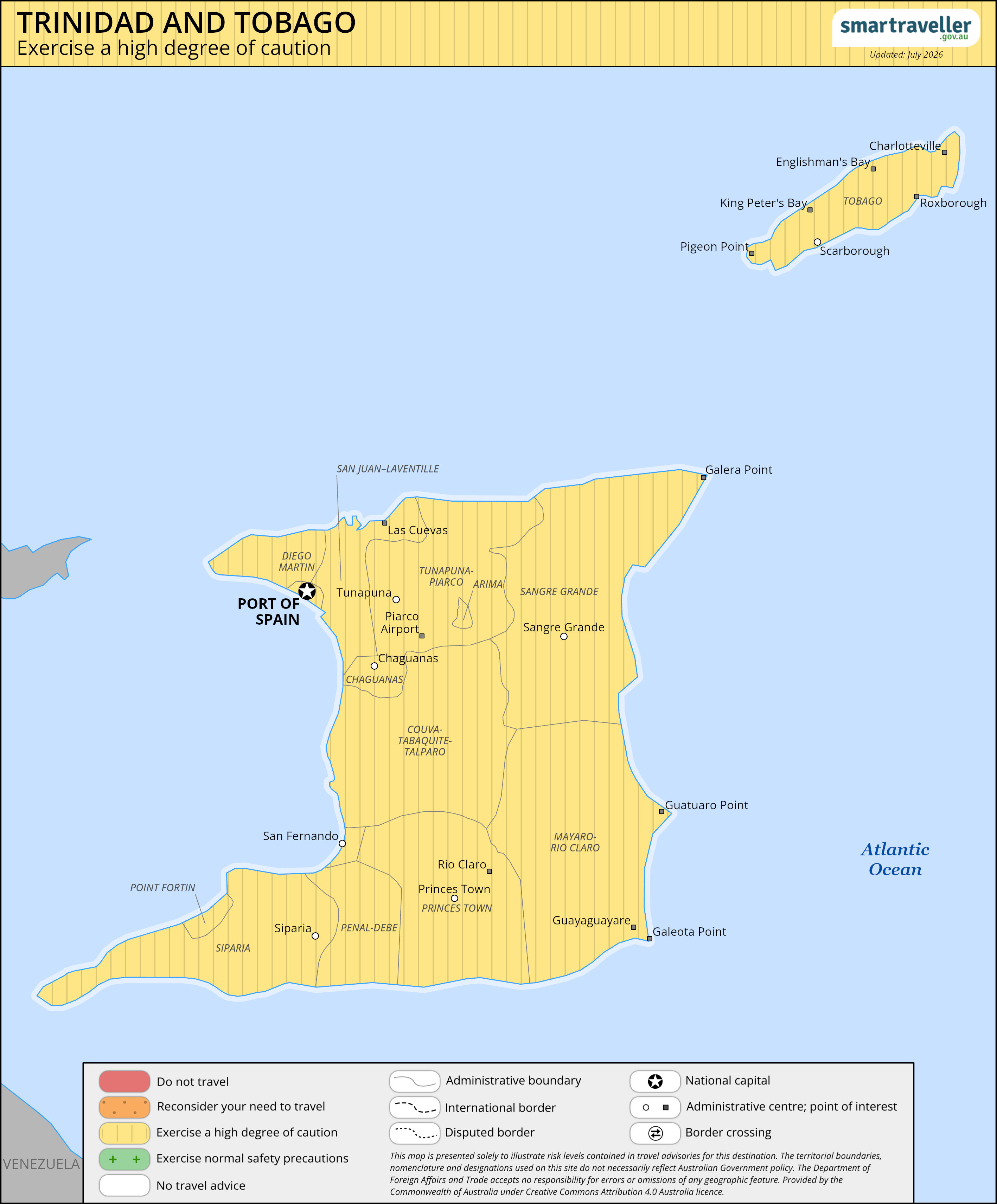
Exercise a high degree of caution in Trinidad and Tobago due to the threat of violent crime.
Full travel advice: Safety
Full travel advice: Health
Full travel advice: Local laws
Full travel advice: Travel
Full travel advice: Local contacts
Violent crime is common, including against travellers and expatriates. Incidents include:
Gang and drug-related crime is also common. Hot spots for violent crime include:
Attacks, including with firearms, have also occurred at:
To protect yourself from crime:
If you're attacked or robbed, don't resist. Criminals are often armed, and you can be seriously injured or killed.
If you're the victim of a violent crime, especially rape, get urgent medical help. HIV/AIDS is widespread in Trinidad and Tobago.
Petty crime, including bag snatching, pickpocketing and theft from cars, is common. Take care at all times.
Thefts and robberies rise in the lead-up to Christmas. This trend continues until the end of Carnival, in February or March.
To prevent theft from your vehicle:
You're at risk if you ride in a shared route or maxi-taxi. They pick up extra passengers, putting your safety at risk. Private taxis and taxis affiliated with major hotels are safer options.
Robberies, assaults and carjackings targeting travellers are common. Always drive with windows closed and doors locked. If you have car troubles, try to get to a safe location before getting help.
Hot spots include:
Gangs have followed cars leaving Trinidad’s Piarco International Airport to rob travellers at their destination.
To reduce your risk of violent crime:
Kidnapping can happen anywhere, even in places that seem safe.
The Australian Government's longstanding policy is that it doesn't make payments or concessions to kidnappers.
More information:
Financial scams are common. Be cautious if using dating apps, criminals have used apps like Grindr and Tinder to rob and assault people.
To protect yourself:
A terrorist attack could happen. Religious holidays and large crowds could be targeted.
To protect yourself from terrorism:
If there's an attack, leave the affected area immediately as soon as it's safe.
Terrorism is a threat worldwide.
More information:
Public protests and events that draw large groups of people can turn violent.
To protect yourself during periods of unrest:
More information:
Trinidad and Tobago can experience hurricanes, severe weather and earthquakes.
In a natural disaster:
If you're travelling during hurricane season or after a natural disaster:
More information:
The Caribbean hurricane season is from June to November. Tropical storms and hurricanes can occur in other months.
The direction and strength of hurricanes can change suddenly.
While hurricanes directly affecting Trinidad and Tobago are rare, severe storms and flooding are common. Landslides, mudslides and disruptions to essential services may occur.
If you're travelling during hurricane season, check if severe weather has affected tourist services.
If there's a hurricane or severe storm:
Severe weather may also affect:
To protect yourself if a hurricane is approaching:
More information:
Trinidad and Tobago is in an active earthquake zone.
Strong earthquakes can cause damage to buildings and disrupt communication networks.
Get to know the earthquake safety measures for each place you stay and visit.
More information:
If you plan to bring medication, check if it's legal with the Trinidad and Tobago Ministry of Health - Chemistry Food and Drug Division.
The rate of HIV/AIDS infection is high in Trinidad and Tobago.
Take appropriate precautions if you take part in activities that put you at risk of infection.
There is a risk of zika virus transmission.
The Australian Department of Health's zika virus bulletin includes advice on how to minimise zika virus risks.
If you're pregnant, the Australian Department of Health recommends that you:
Dengue fever is on the rise in Central America, Mexico and the Caribbean.
Other insect-borne illnesses may be present, especially during the rainy season from June to December. These illnesses include:
To protect yourself from disease:
Seek medical advice if you have a fever, muscle pain, rash or severe headache.
Foodborne, waterborne, parasitic and other infectious diseases, such as hepatitis A, are common.
Serious outbreaks sometimes occur.
To protect yourself from illness:
Seek medical advice if you have a fever or diarrhoea.
More information:
The standard of medical facilities varies.
Costs at public hospitals range from free for general problems to expensive for complicated procedures.
Treatment at private hospitals can be expensive. You may have to pay in local currency before doctors treat you.
Tobago has one decompression chamber in Roxborough in the north of the island.
You might be evacuated to Miami or another destination if you're seriously ill or injured. Medical evacuation can be very expensive.
Penalties for drug offences are severe. They can include lengthy prison sentences in local jails, even for a small quantity of illegal drugs.
Research the local laws before you travel.
More information:
Sodomy is a criminal offence punishable with a prison term of up to 5 years.
There are laws prohibiting LGBTQIA+ individuals from entering the country, but in practice these laws are rarely enforced.
Serious crimes, including murder and treason, can attract the death penalty.
Other illegal activities include:
Carrying ammunition when arriving, leaving or travelling through Trinidad and Tobago is also illegal. This includes bullets, bullet casings and spent ammunition.
You can sometimes find ammunition in decorative items, including jewellery and key rings. If you have these items on you at an airport, police may detain, charge or fine you.
More information:
If you've visited or transited the Democratic Republic of the Congo, Uganda or South Sudan, you will be subject to enhanced health screening on arrival and possible quarantine.
Trinidad and Tobago has introduced a digital Immigration and Customs form for arrival and departure. This form must be completed within 72 hours prior to travel. Visit the Immigration & Customs portal to complete the form.
You'll need an e-Visa to enter. The multiple entry e-visa fee is TTD800. Apply for your visa using the E-Visa Online Portal at least 14 business days before your travel. See the Trinidad and Tobago Immigration Division's website for more information.
If you arrive without a visa, you may be granted a visa waiver. The period of entry will be determined by the immigration officer. The visa waiver fee is TTD800 / USD134 and must be paid in cash (TTD or USD) on arrival at the airport.
Cruise ship passengers entering for less than 24 hours are considered in-transit and don't require a visa or to apply for the visa waiver program.
Entry and exit conditions can change at short notice. Contact the high commission, embassy or consulate of Trinidad and Tobago for details about visas, currency, customs and quarantine rules.
Trinidad and Tobago doesn't have a high commission or consulate in Australia. Its nearest mission is the Embassy of the Republic of Trinidad and Tobago in Beijing, China.
More information:
If you travel to Trinidad and Tobago through the US, you must meet US entry and transit requirements.
Check your visa requirements with a US embassy or consulate before travelling.
More information:
You need a yellow fever vaccination certificate for every person over 1 year of age if you've come from or transited a country with a risk of yellow fever transmission.
Find out about returning to Australia after exposure to yellow fever.
Entry and exit conditions can change at short notice.
The official currency is the Trinidad and Tobago Dollar (TTD).
You can exchange some foreign currencies but not AUD for TTD at commercial banks and official exchange bureaus.
Most international hotels and tourist facilities accept credit and debit cards.
ATMs are widely available across the country. Criminals target ATMs, so take care when using one.
Ask your bank whether your ATM card will work in Trinidad and Tobago.
To drive in Trinidad and Tobago, you need both:
You must get your IDP before leaving Australia.
Hazards include:
High-speed accidents, particularly along the Churchill-Roosevelt Highway, often result in deaths.
Conditions on rural and mountain roads are particularly hazardous.
The road from Port of Spain to the popular Maracas beach area is dangerous. Road users often drive dangerously. The road is also:
Fatal accidents have been caused by erratic driving to and from Piarco International Airport.
Security risks along several routes increase, especially at night.
It's against the law to use mobile phones while driving, except in 'hands-free' or Bluetooth mode.
Police conduct random breath tests. They can also stop traffic if they suspect a person is driving under the influence of alcohol.
If you plan to drive:
More information:
Check whether your travel insurance policy covers you when using a motorbike, quad bike or similar vehicle.
Always wear a helmet.
Private taxis are the safest taxi option. They're available at airports and hotels.
Some vehicles have 'P' (private) registration plates. These vehicles illegally offer informal taxi services.
Use the Airport Taxi Drivers' Cooperative services at the airport.
Crimes including rape, assault, robbery and theft have taken place in private cars and maxi taxis.
Avoid public transport due to safety concerns.
Cruise vessels stop in Trinidad and Tobago.
An inter-island ferry operates between Trinidad and Tobago. Cancellations can happen with little or no notice. Check the status of your travel with the Port Authority.
A water taxi operates between Port of Spain and San Fernando.
More information:
Check Trinidad and Tobago's air safety profile with the Aviation Safety Network.
More information:
Depending on what you need, contact your:
Call 990.
Call 811 or 990.
Call 999.
Call +1 868 634 4440.
Call 999.
Always get a police report when reporting a crime.
Your travel insurer should have a 24-hour emergency number.
The Australian Government aims to provide high quality consular assistance. There are limits to what we can do. Read the Consular Services Charter to understand how we can assist you overseas.
For consular assistance, contact the Australian High Commission in Port of Spain.
18 Herbert Street, St Clair
Port of Spain, Trinidad and Tobago
Phone: +1 868 235 7950
Website: trinidadandtobago.highcommission.gov.au
Email: ahc.portofspain@dfat.gov.au
Facebook: AusHighComTT
Check the High Commission website for details about opening hours and any temporary closures.
The Edghill Building, Wildey Business Park
St Michael, Barbados
Email: australianhcbarbados@gmail.com
HG Christie Office, Millars Court, Shirley and East Sts
Nassau, The Bahamas
Email: australianhcbahamas@gmail.com
80-82 Second Street, Port Bustamante
Kingston 13, Jamaica
Email: marjory.kennedy@jashipco.com
In a consular emergency, if you can't contact an embassy, call the 24-hour Consular Emergency Centre on:
Be the first to know official government advice when travelling.