Fire and rescue services
Call 999.
Medical emergencies
Call 998 or go to a hospital.
Police
Call 997 or visit the nearest police station.

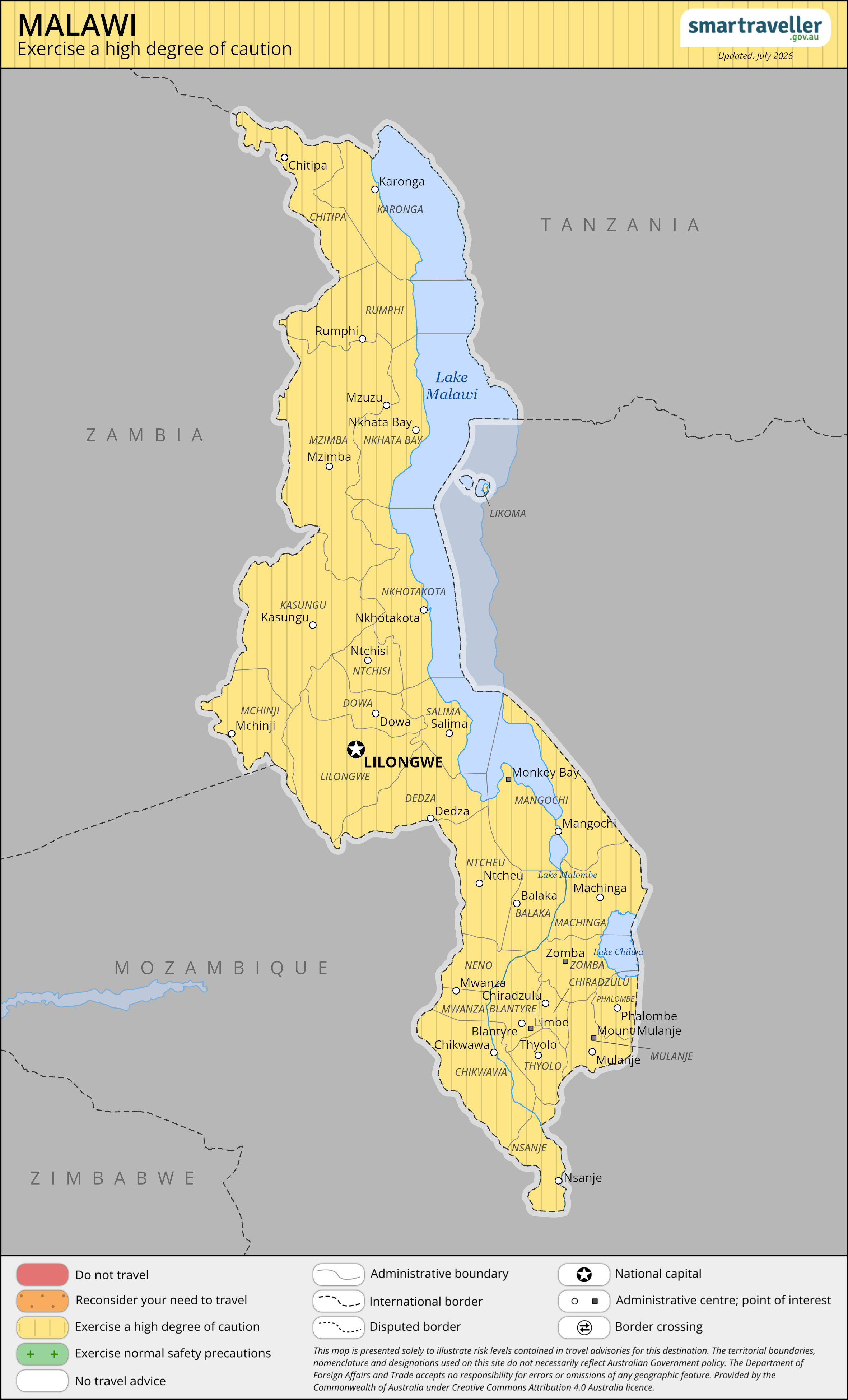
Exercise a high degree of caution in Malawi due to the threat of violent crime.
Full travel advice: Safety
Full travel advice: Health
Full travel advice: Local laws
Full travel advice: Travel
Full travel advice: Local contacts
Demonstrations and protests can happen at any time. Demonstrations and protests often take place in market and city centre areas.
Public protests and events that draw large groups of people can be unpredictable and may turn violent quickly. Avoid activities that could be considered political and stay away from protests and demonstrations.
During periods of unrest, you should:
If you come across a protest, leave the area when it's safe to do so.
More information:
Crime is common in Malawi, including on public transport and around public transport terminals.
Common crimes include:
Burglaries are common in residential areas. Criminals often carry weapons and may become violent. Lock your accommodation, even when you're in it.
There have been incidents of robbery or assault after travellers' food or drink has been spiked.
If you're a victim of violent crime, especially sexual assault, seek immediate medical help. The risk of HIV infection is high.
Throughout the country, women travelling alone may be subjected to harassment and verbal abuse. Be aware of your surroundings at all times.
Criminals are active:
To protect yourself from crime:
Carjacking is a hazard. Take care if you're driving:
To protect yourself against road-based crime:
Don't resist if your vehicle is attacked.
Kidnapping can happen anywhere, even in places that seem safe.
The Australian Government’s longstanding policy is that it doesn’t make payments or concessions to kidnappers.
More information, including advice on how to reduce your risk of kidnapping:
Terrorism is a threat worldwide. Terrorist attacks could occur anywhere and at any time. Be alert to possible threats, especially in public places.
More information:
Transport and tour operators don't always follow safety and maintenance standards.
If you plan to do an adventure activity:
If proper safety equipment isn't available, use another provider.
Paths on Mount Mulanje aren't marked. Use a registered local guide.
Before climbing Mount Mulanje, contact the Mountain Club of Malawi for safety advice.
Respect wildlife laws. Maintain a safe and legal distance when watching wildlife, including marine animals and birds.
Use well-known and professional guides or tour operators.
Follow park rules and the advice of wardens.
Malawi experiences extreme weather and natural disasters, including flooding and cyclones.
Malawi experiences earthquakes.
Get to know what to do in an earthquake.
The rainy season is from November to April and can make road travel difficult.
Flooding, including flash flooding, may occur across the country and can affect the following essential services:
transport and infrastructure - roads can become impassable
electricity supply
water and food supply
emergency services
If a natural disaster occurs:
If you're planning to visit an area that has recently suffered severe weather:
If you plan to bring medication, check if it's legal in Malawi. Take enough legal medication for your trip.
Malaria is common and occurs year-round.
Other common insect-borne diseases include:
To protect yourself from disease:
Visit a doctor if you have a fever, muscle pain, a rash or a bad headache.
The rate of HIV/AIDS infection is high.
Take steps to reduce your risk of exposure to the virus.
Outbreaks of cholera are common during the rainy season, from November to April.
Cholera is transmitted by consuming contaminated food or water. Practice safe food and water precautions. To protect yourself from illness:
There have been cases of Mpox in parts of Africa, including Malawi.
Mpox can be transmitted to humans through physical contact with an infectious person, infected animals or contaminated materials.
Maintain strict hygiene standards. Avoid physical contact with anyone who has Mpox.
See a doctor if you feel unwell and isolate from others if you develop any Mpox symptoms.
More information:
Other waterborne, foodborne and infectious diseases sometimes occur, including:
Serious outbreaks sometimes occur.
Practice safe food and water precautions and avoid contact with dogs and other mammals.
If you're bitten or scratched by an animal, get medical help straight away.
Get medical help if you have a fever or diarrhoea.
Ask your doctor about health risks and vaccines before you go.
More information:
There’s no agreement between Australia and Malawi for free healthcare.
Tourists must pay for all medical care, even if they need to stay in hospital or be evacuated. This can be very expensive. Make sure your travel insurance covers you. The Australian Government won't pay for these costs.
The standard of medical facilities is poor, especially in rural areas.
There are some private clinics in Lilongwe and Blantyre, but they may not meet Australian standards. Most doctors and hospitals require up-front cash payment.
If you feel unwell, seek medical attention early to minimise the risk of serious complications.
You face severe penalties for using or carrying illegal drugs, including cannabis. Penalties include long prison sentences in local jails.
More information:
You must always carry your passport or a copy of your passport with you.
You are legally required to:
In Malawi it's illegal to:
It's illegal to photograph:
Malawi may recognise dual nationality for adult citizens by birth or descent. Children under the age of 21 can hold dual citizenship.
If local authorities consider you a citizen of Malawi, they may refuse to grant you access to consular assistance from Australian officials if you are arrested or detained.
More information:
Some areas have modest standards of dress and behaviour. Take care not to offend.
Dress modestly. If you're a woman, wear loose clothing that covers your legs and shoulders.
Avoid public displays of affection.
Same-sex relationships are illegal in Malawi and carries harsh penalties, including up to 14 years imprisonment. Malawian society can be hostile to the LGBTQIA+ community. Avoid public attention.
More information:
Australians need a visa to enter Malawi. Fees apply. Check the Malawian Department of Immigration website for visa guidance and to apply for an eVisa. Contact your nearest Malawian diplomatic mission for more information on visa requirements.
If you want to migrate, study, work or do business in Malawi, you will need to apply for the appropriate permit. For more information, visit the Malawian Department of Immigration website, or contact your nearest Malawian diplomatic mission.
You can only cross land borders during daylight hours. Check border opening times before you cross to confirm that immigration and customs services will be available.
You are required to complete a Traveller Health Check form. This can be accessed on arrival through a QR code or completed in advance via the Ministry's online form.
You must have a valid yellow fever vaccination certificate if you're arriving from an area or country with yellow fever.
South African authorities do not accept provisional travel documents if you're transiting through South Africa. South African authorities do accept Australian emergency passports.
Strict rules apply to a child aged under 18 years travelling through South Africa.
More information:
The local currency is the Malawi Kwacha (MWK) and the economy is largely cash based.
Declare any foreign currency when you arrive and depart. This covers all forms of currency, not only cash. When you leave, authorities may take any foreign currency you didn't declare on entry.
Ask Malawian authorities for advice if you want to export currency.
The US dollar is the most easily exchanged foreign currency. Some hotels and restaurants will accept payments in US dollars.
Credit cards are increasingly accepted but it is advised to still carry cash. Before you arrive, ask your host, hotel or tour operator about the best ways to pay.
ATMs are increasingly common but they often run out of cash. Some ATMs accept some Australian cards.
Ask your bank if your credit or debit cards will work in Malawi.
To drive in Malawi, you need both:
Get your IDP before leaving Australia.
If you'll be in Malawi for an extended period, you'll need to apply for a local driver's licence.
Driving in Malawi is dangerous, particularly at night.
Hazards include:
Road accidents are a common cause of death.
Petrol and diesel shortages occur regularly. You may experience long queues at petrol stations. Plan ahead and keep a supply of fuel on hand. There are no roadside assistance organisations for stranded drivers.
Police regularly conduct breathalyser tests on drivers. Main roads have speed cameras.
Drivers caught speeding or over the 0.08% alcohol limit face immediate:
Police place roadblocks throughout the country. If stopped, you may need to show:
Before you drive:
To protect yourself while driving:
More information:
Check if your insurance policy covers you for the vehicle you intend to ride. You might need extra cover for an accident on a motorbike, quad bike or similar vehicle.
Use only registered taxis. Book them through your hotel.
There are no international app-based transport services in Malawi. Local services are relatively new and should be checked carefully and used with caution.
Malawi has limited and unreliable public transport, particularly in rural areas.
Check Malawi's air safety profile with the Aviation Safety Network.
More information:
Depending on what you need, contact your:
Call 999.
Call 998 or go to a hospital.
Call 997 or visit the nearest police station.
Always get a police report when you report a crime.
Your insurer should have a 24-hour emergency number.
The Australian Government aims to provide high quality consular assistance. There are limits to what we can do. Read the Consular Services Charter to understand how we can assist you overseas.
There is an Australian Consulate in Malawi.
Email: Australian.Consulate.Malawi@gmail.com
Phone: +265 (0) 999 960 120
The Australian Embassy in Harare, Zimbabwe, provides consular and passport services to Australians in Malawi. Contact the embassy in Harare for dates of the next consular visit to Malawi.
1 Green Close
Borrowdale
Harare, Zimbabwe
Phone: +263 861 200 2100
Website: zimbabwe.embassy.gov.au
Email: zimbabwe.embassy@dfat.gov.au
Facebook: Australian Embassy, Zimbabwe
X: @AusEmbZim
Check the Embassy website for details about opening hours and any temporary closures.
In a consular emergency, if you can't contact an embassy, call the 24-hour Consular Emergency Centre on:
+61 2 6261 3305 from overseas
1300 555 135 in Australia
Be the first to know official government advice when travelling.