Fire and rescue services
Call 999.
Medical emergencies
Call 999 or go to a hospital.
Police
Call 999 or Harare Central Police Station on 777 777 or visit the nearest police station.

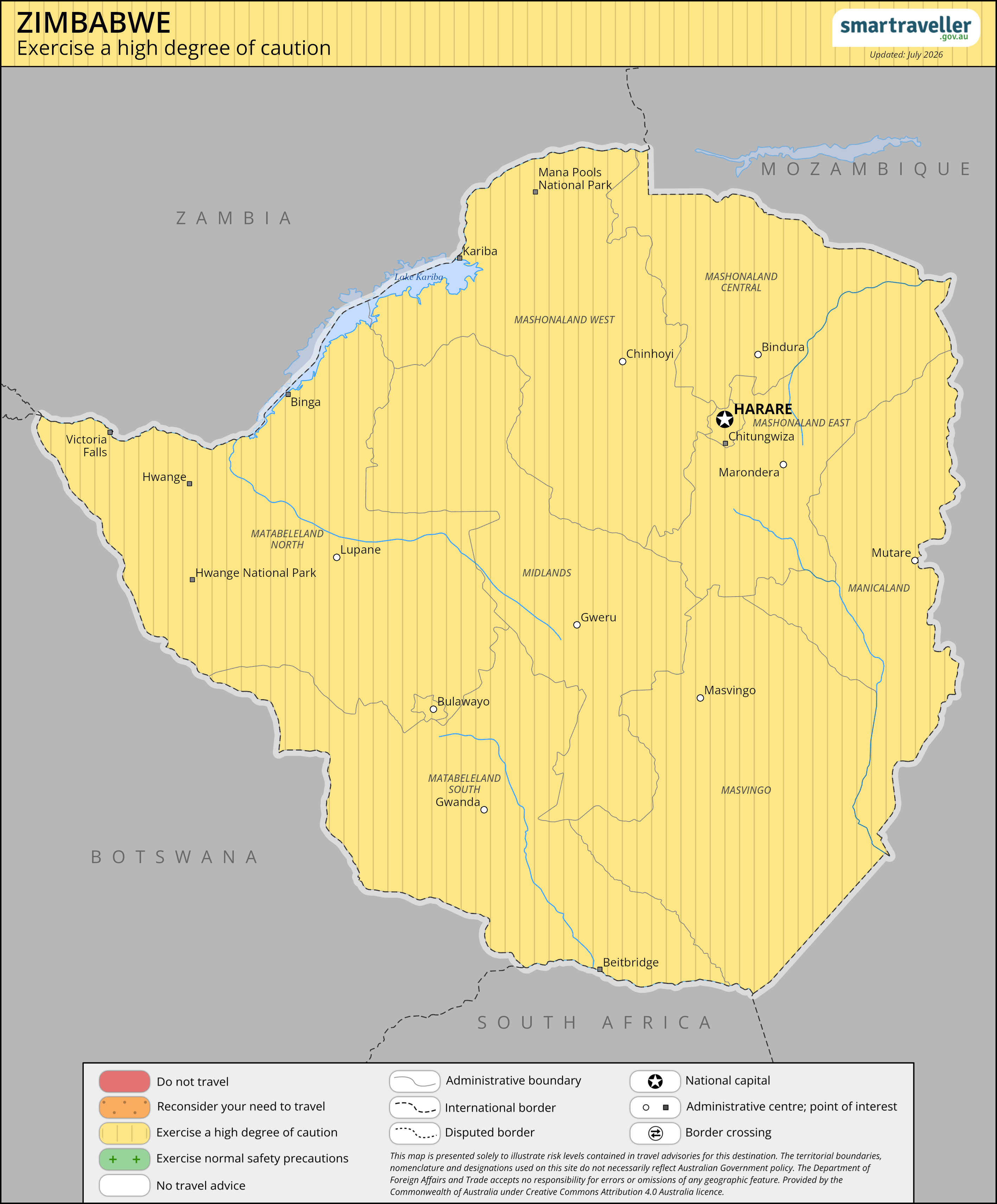
Exercise a high degree of caution in Zimbabwe due to the threat of crime and the risk of civil unrest.
Full travel advice: Safety
Full travel advice: Health
Full travel advice: Local laws
Full travel advice: Travel
Full travel advice: Local contacts
The security situation can be unpredictable. Unemployment is high, the economy is unstable, and the high crime rate is increasing.
Sometimes there are shortages of medical supplies, basic goods and food.
Essential services such as power, water and transport are unreliable. There are frequent and sometimes long power outages. Water rationing occurs in some parts of the country.
In some areas of Zimbabwe, issues causing unrest include:
Demonstrations and protests can be volatile and may turn violent quickly. Transport disruptions and delays may occur. Avoid activities that could be considered political, including political discussions in public places and online. Stay away from protests and demonstrations.
During periods of unrest:
More information:
There's a high risk of theft and other crime.
Petty crime is common, especially in urban and tourist areas and increases after dark. Common crimes include:
Violent crimes, such as armed robbery and assault, also occur. People known to be storing large sums of cash are sometimes targeted.
The risk of crime increases:
Robberies may happen during the day, particularly in crowded urban areas.
To help protect yourself from violent crime:
Get immediate medical help if you're a victim of violent crime, especially sexual assault. The risk of HIV/AIDS is high, and post-exposure prophylaxis (PEP) HIV medication needs to be taken within 72 hours of the incident for it to be effective.
Kidnapping can happen anywhere, even in places that seem safe.
The Australian Government's longstanding policy is that it doesn't make payments or concessions to kidnappers.
More information:
Theft from vehicles is common and smash and grab robberies occur.
Thieves target cars stopped at intersections. In Harare, remain alert on the way to and from Harare International Airport and along Churchill, Borrowdale, and Masvingo-Beitbridge roads.
Thieves also slash the tyres of cars parked or stopped in traffic. When someone stops to change their tyre, thieves rob them.
You could be robbed while visiting national parks. Safari operators may ask you to show proof of indemnity insurance.
Get updates on the security situation before you visit:
Lodges and camps in national parks can be isolated and remote. Options to travel to them may be limited.
To prevent theft when travelling by a vehicle:
Commercial fraud, money transfer and employment scams are increasing. Credit card fraud occurs.
To protect yourself from fraud:
More information:
Police have limited resources, including vehicles and fuel. They may ask to be driven from a police station to a crime scene.
Police processes can be slow and complicated when recovering property or prosecuting offenders.
Terrorism is a threat worldwide. Terrorist attacks could occur anywhere and at any time. Be alert to possible threats, especially in public places.
If there’s a terrorist incident, leave the area if it’s safe to do so and follow the instructions of local authorities.
More information:
Transport and tour operators don't always follow safety and maintenance standards. This is important for adventure activities, such as rafting, bungee jumping and other adventure sports.
If you plan to do an adventure activity:
If proper safety equipment isn't available, use another provider.
Carry your passport in a waterproof bag. Authorities may not accept a damaged passport.
Respect wildlife laws and keep a safe and legal distance when watching wildlife. Only use reputable guides or tour operators. Follow park regulations and warden’s advice. Fees are often payable to enter designated conservancies and national parks.
Swimming in lakes and rivers is unsafe. Avoid swimming in lakes and rivers due to the risk of:
Zimbabwe experiences severe weather.
The rainy season is from November to April. Flooding can occur and essential services can be affected, such as transport and infrastructure, electricity, water and food supply and emergency services.
If there's a natural disaster you should:
The World Health Organisation (WHO) declared an outbreak of Ebola disease in the Democratic Republic of the Congo (DRC) a public health emergency and also reported cases in Uganda. The Bundibugyo strain of Ebola has no approved vaccines or specific antiviral treatments.
Ebola can be transmitted to humans through physical contact with an infectious person, infected animals or contaminated materials. Ebola is often fatal with a mortality rate of around 50 per cent.
Symptoms of Ebola can include:
Seek medical advice immediately if you experience these symptoms. Maintain strict hygiene standards and avoid physical contact with anyone displaying symptoms.
Health screening on arrival and entry restrictions for travellers who have visited countries affected by Ebola may be imposed with limited notice and can change quickly, including for transit passengers. Check the latest requirements with your airline or travel provider before departure.
Further information and updates on Ebola can also be found on the World Health Organization (WHO) website.
Malaria is a risk everywhere except in Harare and Bulawayo.
Mosquitoes also spread other diseases, including filariasis.
To protect yourself from disease:
Get medical advice if you have a fever, muscle pain, rash or severe headache.
More information:
The rate of HIV/AIDS infection is high.
Take precautions if you engage in activities that put you at risk of infection.
If you’re the victim of a violent crime, including rape, see a doctor immediately.
Serious outbreaks of other waterborne, foodborne and infectious diseases sometimes occur, including:
Water shortages have driven some people to use unsafe water sources.
To protect yourself from illness:
If you're bitten or scratched by an animal, get medical help straight away.
To avoid waterborne diseases, don't swim in freshwater lakes or rivers.
Get medical help if you have a fever or diarrhoea.
Ask your doctor about health risks and vaccines before you go.
More information:
There’s no agreement between Australia and Zimbabwe for free healthcare. Tourists must pay for all medical care, even if they need to stay in hospital or be evacuated. This can be very expensive. Make sure your travel insurance covers you. The Australian Government won't pay for these costs.
Health services are poor.
Medical facilities are generally of a poor standard. Some private medical facilities in the larger cities are of average standard. Outside of Harare and Bulawayo, facilities are even more limited. Some medical supplies and prescription medications may not be available.
Public hospitals in Harare and other towns have shortages of:
They may not treat patients with certain illnesses. They may not be able to help in an accident or emergency.
You may need to pay up-front before receiving treatment, even in an emergency.
You may need to be evacuated if you become seriously ill or injured.
You're subject to all local laws and penalties, including those that may appear harsh by Australian standards. Research local laws before travelling.
If you're arrested or jailed, the Australian Government will do what it can to help you under our Consular Services Charter. But we can't get you out of trouble or out of jail.
Penalties are severe for carrying, making or dealing in illegal drugs, including marijuana.
You may face lengthy prison sentences and heavy fines.
More information:
By law, you must always carry ID, such as a copy of your passport.
You may have to show these documents if you're stopped by police or immigration officials.
Juvenile offenders may get corporal punishment.
In Zimbabwe, it's illegal to:
Same-sex relationships are illegal.
It's illegal to take photos of sensitive locations. You need permission from the Ministry of Information to photograph:
It's also illegal to photograph demonstrations and protests.
By law, you can't take part in political activities, or activities that authorities could interpret as political.
You can't:
An open hand is the symbol of a main political party. Authorities could think a friendly wave is deliberate political activity.
The President's official residence is at State House, Chancellor Avenue, The Avenues, Harare. The roads around the residence are closed between 6pm and 6am. Do not rely on GPS navigation around this area. Security is strict. Don't look through the gates or hang around outside the walls.
If you plan to do business, research local laws and regulations, including for land and business ownership.
More information:
Zimbabwe doesn't have a clear policy regarding dual nationals.
Australian-Zimbabwean dual nationals who are arrested or detained may not be able to obtain consular help from Australian officials.
More information:
You need a visa to enter Zimbabwe. A 30-day tourist visa (single or multiple entry) is available on arrival at the port of entry for a fee payable in USD Cash or by international credit/debit cards. You can also apply on the e-visa platform prior to arrival at Zimbabwe eVisa Platform - Secure Your Entry with Ease
You can apply for 2 consecutive extensions from within Zimbabwe (maximum stay is 90-days) at any Zimbabwean Department of Immigration Office.
Don't overstay a visa. Penalties (including jail) may apply. To extend a visa you must visit the Department of Immigration in person. Allow enough time for an extension review.
You can also apply for a double-entry tourist visa, valid for 30 days from each entry date.
Alternatively, you may be eligible for a KAZA UniVisa that allows multiple entries in 30 days:
You can get a KAZA UniVisa at:
You must apply for a permit before arriving in Zimbabwe to:
Volunteering and missionary activities are considered work. You will require a business visa to engage in these activities.
The Zimbabwe Chief Immigration Officer must approve the permit.
Be careful using local migration agents. It's better to get visas, and work permits yourself.
To arrange a visa or work permit, apply:
Entry and exit conditions can change at short notice. Contact an embassy or consulate of Zimbabwe for details about visas, currency, customs and quarantine rules.
Your options for leaving Zimbabwe may be limited if security deteriorates quickly. Keep your documents up to date. You'll need a valid passport, visa, and vehicle police clearance if leaving via a land border.
As part of health screening measures, you may have your temperature checked at points of entry into Zimbabwe.
You need a valid yellow fever vaccination certificate if you're arriving from a country with yellow fever. Some airlines may want to see one when you leave.
Find out about returning to Australia after exposure to yellow fever.
More information:
When you arrive, check you get a legible entry stamp in your passport. Immigration officials will ask to see it when you leave.
If you're using an emergency travel document, you may need to show a police report to prove your passport was lost or stolen.
You must have proper accreditation to work as a journalist. Without this, you can be arrested and detained or deported.
Strict rules apply to children aged under 18 years travelling through South Africa. South African authorities do not accept provisional travel documents. They do accept Australian emergency passports. Check our travel advice for South Africa.
More information:
Ensure you have 3 blank pages in your passport in case you need to enter Zimbabwe and exit through one of the neighbouring countries or if you need to leave at short notice.
If travelling to multiple African countries on one trip, ensure you have enough blank pages to accommodate the requirements of all countries you plan to visit.
Zimbabwe’s economic situation is unpredictable. In April 2024, Zimbabwe announced the introduction of a new currency, Zimbabwe Gold ($ZWG), to replace the Zimbabwe dollar ($ZWL).
The US dollar is widely accepted, but this could change without notice. Prices can be listed in either currency. Check before making a transaction, as the $ symbol can be used for both currencies. The exchange rate between the local currency and USD can change quickly. Most stores and businesses will not accept US banknotes issued before 2006.
Zimbabwe is experiencing a cash crisis. Authorities have introduced restrictions. You may not be able to withdraw cash from an ATM with an international debit/credit card. International debit/credit cards are not widely accepted outside of major urban centres. Bank fees are high, including when withdrawing from ATMs. ATMs are available in the main cities but may not accept international cards.
Take enough cash to cover your stay. Changing money anywhere except at officially licensed banks and bureaux de change is illegal. If possible, carry small denominations. Most vendors prefer $US in cash and may be unable to provide change if you pay in $US.
Check if your hotels and other providers (including medical providers) will accept international credit cards. Many businesses only have point-of-sale machines that accept local credit and debit cards. Many companies charge a fee to use a credit card.
It's illegal to leave Zimbabwe with more than $US2,000 in cash or the same amount in a different currency. The amount can change with little or no notice.
More information:
Disruptions to power and water are common and can last for weeks, including in cities. Mobile phone reception and data can also be unreliable.
Parts of the country have unexploded landmines, mainly in:
The Zimbabwe Government has a national program to locate and remove landmines.
Stick to main roads and paths in areas where landmines could exist.
To drive you need both:
Get your IDP before leaving Australia.
Road travel is very dangerous.
Hazards include:
Flash flooding during the rainy season can make roads, including in major cities, impassable from November to March.
All vehicles must carry the following:
If your vehicle isn't fully equipped, authorities could fine you.
It's illegal to use a phone without a hands-free device when driving.
Fuel shortages can occur. Keep your tank topped up and carry sufficient fuel for long journeys. You may need to check if international credit/debit cards will be accepted when purchasing fuel.
If you plan to drive:
If you hire a vehicle, make sure it's equipped with all compulsory safety equipment.
While driving:
More information:
By law, all vehicles must stop and pull over when an official motorcade goes past. You must stop even if you're on the opposite side of the road on a dual carriageway.
Security forces sometimes intimidate motorists who don't abide with this requirement or pull over in time.
Police roadblocks can appear with little warning. If asked, you must show police your identification documents, car registration and ownership papers.
Police may also ask to see your car's safety equipment.
Police may ask drivers to pay on-the-spot fines or a bribe. If you pay a bribe, they could demand more.
Check if your travel insurance policy covers you for the vehicle you intend to ride. You might need extra cover for an accident on a motorbike, quad bike or similar vehicle.
Always wear a helmet.
Use only registered taxis and limousines. If possible, book them through your accommodation.
Avoid using public transport, buses and commuter buses (combis). They present safety concerns due to overcrowding, poor maintenance and reckless driving.
Accidents have occurred on passenger ferries and boats.
Use transport providers with a good reputation.
Always wear a life jacket, even if others don't.
The European Union (EU) has banned Air Zimbabwe flights to the EU. Australian Embassy staff are not permitted to use Air Zimbabwe for official travel except in exceptional circumstances.
Check Zimbabwe's air safety profile with the Aviation Safety Network.
More information:
Zimbabwe has hunting rules.
Risks include landmines in some areas.
If you plan to do guided hunting, engage an operator with a good reputation and a valid hunting licence.
Before you hunt, research the rules and requirements of the Convention on International Trade in Endangered Species (CITES).
Depending on what you need, contact your:
Call 999.
Call 999 or go to a hospital.
Call 999 or Harare Central Police Station on (0242) 777 777 or visit the nearest police station.
Always get a police report when you report a crime.
Your insurer should have a 24-hour emergency number.
The Australian Government aims to provide high quality consular assistance. There are limits to what we can do. Read the Consular Services Charter to understand how we can assist you overseas.
For consular assistance, contact the Australian Embassy in Harare. The Australian Embassy in Harare is open to the public by appointment only.
1 Green Close
Borrowdale, Harare, Zimbabwe
Phone: +263 861 200 2100
Email: zimbabwe.embassy@dfat.gov.au
Website: zimbabwe.embassy.gov.au
Facebook: Australian Embassy, Zimbabwe
X: @AusEmbZim
Check the Embassy website for details about opening hours and any temporary closures.
In a consular emergency, if you can't contact an embassy, call the 24-hour Consular Emergency Centre on:
Be the first to know official government advice when travelling.