Fire and rescue services
Call 18.
Medical emergencies
Call 18 or go to the nearest hospital.
Police
Call 18, or go to the nearest police station.

Exercise a high degree of caution in Djibouti overall due to the threat of terrorism.
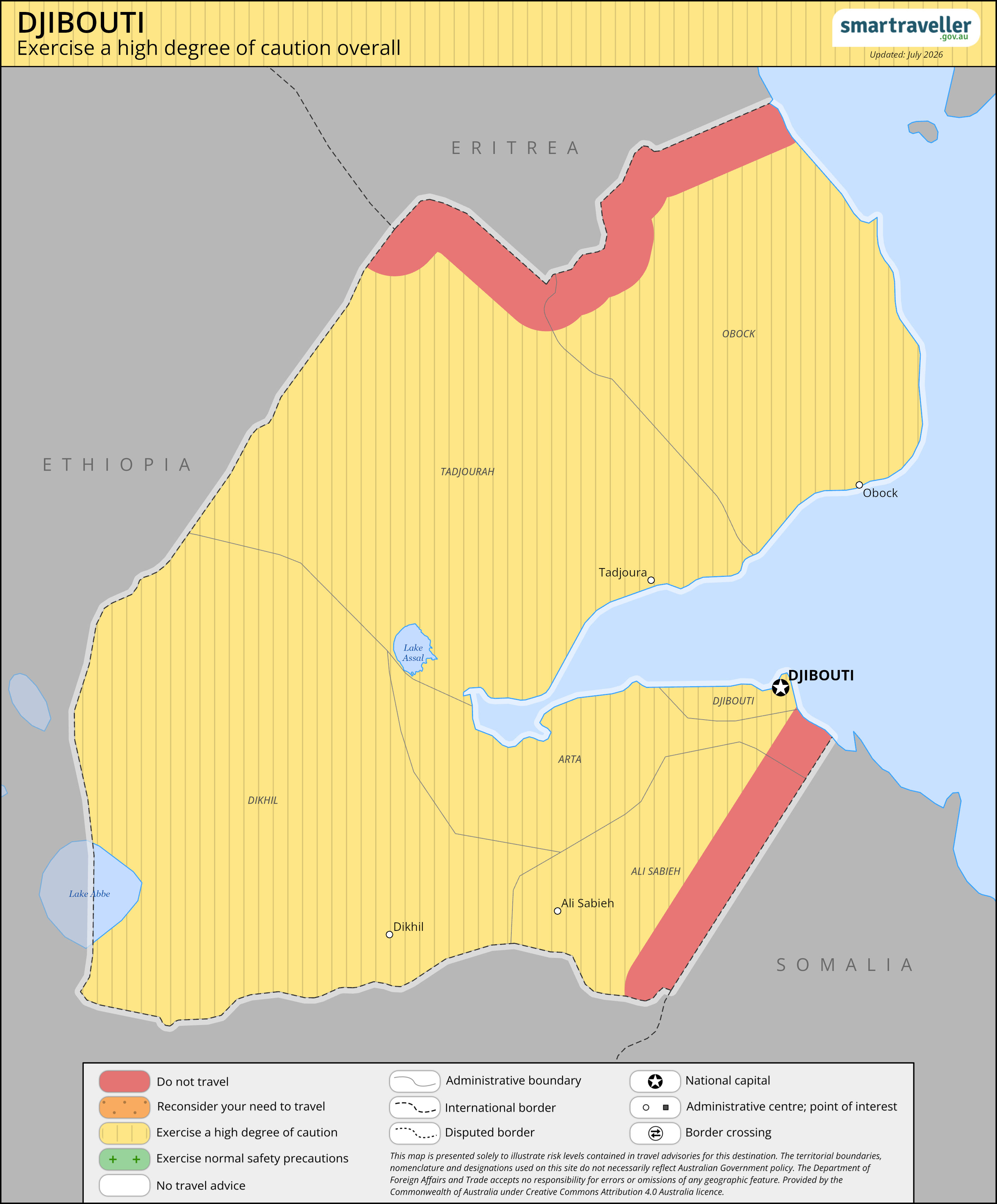
Do not travel within 10km of the border with Eritrea due to ongoing border tensions.
Do not travel within 10km of the border with Somalia (Somaliland) due to the volatile security environment.
Full travel advice: Safety
Full travel advice: Health
Full travel advice: Local laws
Full travel advice: Travel
Full travel advice: Local contacts
A terrorist attack could happen anywhere and at any time. Terrorists may attack Djiboutian or western targets, including travellers.
Terrorist groups, including Al-Shabaab, maintain a strong interest in attacking targets in Djibouti.
Possible terrorist targets include:
To reduce your risk:
If there’s a terrorist incident, leave the area if it’s safe to do so and follow the instructions of local authorities.
More information:
Civil unrest and armed conflict in Somalia, Ethiopia and Eritrea could impact your safety in Djibouti.
Do not travel within 10km of the borders with Eritrea and Somalia (Somaliland). Djibouti’s borders are not always clearly identified in remote areas.
Public protests and events that draw large groups of people can turn violent.
To protect yourself during periods of unrest:
More information:
Pickpocketing and other petty crimes can happen.
There have been reports of bandit groups outside the capital in areas where the law has broken down.
Crime risks increase at night and in isolated locations such as Dorale and Khor Ambado beaches.
To protect yourself from crime:
More information:
There's a significant threat of piracy and armed robbery in Djibouti’s coastal waters and maritime regions of the Gulf of Aden and the Red Sea, including the Sawabi (Sept-frères) Islands. You should limit unnecessary travel to these areas.
Pirates have attacked vessels and held foreigner's hostage for ransom in and around Djibouti's waters.
Attractive targets for pirates include:
If you need to travel by boat to Djibouti's coastal waters and surrounds, you should:
More information
Kidnapping can happen anywhere, anytime, including in destinations that are typically at lower risk.
There is a high threat of kidnapping within 10 km of Djibouti's border with Somalia (Somaliland).
The Australian Government's longstanding policy is that it doesn't make payments or concessions to kidnappers.
More information, including advice on how to reduce your risk of kidnapping:
Djibouti can experience extreme weather and natural disasters.
It's in an active seismic zone and can experience:
To protect yourself if a natural disaster occurs:
More information:
Djibouti experiences extreme temperatures in summer. The hottest months are from May to October. Daytime temperatures can be more than 50°C.
In extreme heat, stay out of the sun and drink plenty of water to avoid dehydration.
Strong dust storms happen in June.
Djibouti is in a long-term drought. In some areas, the drought may affect:
Parts of Djibouti, including the capital city are prone to floods.
Earthquakes can happen.
Djibouti has one active volcano, Ardoukoba. It last erupted in 1978. Volcanic activity in neighbouring Ethiopia can impact Djibouti.
Ash from a volcanic eruption can fall over a wide area.
Volcanic ash, dust and toxic fumes are a significant health risk, especially for people with respiratory problems.
Tsunamis can happen.
Register for tsunami alerts from the Global Disaster Alert and Co-ordination System.
If you're near the coast, move immediately to high ground if advised or if you:
Don't wait for official warnings, such as alarms or sirens. Once on high ground, monitor local media.
Malaria occurs through the year. Other diseases spread by insects are a risk, including:
To protect yourself from disease:
Get medical advice if you have a fever, muscle pain, rash or severe headache.
Outbreaks of polio (poliomyelitis) happen in Djibouti.
Check your polio vaccination status with your doctor or travel clinic at least 8 weeks before you travel.
If you aren't vaccinated, complete the full course of vaccinations before you leave.
HIV/AIDS is widespread. Take steps to reduce your risk of exposure to the virus.
Foodborne, waterborne and other infectious diseases are common. These include:
Serious outbreaks sometimes occur.
To avoid illness:
Get medical advice if you have a fever or diarrhoea.
Ask your doctor about health risks and vaccines before you go.
More information:
There’s no agreement between Australia and Djibouti for free healthcare. Tourists must pay for all medical care, even if they need to stay in hospital or be evacuated. This can be very expensive. Make sure your travel insurance covers you. The Australian Government won't pay for these costs.
The standard of medical facilities in Djibouti is poor. Rural areas may have very basic care or none at all. English-speaking staff may not be available.
Payment for medical treatment is required upfront. Your treatment may be delayed if you can’t pay.
Availability of medication in rural areas is limited and can be expensive.
If you become seriously ill or injured, you may need to be evacuated to a place with better facilities. Medical evacuation can be very expensive. Make sure you have adequate travel insurance, including for medical evacuation.
More information:
While the consumption of alcohol is legal, the sale and consumption of alcohol in all but approved locations (such as hotels) is illegal. Public intoxication is illegal and includes a penalty of up to two years imprisonment.
Penalties for drug offences are severe and include long jail sentences and heavy fines.
The narcotic khat is legal in Djibouti, but illegal in many other countries.
More information:
Illegal activities in Djibouti include:
It's illegal to photograph military facilities and public infrastructure, such as government buildings, ports, airports and bridges
If you take photos near prohibited places, you may:
If in doubt, ask for advice from local authorities.
Same-sex relationships are not illegal in Djibouti but authorities may prosecute same-sex couples displaying affection in public.
More information:
Standards for dress and behaviour are conservative. Be respectful toward religious and social traditions.
The working week is Sunday to Thursday. Many shops, clinics, and other amenities are closed on Fridays.
The Islamic holy month of Ramadan is observed in Djibouti. Respect religious and cultural customs and laws at this time.
During Ramadan, avoid eating, drinking and smoking in public during the day. If you're not fasting, avoid these activities around people who are. Seek local advice to avoid offence.
Airline schedules can be affected during the month of Ramadan. Check flight schedules with your travel provider.
Explore our Ramadan page to learn more, including dates for Ramadan.
You need a visa to visit Djibouti. Check the official e-visa portal for information.
Entry and exit conditions can change at short notice. Contact the Embassy of Djibouti in Tokyo for details about visas, currency, customs and quarantine rules.
If you're arriving from a yellow fever-prone country, you will need a valid yellow fever vaccination certificate to enter Djibouti.
More information:
The local currency is the Djibouti Franc (DJF).
Travellers cheques can be exchanged at major banks.
Djibouti has a cash-based economy. Credit cards aren't widely accepted. USD can be changed at major hotels and some banks.
There are a limited number of ATMs, but they often don't work.
Ask your bank if your card will work in Djibouti.
Communications networks are limited in the city of Djibouti. Outside the capital, mobile coverage is often unavailable or non-existent. Consider getting a local SIM. You will need to present your passport to purchase a local SIM.
Djibouti is a 'mine-safe' country. This means landmines have been identified and marked, but haven't been removed. However, unmarked landmines may still exist in the border region with Eritrea.
Security is limited in remote areas, including regions bordering Ethiopia and Somalia.
You need permission from the Government of Djibouti to travel above the 12° north latitude line, which passes through Obock.
Avoid travel to remote areas.
Djibouti is one of the world's most arid countries experiencing severe drought. In some areas, the drought may affect:
To drive in Djibouti, you need both:
You must get your IDP before leaving Australia.
Conditions on roads are unsafe, especially in central Djibouti and the Ethiopia-Djibouti border.
Hazards include:
The standard of driving and vehicle maintenance is poor. Exercise caution at intersections; drivers often run red lights and do not stop at intersections. Avoid driving outside the city, especially to the north and Abbey Lake.
Police may set up roadblocks on some major roads, which can be difficult to see at night. Follow the advice of local authorities at checkpoints.
In an accident, drivers must wait at the scene until police arrive.
Before you drive:
To reduce your risks while driving:
More information
Check whether your travel insurance policy covers you when using a motorcycle, quad bike or similar vehicle.
Always wear a helmet.
Avoid using taxis; they are often in poor condition and unsafe.
Use a reputable car rental company or hotel transport provider.
Public transport is limited to bus and ferry services between the capital city and the towns of Tadjoura and Obock and the Ethio-Djiboutian railway line. Avoid travel by public transport.
App-based ride share transport services in Djibouti remain at an early stage of development, with a limited number of local providers operating and no internationally recognised companies currently present in the market.
Don't travel at night.
More information:
There's a high risk of piracy and other maritime security incidents in coastal areas (see 'Safety').
To stay safe when travelling on the water:
Check Djibouti's air safety profile with the Aviation Safety Network.
More information:
Depending on what you need, contact your:
Call 18.
Call an ambulance: 21 35 09 62 or 21 35 27 12.
Call 17 or go to the nearest police station.
Always get a police report when you report a crime.
Your insurer should have a 24-hour emergency number.
The Australian Government aims to provide high quality consular assistance. There are limits to what we can do. Read the Consular Services Charter to understand how we can assist you overseas.
Australia doesn't have an embassy or consulate in Djibouti.
For consular assistance, contact the Australian Embassy in Addis Ababa, Ethiopia.
Turkish compound (off Cape Verde street)
Bole Subcity, Woreda 3
PO Box 3715
Addis Ababa, Ethiopia
Phone: +251 11 6672651 / 6672652 / 6672693 / 6672694
Email: Consular.AddisAbaba@dfat.gov.au
Website: ethiopia.embassy.gov.au
Facebook: @AusEmb.ET
X: @AusEmbET
See the Embassy website for details about opening hours and any temporary closures.
In a consular emergency, if you can't contact and embassy, call the 24-hour Consular Emergency Centre on:
Be the first to know official government advice when travelling.