Police
Call 117.

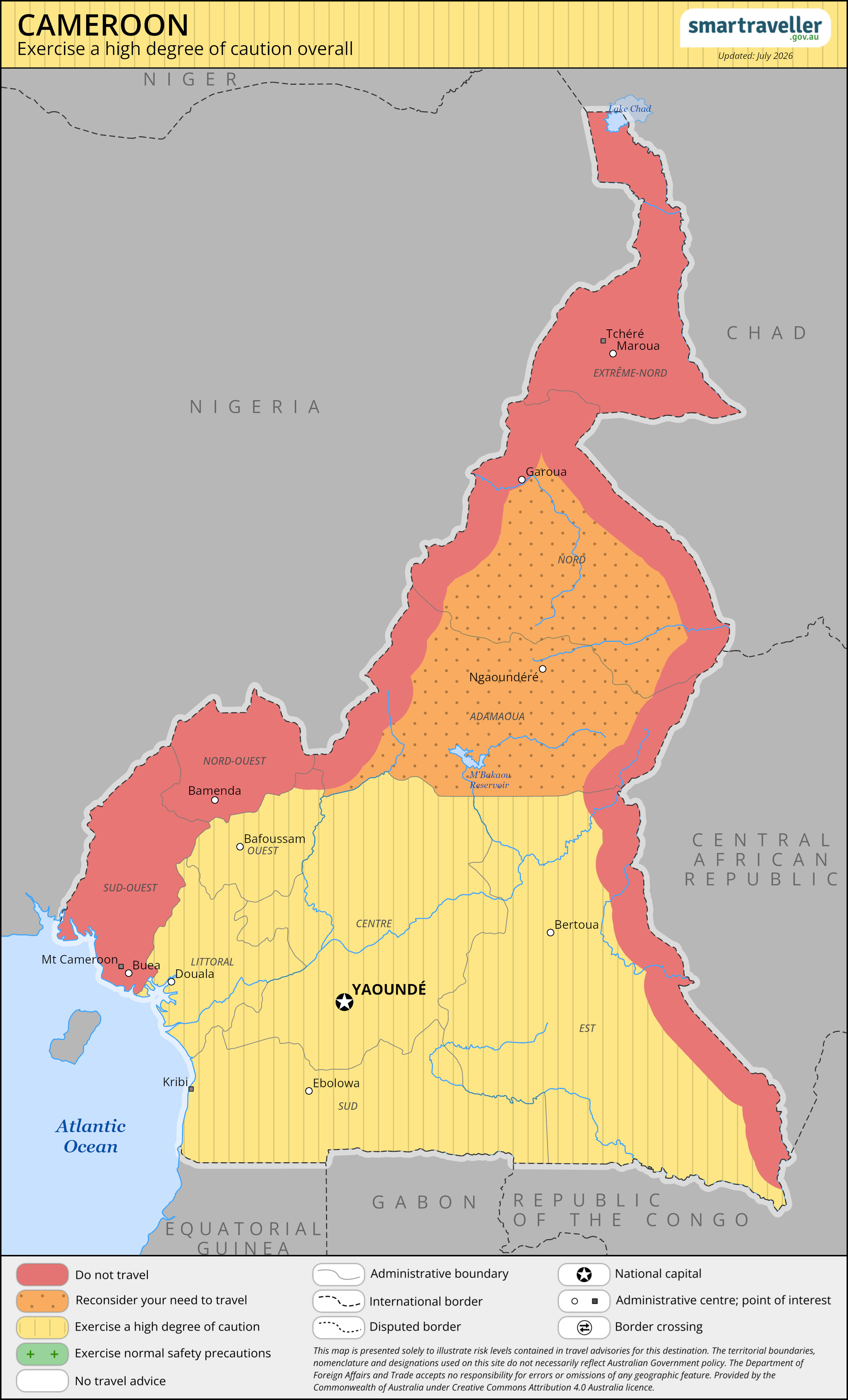
Exercise a high degree of caution in Cameroon overall due to the threat of violent crime and risk of civil unrest.
Do not travel to:
due to the unpredictable security conditions and the threat of terrorism, kidnapping, violent crime including armed robbery, assault and carjacking.
Do not travel to the Northwest and Southwest regions, including Bakassi Peninsula due to the threat of kidnapping, civil unrest and violent crime including armed robbery, assault and carjacking.
Reconsider your need to travel to the North and Adamaoua regions.
Reconsider your need to travel to the North and Adamaoua regions due to the threat of terrorism, kidnapping and violent crime including armed robbery, assault and carjacking.
Full travel advice: Safety
Full travel advice: Health
Full travel advice: Local laws
Full travel advice: Travel
Full travel advice: Local contacts
Demonstrations and events that draw large public gatherings can occur without warning and turn violent quickly. The risk is heightened during election periods and other significant events.
To protect yourself during periods of unrest:
More information:
Due to conflict between Anglophone separatists and Cameroon government forces, tensions in the Northwest and Southwest (Anglophone) regions are high. There have been clashes between security forces and armed groups in recent years. Avoid travelling to these regions, including the Bakassi Peninsula, due to the high threat of localised violence and kidnapping. If you do travel through these areas, monitor the local media and follow with directions by local authorities.
People have been killed and injured in armed clashes and explosions in the regional capitals of Buea and Bamenda. Serious incidents have also taken place at informal roadblocks set up by non-state groups. There's potential for civil unrest to turn into armed conflict. Restrictions, including night curfews and a ban on public meetings, remain in place in some areas.
The Northwest and Southwest regions experience:
Civil unrest and armed conflict are a high risk in the Adamaoua and East regions, particularly along the border, due to conflict spilling over from neighbouring countries such as the Central African Republic.
More information:
Terrorist groups are active in Cameroon. Terrorist attacks have occurred in the last 3 years. There's a high threat of attacks in the Far North Region, including near Lake Chad and areas bordering Nigeria, Chad and the Central African Republic. However, attacks could occur anywhere and at any time, including in major cities like Douala and Yaoundé.
Terrorists may target foreign nationals, including business people, workers in extractives industries, tourists, journalists and humanitarian aid workers.
To reduce your risk, be aware of your surroundings and alert to suspicious behaviour and items being left in public places.
If there’s a terrorist incident, leave the area if it’s safe to do so and follow the instructions of local authorities.
For more information on common targets for terrorists and what to do if there’s an attack, read our Terrorism page.
Kidnapping occurs across the world with political, ideological, and criminal motives. Foreigners, including Australians, have been kidnapped overseas whilst travelling. Kidnaps can happen anywhere, even in places that seem safe.
Kidnapping is a risk in Cameroon. The threat is very high in:
Kidnappers have also targeted foreigners in urban areas of Douala and Yaoundé.
Pirate gangs regularly attack shipping in Cameroonʼs waters and have carried out maritime kidnappings there. The Bakassi peninsula, adjacent to the Nigerian border, has a history of local militancy and kidnapping.
If despite our advice, you travel to an area with a high risk of kidnapping our ability to provide consular assistance in these destinations is extremely limited.
You’re responsible for your own safety. You can find more information on how to reduce your risk of kidnapping here: Kidnapping
The Australian Government's longstanding policy is that it doesn't make payments or concessions to kidnappers. Ransom payments to kidnappers have funded further terrorist attacks and criminal activity. Ransom payments to terrorist groups are likely to contravene Australian counter-terrorism financing laws.
More information:
Violent crime, including muggings, robberies, and attacks on motorists, occurs in urban areas and on intercity highways. Armed highwaymen operate across the country. Armed gangs have targeted restaurants and hotels frequented by foreigners.
Armed criminals and bandits are common, particularly in the border areas with the Central African Republic, Nigeria and Chad. They have been known to set up false and illegal roadblocks on certain roads to ambush victims.
Stay in accommodation with adequate security measures in place. Avoid isolated and poorer urban areas, including in Yaoundé and Douala, particularly at night and when walking alone. When travelling by car, keep doors locked, windows up and valuables out of sight.
Thieves are active on trains, coaches, buses and taxis, and around bus stations, markets and hotels. Be aware of your surroundings, especially in busy areas. Always take care of your belongings when in public and take care to not show signs of wealth, including cash, expensive watches, jewellery and electronic devices.
If you become a victim of violent crime, including rape, seek medical help straight away. The HIV/AIDS infection rate in Cameroon is high (see 'Health').
Commercial and internet fraud often originates in West African countries, including Cameroon. ATM, debit and credit card fraud is also common (see 'Money').
Online scammers defraud victims. Victims who have travelled to the originating country have put their lives in danger.
Criminals often seek details of 'safe' bank accounts overseas, such as yours. They claim they will transfer large sums of money into the account. Victims believe they will get a donation, or a percentage of the amount involved.
Be aware of other scams where criminals:
To protect yourself against a scam, be wary of:
Be careful about giving out personal information or disposing of personal documents in Cameroon.
Scammers can access your personal data when you use open networks. Be careful when and where you use internet banking and other sites that transmit or store your data or passwords.
If you're travelling to Cameroon, your family and friends may receive bogus phone calls and emails from scammers in Cameroon. Scammers may claim that you're in legal, financial or medical trouble and that you need money.
Some scammers may pretend to work for the Australian High Commission in Abuja and ask you to transfer money to the High Commission. Check with the High Commission first through its official contact details if you're asked to send money or information to them (see 'Local contacts').
Criminals in West Africa operate fake online friendship, dating and marriage schemes.
Scammers use these schemes to defraud and threaten the lives of Australians. They do this by targeting Australians and other foreigners on social media, internet dating sites and chat rooms, posing as a prospective friend or spouse and may use a completely false identity. Scammers can develop relationships with victims over many weeks, months or years.
Once a friendship develops, the scammer asks for money to allow them to travel to Australia. Sometimes, the scammer ends the relationship once the money has been sent. There's little chance of getting the money back.
In other cases, foreigners are lured to Africa to meet their prospective friend or marriage partner. Once in Africa, they may become the victim of kidnapping, assault, robbery or extortion.
There have also been cases of sexual extortion or 'sextortion', where scammers develop a fake romantic relationship and then ask to exchange revealing photographs or videos. Once they have these, the nature of the relationship will often change abruptly, and the scammers will demand payment in exchange for not releasing these items to the victim's family, friends or work colleagues.
Don't travel to Cameroon to try to get your money back or seek revenge. You could be in danger.
More information:
Cameroon experiences extreme weather and natural disasters, flooding and volcanic eruptions.
To protect yourself during a natural disaster:
The rainy season is:
Heavy rain may cause flooding and landslides, blocking roads during these periods and impacting essential services.. Seek advice from local authorities and monitor local media.
Mount Cameroon is an active volcano that may experience explosions and lava flows. Seek advice from local authorities before climbing it.
The Nyos and Monoun volcanic lakes sometimes give off toxic fumes, which have caused deaths in the past. Seek advice from local authorities before visiting.
Register with the Global Disaster Alert and Coordination System to receive alerts on major disasters.
Power outages occur regularly throughout the country. Outages can be short or last longer than 8 hours, and can affect traffic lights, water supply, communications networks and banking. Check if your accommodation has generators.
Malaria is prevalent throughout the year. Consider taking medicine to prevent malaria.
Other insect-borne diseases include:
Yellow fever is widespread in Cameroon. Yellow fever is a potentially fatal virus spread by mosquitoes. It's prevented by vaccination. Get vaccinated before you travel. You must show a yellow fever certificate for entry into Cameroon.
To protect yourself from diseases spread by insects:
More information:
The rate of HIV/AIDS infection in Cameroon is high. Take precautions before you do anything that puts you at risk of infection.
Waterborne, foodborne, parasitic and other infectious diseases are widespread. These include:
To protect yourself from these diseases:
Seek medical advice if you have a fever, diarrhoea, or suspect poisoning.
Ask your doctor about health risks and vaccines before you go.
More information:
There’s no agreement between Australia and Cameroon for free healthcare. Tourists must pay for all medical care, even if they need to stay in hospital or be evacuated. This can be very expensive, and payment will generally need to be made in advance of treatment. Make sure your travel insurance covers you. The Australian Government won't pay for these costs.
Medical facilities in urban centres are very basic and generally of a lower standard than Australia. Facilities are extremely limited in rural areas.
Medical facilities often lack trained staff. They may have poor hygiene, outdated equipment, a lack of water and medical supplies.
Even in an emergency you will generally need to pay treatment costs in advance. While receiving treatment you may need to bring or buy your own basic medical supplies, such as gloves, soap, sheets and other medical resources.
If you become seriously ill or injured, you'll need evacuation to a place with better facilities. Make sure your insurance covers this risk.
When you travel to another country, you must follow their laws. Even if they seem strict compared to Australia's. Before you go, learn about the local laws in that country.
The Australian Government is limited in how and when we can help if you're arrested overseas. We can't get you out of trouble or out of jail. Understand our limits. Read the Consular Services Charter.
Penalties for drug offences are severe. They may include long jail terms and large fines.
More information:
Always carry proof of your identification (ID), such as a residence permit or a certified copy of your passport showing a valid visa.
Police might detain you if you can't show a valid ID.
Penalties for serious crimes, such as murder, include the death penalty.
There are strict rules around what you can import and export from Cameroon. You must declare anything that is prohibited or subject to taxes and duties, check with the Cameroonian Customs service prior to travel.
It's illegal to buy, sell, kill or capture any protected wildlife without a licence. Persons found to be trafficking these goods face long jail terms and large fines.
It's illegal to wear camouflage clothing in Cameroon unless you are a member of the armed forces. Penalties can include fines and detention.
Same-sex relationships are illegal in Cameroon. Penalties for same-sex activity include both:
The media has reported extra-judicial attacks and arrests targeting LGBTQIA+ people in Cameroon.
More information:
It's illegal to take photos of:
In other areas communities may be sensitive to people taking photos without permission. This may result in locals or officials asking for money for a ‘permit’ to photograph certain places.
Some Australian laws still apply even if you’re in another country. You could be charged in Australia if you break these laws overseas.
More information:
Cameroon doesn't recognise dual nationality.
If you're a dual national, this limits the consular services we can provide if you're arrested or detained.
Always travel on your Australian passport.
More information:
Standards of dress and behaviour are conservative in Cameroon. Take care not to offend. If in doubt, seek local advice.
You must have a visa to enter Cameroon.
You'll need to apply for a Cameroonian visa online via the Cameroonian Government's E-visa system before departing for Cameroon. You cannot get a visa on arrival.
You must sign up to the online portal, complete the required information, upload supporting documents and pay the necessary fees before Cameroonian authorities will process it.
Applicants travelling from countries without a Cameroonian Embassy or High Commission will be issued an online visa authorisation with a QR code. You must bring a printed copy of this authorisation and original copies of all supporting documents with you. A visa sticker will be issued in your passport only after border control checks these on arrival.
Entry and exit conditions can change at short notice. Contact the nearest High Commission of the Republic of Cameroon for the latest information on entry requirements into Cameroon.
Flight availability may change rapidly due to travel disruptions. Access via Cameroon's land and sea borders remains restricted.
All documents presented to border authorities must be in one of the official languages of Cameroon, French or English.
In the past, borders with Cameroon's neighbours have closed with little or no warning. Monitor news and consult travel providers for the latest updates.
We continue to advise you not to travel within 40km of the border with the Central African Republic, Chad and Nigeria due to unpredictable security conditions and the high threat of terrorist attacks, kidnapping for ransom, armed robbery, assault and carjacking. If, despite our advice, you travel to the border with Central African Republic, Chad or Nigeria, consider engaging professional security support and planning.
Very poor road conditions make it difficult to cross the land border with Gabon. If you plan to take this route:
You'll need a valid yellow fever vaccination certificate to enter Cameroon and neighbouring countries. Some airlines may want to see one when you leave.
Find out about returning to Australia after exposure to yellow fever.
More information:
Cameroon is largely a cash economy.
The local currency is the Central African CFA Franc (XAF).
Large hotels usually accept US dollars and Euros. You can exchange US dollars and euros for local currency. Australian dollars are not accepted.
Credit card facilities are not widespread, but major hotels may accept them. Traveller’s cheques are not widely accepted.
ATMs that accept international cards are limited and may attract heavy fees. Check ATM locations with your bank before you travel.
Fraud and skimming are high risks when using debit and credit cards with ATMs or EFTPOS machines. Pay careful attention when using these or when others are handling your cards. Report any unauthorised transactions to your bank immediately.
Driving in Cameroon is dangerous. Hazards include:
If bystanders believe you're at fault in a road accident, they may become hostile.
Avoid driving at night.
Be alert to security threats, particularly in traffic jams and at traffic lights. Keep your doors locked and windows up at all times.
Police and gendarmerie roadblocks are common in Cameroon. You may need to show your passport, driver’s licence, visa/residence permit and vehicle registration documents.
Officers may detain you if you can’t produce identification, or they may seek small on the spot ‘fines’ for perceived infractions. Ask the officer for a ticket setting out the alleged offence and pay any fines at a local court to avoid inadvertently paying a bribe.
You may be able to use your Australian licence to drive in Cameroon with an international driver’s permit for up to six months. If you’re staying longer, you must get a local Cameroonian licence.
Rental cars may be available. Confirm their insurance coverage and maintenance record prior to driving.
Fuel shortages occur occasionally in Cameroon. Local authorities may impose fuel rationing, leading to line-ups at petrol stations.
If you’re driving through rural areas, plan in advance, avoid travelling after dark, maintain an emergency supply of water, food and fuel, and bring multiple reliable means of communication including a satellite phone and VHF radio.
More information:
Taking taxis or using local app-based transport services can be very dangerous. There have been reports of violent assaults and robberies of passengers.
Use only trusted, registered taxis or transportation arranged by the hotel and check the licence plate and driver’s identity before starting your trip. There aren’t any internationally recognised app-based transport services in Cameroon.
We strongly advise against hailing taxis from the street due to high crime levels.
Taxis in cities operate like buses, picking up passengers while there is still room in the vehicle. They often take indirect routes. Many don't meet basic safety requirements.
Avoid all travel on motorcycle taxis, locally called ‘okada’, as these are driven recklessly, helmets are not provided and they are frequently involved in accidents.
Rail travel is possible between Douala, Yaoundé and Ngaoundéré. However, many rail tracks and trains in Cameroon are in poor condition. Safety and security on board trains and around stations are not up to Australian standards.
At sea or on ships in port, you may encounter piracy, hijacking, kidnapping or armed robbery. While Cameroonian security forces patrol their waters, they may not have the capacity to respond to all events.
Piracy is a threat in the Gulf of Guinea, and particularly in the waters around the Niger Delta and the Bakassi Peninsula. Do not travel by boat in this region.
Pirates are heavily armed and target passenger ferries, local fishing boats, commercial boats, pleasure craft and luxury cruise liners.
The International Maritime Bureau (IMB) publishes piracy reports.
Domestic and inter-country ferry services can be unsafe and unreliable, especially between Cameroon and Nigeria. Maintenance procedures and safety standards are not to Australian standards. If you travel on these services, insurance may not cover you.
Scheduled flights to, from and within Cameroon are often delayed or cancelled.
Arrange for someone to meet you on arrival at the airport. Prearrange your transport from the airport to your accommodation.
Check Cameroon's air safety profile with the Aviation Safety Network.
More information:
Depending on what you need, contact your:
When contacting some local authorities, be aware that English may not be used.
Call 118.
Call 119.
Ambulance service response times are unreliable and may not be available outside of major cities.
In an emergency situation, it can be quicker to call the nearest private clinic or hospital directly and to organise other transport to take you to the hospital.
Call 117.
Always get a police report when reporting a crime.
Your insurer should have a 24-hour emergency number.
Call 113.
Call 112.
This number can connect you to different services, such as police, fire and ambulance. However, we advise contacting the service you need directly.
The Australian Government aims to provide high quality consular assistance. There are limits to what we can do. Read the Consular Services Charter to understand how we can assist you overseas.
Australia has a consulate in Cameroon headed by an Honorary Consul. It provides limited consular assistance and doesn't issue Australian passports.
Les Manguiers
BAT Compound Bastos,
BP 7063 Yaoundé
Republic of Cameroon
Phone: (+237) 222 217 442
Mobile: (+237) 696 802 662
Email: bellah_chambers1@yahoo.com
Limited consular services are also available from the Australian High Commission in Nigeria.
Phone: +234 906 540 5487
Email: ahc.abuja@dfat.gov.au
Website: nigeria.highcommission.gov.au
Facebook: Australia in Nigeria
X: @AusHCAbuja
Check the High Commission website for details about services, opening hours, appointments and any temporary closures.
In a consular emergency, if you're unable to contact an embassy, call the 24-hour Consular Emergency Centre on:
Be the first to know official government advice when travelling.