Fire services
Call 113.
Ambulance and rescue services
Call 118.
Medical emergencies
Call 119.
Police
Call 110 or 112.
SMS 1717.

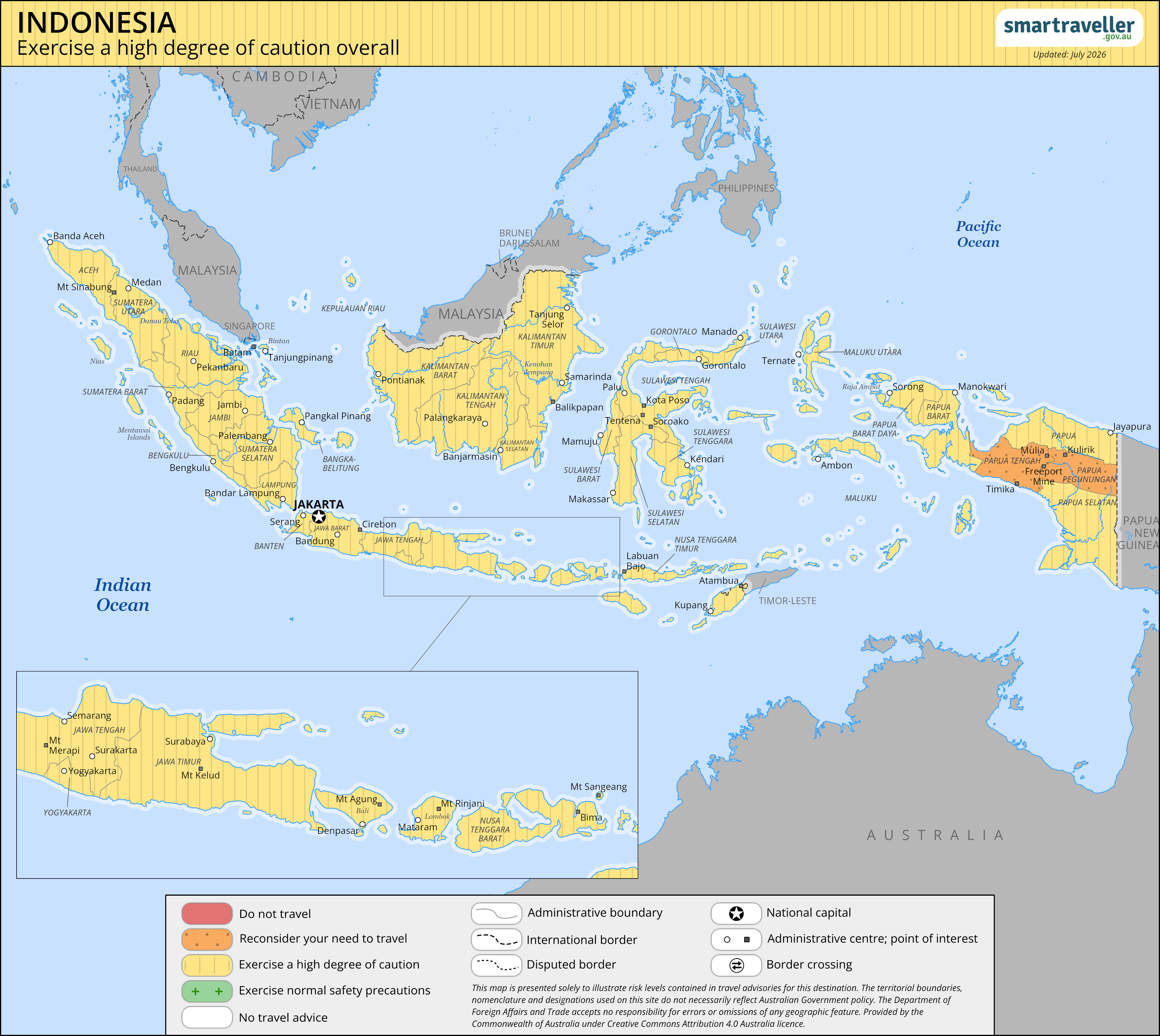
Exercise a high degree of caution in Indonesia overall.
Exercise a high degree of caution in Indonesia overall due to security risks.
See Safety.
Reconsider your need to travel to the provinces of Highland Papua (Papua Pegunungan) and Central Papua (Papua Tengah).
Reconsider your need to travel to the provinces of Papua Pegunungan and Papua Tengah due to the risk of serious security incidents or demonstrations that may turn violent.
See Safety.
Full travel advice: Safety
Full travel advice: Health
Full travel advice: Local laws
Full travel advice: Travel
Full travel advice: Local contacts
The terrorist threat in Indonesia is ongoing. Attacks could happen anywhere and anytime, including at popular tourist areas and government buildings.
Terrorists in Indonesia may carry out small-scale violent attacks with little or no warning.
Take official warnings seriously and follow the advice of local authorities. Remain respectful of religious and local customs.
Indonesian authorities continue to investigate and disrupt terrorist groups in Indonesia, including in Bali.
In the past, police have said that terrorist suspects remain at large and may target Westerners or Western interests, including on days of significance.
Terrorists have attacked places of worship, including in Makassar, Surabaya, Solo and Poso. Be alert in places of worship, especially during periods of religious significance.
Terrorist attacks are motivated by extreme beliefs. Both local grievances as well as conflicts and events in other parts of the world could motivate extremists in Indonesia towards violence.
Supporters have committed additional acts of violence in response to high-profile extremists being detained or killed.
Security remains at a high level at:
If there’s a terrorist incident, leave the area if it’s safe to do so. Don’t gather in a group after an attack or if you’re evacuated from a building. Follow the instructions of local authorities.
For more information on common targets for terrorists and what to do if there’s an attack read our Terrorism page.
Usually, protests are planned in advance, but can occur with little or no notice.
Protests and events are often held near important government buildings and embassies, including the Australian Embassy in Jakarta, Australian Consulates-General in Surabaya, Bali and Makassar, or the offices of international organisations.
Phone or email ahead for an appointment before going to the Embassy or the Consulates-General (see Local contacts).
Protests can cause traffic delays and make it hard to reach some locations.
Demonstrations and acts of violence can happen when courts try and sentence extremists.
Local violence can also happen against minority groups.
Conflict between different communities can sometimes occur, including in the provinces of Papua Pegunungan (Highland Papua) and Papua Tengah (Central Papua), as well as at towns close to the border of the provinces of Papua and Papua Selatan (South Papua). Our ability to provide consular support in these provinces is limited.
If you do something that is seen as a threat to security or public order, you can be arrested, detained or deported under Indonesia's Immigration laws.
To stay safe:
More information:
There are often violent clashes in the provinces of Papua Pegunungan (Highland Papua) and Papua Tengah (Central Papua), and in towns near their borders. These clashes often involve armed groups, civilians, police, and the military. Armed groups have said that they are targeting foreigners, including Australians. Our ability to provide consular help in these provinces is limited.
Attacks have occurred in other remote areas of the Papua provinces including in the province of Papua Barat Daya (Southwest Papua). Get local advice about the current security situation before travelling away from key tourist locations.
Many people have been seriously hurt or killed in clashes, including members of security forces, armed groups and civilians. Violent attacks have occurred in several areas of these provinces, including around the Freeport Mine in Papua Tengah Province.
There's a risk of more attacks. Attacks could target infrastructure and national institutions.
Armed groups have:
Many businesses don't follow safety and maintenance standards, including transport and tour operators, water sports providers, hotels, restaurants and shops.
This makes certain activities risky, including:
Australians have been seriously hurt or even died while doing adventure activities. If you need emergency care or medical evacuation, the Australian Government won't pay for these costs.
If you plan to do an adventure activity:
If you don't see proper safety gear or you're not sure about the company's safety, choose another provider or don't do the activity at all.
Some mountain treks are only for experienced climbers. Always travel with a guide and check how hard the trek is before you go.
Many treks or hikes are near or on an active volcano. Read our advice on Extreme weather and natural disasters before you go. Follow exclusion zones around volcanoes - these can change quickly.
If you plan to visit an area near an active volcano, check with local authorities before you go. Also check for updates on volcano status and alerts from:
Australians have drowned due to rough seas and strong rip currents at popular beaches, including in Bali, Lombok, the Gili Islands, Labuan Bajo and Raja Ampat.
Swimming conditions can vary and change rapidly. Before you dive into the water be informed:
Cases of drink spiking have been reported in Indonesia, including in Bali and Lombok.
Locals and foreigners, including Australians, have died or become seriously ill from methanol poisoning in Indonesia.
Symptoms can be similar to drinking too much. However, they're usually stronger.
Drink only at reputable licensed premises. Avoid homemade alcoholic drinks. Labels on bottles aren't always accurate.
Report suspected cases of methanol poisoning to the Indonesian police.
Contaminated drinks have included:
A range of crimes occur, including violent crime. Crimes can also happen in popular tourist locations in Bali.
Stay alert in your surroundings and in crowds. Learn about dangers in the location you're travelling to.
Theft, robbery, pickpocketing, bag and phone snatching can happen. These crimes can sometimes be violent.
Be careful of thieves:
Keep bags and valuables out of sight.
If you're walking, use footpaths, stay away from the curb, and carry your bag away from the road.
There's a risk of sexual assault, including in popular tourist areas such as Bali. Be alert and stay close to someone you trust if you're going out at night.
If you're a victim of sexual assault:
Your sworn statement, or statements by witnesses, can be used as evidence in court. In some cases, you may be asked to return to Indonesia for the case to progress.
Should you wish to speak to a counsellor, you can call the 24-hour Consular Emergency Centre on +61 2 6261 3305 or contact your nearest Australian Embassy or Consulate (see Local contacts). They can connect you to counselling hotlines and services.
More information:
Kidnapping can happen anywhere, even in places that seem safe.
The risk of kidnapping is higher in Papua Pegunungan, Papua Tengah, and towns close to the borders of these two provinces. In February 2023, a New Zealand pilot was taken hostage by an armed group in Paro, Papua Pegunungan Province. They were released in September 2024. Foreign nationals and expats working for international companies may be at risk.
Kidnappings sometimes occur in Bali. An increasing number of victims have links to the cryptocurrency industry.
The Australian Government's longstanding policy is that it doesn't make payments or concessions to kidnappers.
More information, including advice on how to reduce your risk of kidnapping:
Credit card, online banking and ATM fraud occurs.
Tell your bank you're going to Indonesia before you travel. Ensure your phone number and bank accounts work overseas.
Never let your card out of your sight. Cover your PIN when you use it.
Some vendors, including at ATMs, install hidden cameras and use card skimmers. Use authorised ATMs in safe places, like at a bank branch, shops or shopping centres.
Check your bank statements often. Don't use public Wi-Fi networks for banking, uploading or accessing personal information.
Don’t click on links from people you don't know, especially if your phone is connected to your banking.
Beware of scams and confidence tricks.
Money exchange
Only exchange money at authorised money changers. Authorised money changers can also be found on the Bali Foreign Exchange website. Unauthorised money changers may scam foreign tourists.
Gambling
All types of gambling are illegal in Indonesia.
Australians have lost money in card game scams run by organised gambling gangs, particularly in Bali. See Local laws.
Safety around new people
Some tourists have been robbed or had drugs planted on them after taking new friends or acquaintances back to their hotel rooms. In some cases, their drinks were spiked.
Property
Legal disputes or problems happen over buying land, villas, houses, holiday clubs, resorts, businesses, or timeshares (for example, Airbnbs), including in Bali.
Before entering into an agreement or giving your financial details to anyone:
Always use official, licensed taxis with a meter running, or rideshare apps that track your ride and have real contact details. Check your driver is using a map or GPS while driving.
Crimes involving unregistered taxis and rideshares include:
If you're in an incident involving a taxi or rideshare, leave the vehicle and the immediate area if it's safe to do so. Report the incident to the travel provider or local authorities immediately.
To protect yourself from overcharging and scams:
See Travel.
Piracy
Piracy occurs in the coastal areas of Indonesia.
The International Maritime Bureau (IMB) issues weekly piracy reports.
If you decide to travel by boat in these regions:
More information:
Indonesia experiences natural disasters and severe weather, including:
If there's a natural disaster or severe weather:
More information:
Floods, landslides and mudslides occur regularly during the wet season, which usually runs from October to April. However, the wet season can be different in Eastern Indonesia, which runs from April to August. Some severe weather events result in injury, displacement, death or damaged infrastructure.
Heavy rains can cause significant flooding, including in Bali and the greater Jakarta region, with disruption to roads and transport. Check local media for updates. Walking and driving in flooded areas is dangerous. Flood waters can hide uncovered drains and ditches.
Volcanic activity may escalate with little or no notice, causing flight delays, cancellations or airport closures, including in surrounding provinces. Contact your airline for the latest flight information. You may be ordered to evacuate at short notice.
There are over 120 volcanoes in Indonesia. 76 of them are active volcanoes and could erupt at any time.
The Indonesian Government uses a volcano alert system with 4 levels:
Before you travel to areas that are prone to volcanic activity, check local media and read the Indonesian Government's latest advice on current volcanic activity, including:
If there's volcanic activity, read our advice on what to do during a volcanic eruption while travelling.
Recent and frequent volcanic activity has included:
Some trekking routes are on or near active volcanoes, including Mount Agung and Mount Batur in Bali, Mount Marapi in Sumatra Barat, Mount Merapi near Yogyakarta, Mount Rinjani in Lombok, Mount Bromo and Mount Ijen in Jawa Timur.
Indonesia is in an active earthquake region. It has a high level of earthquake activity, that sometimes triggers tsunamis.
Earthquakes can cause death, injury and significant damage to infrastructure.
The Indian and Pacific Oceans experience more frequent, large and destructive tsunamis than other parts of the world.
High wave events can happen throughout coastal regions, including between islands. They're caused by strong weather conditions and storms.
If you plan to surf, do water activities or travel by sea, check local conditions regularly.
If there’s a tsunami or high wave event:
More information:
Widespread forest fires may occur during the dry season, usually in April to November, particularly in the Riau Islands, central Sumatra and Kalimantan.
They can cause smoke haze resulting in poor air quality, which can affect your health and travel plans.
Stay informed with local updates, including through local media and ask your doctor about how to protect your health.
More information:
Some drugs used to treat attention deficit hyperactivity disorder (ADHD) are illegal in Indonesia.
If you plan to bring over-the-counter or prescription medication, check if it's legal by visiting the Indonesian Embassy in Canberra advice on bringing prescription medication to Indonesia and contacting the Indonesian Embassy in Canberra well in advance of your planned travel. Take just enough legal medicine for your stay and carry it in its original packaging with a receipt from your pharmacy.
On arrival, you may be asked to complete an Indonesian Food and Drug Authority form outlining your prescription medication. An example of the form and information that could be requested is found on pages 15 and 16 (Bahasa Indonesia and English translation).
If you're caught with illegal medicine, you could face imprisonment, fines or harsher penalties. You could face charges even if an Australian doctor prescribed the medication.
Purchasing medication that is classified as 'prescription only' without a valid prescription from an Indonesian doctor is illegal. Authorities monitor the delivery of illegal medication from overseas and in Indonesia.
Cannabis-based products such as cannabis oil and creams, hemp, CBD, THC, hash and edibles, including for medicinal purposes, are illegal. A medical prescription doesn't make it legal. If you bring such products, purchase or use them in Indonesia, you can be arrested and face imprisonment, fines, deportation or the death penalty.
Ask your doctor about health risks and vaccines before you go. Make sure your vaccinations are up to date.
To prevent the spread of infectious diseases, you may be subject to medical screening on arrival, including temperature or health checks.
Insect-borne illnesses are common throughout the year, including:
Australian health authorities have reported Dengue and Japanese encephalitis have been present in people returning from Indonesia, including from popular tourist regions such as Bali.
To protect yourself from disease:
Waterborne, foodborne, parasitic and other infectious diseases are widespread, and serious outbreaks occur. These include:
To stay safe:
More information:
To prevent the entry of Mpox to Indonesia, all international passengers are required to complete the new All Indonesia Arrival Card online and within 72 hours (3 days) of your travel to Indonesia. The arrival card is required for all passengers entering Indonesia at international airports and ferry terminals.
If you have Mpox symptoms, you may be referred to a hospital for treatment on arrival.
If you're in a risk group for Mpox, ask your doctor about vaccination before you travel.
Don't consume magic mushrooms. They're illegal and can cause major health problems including severe hallucinations, psychosis, erratic behaviour and anxiety.
Australians have become sick or injured after taking magic mushrooms. They've also been in trouble with local police, particularly in Bali.
Rabies is throughout Indonesia. It's 100% fatal and is mainly transmitted by dogs, cats, monkeys and bats, but can be transmitted by all land mammals.
To protect yourself from rabies:
Rabies treatment may be limited. The rabies vaccine is not available everywhere. If you're bitten, you may need to return to Australia or travel to another country for immediate treatment.
You can become sick from naturally occurring seafood toxins, including:
Avoid black henna tattoos. The dye often causes serious skin reactions.
Before you get any tattoo, check the hygiene and safety of the provider.
There’s no agreement between Australia and Indonesia for free healthcare. Tourists must pay for all medical care, even if they need to stay in hospital or be evacuated. This can be very expensive. Make sure your travel insurance covers you. The Australian Government won't pay for these costs and can't guarantee your access to hospitals and other health services.
Hospitals will expect your family member or next of kin (family or friend) to guarantee payment before they treat you. They'll also generally need confirmation of medical insurance, a deposit payment, and for your family or friend to guarantee payment in writing.
The standard of medical facilities, including for critical care of seriously ill patients, is generally lower than in Australia, including in Bali. Many regional hospitals only provide basic facilities.
Psychiatric and psychological services are limited. Hospital staff may use physical restraints on patients.
When diving, you may get decompression illness and experience other dive-related medical problems. It can be very serious. Understand the risks before you dive.
Decompression chambers are available in various locations, including in Jakarta, Bali, Lombok, Labuan Bajo, Raja Ampat (Waisai) and Manado.
Confirm the location and quality of decompression chambers and other medical facilities available in the area before you travel.
If you plan to dive, check your insurance covers you for diving.
Ensure you respect local religious beliefs, places of worship, traditional ceremonies, religious offerings and days of significance. Don't climb sacred trees or take photographs that may be offensive, including at religious and cultural sites. Be careful of what you share on social media.
If you're travelling to Bali, read the Bali Provincial Government's official 'Do's and Don’ts' advice before you travel. If you don't observe local customs and laws, you may face criminal penalties and/or deportation. If in doubt, get advice from local officials.
Indonesia's revised criminal code includes penalties for cohabitation, adultery and sex outside of marriage between a man and a woman. If you're married, authorities can act on a complaint from your spouse. If you're unmarried, authorities can act on a complaint from your child or parent.
There's an Electronic and Information Transactions Law (ITE Law). Tough penalties apply for defamation, hate speech, spreading hoaxes or fake news, and posting immoral content online. The law applies both within and outside Indonesia, to both Indonesians and foreigners.
Penalties for drug offences are severe. They include the death penalty.
Police target illegal drug use and possession across Indonesia. Don't possess or use illegal drugs. Police often target popular places, recreation events and venues, including in Bali, Lombok and Jakarta.
You may face heavy fines or jail for using or possessing even small amounts of drugs, including marijuana. Cannabis-based products such as cannabis oil and cream, hemp, CBD, THC, hash and edibles, including for medicinal purposes, are illegal. A medical prescription doesn't make it legal. If you use, purchase or take these products to Indonesia, you can be arrested and face imprisonment, fines, deportation or the death penalty.
More information:
The death penalty exists for some crimes.
Local labour laws can change at short notice. This can affect expat workers.
Standards of dress and behaviour are conservative in many parts of Indonesia. Take care not to offend.
Find out what customs apply at your destination.
If in doubt, seek local advice.
Same-sex relationships aren't legally recognised. Visible displays of same sex relations could draw unwanted attention.
Same-sex relationships are also illegal in the province of Aceh and may attract corporal punishment.
Some laws and regulations may be applied in a way that discriminates against the LGBTQIA+ community, including for pornography and prostitution.
More information:
The Islamic holy month of Ramadan is observed. Respect religious and cultural customs and laws at this time.
During Ramadan, eating, drinking and smoking may be illegal in public. If you're not fasting, avoid these activities around people who are. Seek local advice to avoid offence and follow the advice of local authorities.
More information:
Aceh is governed as a special territory, not a province, and has a degree of special autonomy.
Sharia police enforce Sharia law. This includes regulations and punishments that don't apply in other parts of Indonesia. Punishments may include caning, fines, and imprisonment.
Sharia law is intended for Muslims only. It may be applied to non-Muslims, including foreigners, in some circumstances.
Sharia law doesn't allow:
It also requires a conservative standard of dress.
Take care to be respectful of local customs and social norms. Learn about the laws in Aceh. If in doubt, seek local advice.
Indonesia doesn't allow Indonesian adults to have dual nationality. If you hold an Indonesian passport, you're expected to enter and exit Indonesia on your Indonesian passport. If you hold multiple passports, you must enter and exit Indonesia on the same passport.
Children are allowed to hold Indonesian and Australian dual nationality and passports until they turn 18.
Before a child with dual nationality leaves Indonesia, extra documentation may be needed. Visit an Indonesian Immigration office, contact Indonesian Immigration or the Indonesian Embassy in Canberra well in advance before you travel. You may not be able to leave Indonesia if you don't have the required documents.
More information:
Before travelling to Bali, read the Bali Provincial Government's official 'Do's and Don'ts' advice. Failure to observe local customs and laws may lead to criminal penalties and/or deportation.
Foreign tourists entering Bali must pay a tourist levy of IDR 150,000 per person. The tourist levy is separate from the e-Visa on Arrival (e-VOA) or the Visa on Arrival (VOA).
Cashless payments can be made online before you travel or when you arrive at designated payment counters at Bali's airport and seaport. If you're just transiting or hold a certain visa, you may be exempt from paying the levy. See the Bali Provincial Government's official website and FAQs for further information.
If you're travelling for tourism, official government duties or business meetings, you can apply for an e-VOA online, at least 48 hours before your travel, through the Directorate General of Immigration e-Visa website or the All Indonesia website, following the submission of your arrival card.
You can't transit without an e-VOA or VOA. Check the requirements from Indonesian Immigration before applying.
Additional requirements may apply if you're travelling on government duties.
The e-VOA and VOA cost IDR 500,000, with the e-VOA also charging a small online processing fee.
If you don't apply for an e-VOA at least 48 hours in advance of your travel, you can still apply for a regular VOA at certain international airports, seaports and land crossings. A list of locations can be found on the Directorate General of Immigration website.
For the VOA, some immigration checkpoints may only accept cash payment. ATM facilities, if available, may be in high demand. Be prepared to pay in cash if required.
To apply for a regular VOA, you must show:
The e-VOA and VOA is valid for a 30-day stay and can be extended once (for a maximum of 30 days) by applying at the immigration office closest to your hotel or residence. Make sure you extend your visa within the first 30 days to avoid an overstay fine and deportation.
If travelling on an emergency passport, you can obtain a VOA for tourism (B1) or official travel (B4) only, as long as the passport has 12 months of validity when you enter Indonesia.
Make sure you have the right visa for your trip. It's illegal to work, conduct research, volunteer, or post online content for revenue, payment, sponsorship or other commercial purposes on a tourist visa. Indonesian authorities may consider it a breach of visa conditions if you create content for commercial purposes while you're on a tourist visa, even if the content is published after you've departed Indonesia. Authorities may check that you are following your visa conditions, including what you post online.
Contact your travel agent, airline, or your nearest Embassy or Consulate of Indonesia for details.
If you're entering Indonesia from a port or airport that doesn't issue a VOA, or you're visiting for a purpose not allowed under the e-VOA or VOA conditions, you must apply for a visa before you travel.
Check the Indonesian Immigration website for further information or contact your nearest Embassy or Consulate of Indonesia. Entry and exit conditions can change at short notice.
Overstaying your visa or stay permit, or breaching Indonesian immigration regulations may result in fines, detention, deportation or re-entry bans.
You may not be allowed to enter Indonesia if you have a criminal record. This is regardless of how long ago you committed an offence. If you're concerned, contact an Embassy or Consulate of Indonesia well in advance before you travel.
Indonesian immigration and visa decisions are final. The Australian Government can't help you.
Before entering Indonesia, make sure you understand your visa conditions, entry and exit requirements, including if you travel by private sea vessel. The Australian Government can't intervene in immigration, customs or quarantine matters in other countries.
All international passengers are required to complete the All Indonesia Arrival Card online and within 72 hours (3 days) of your travel to Indonesia. You can apply for an e-VOA following the submission of your arrival card on the All Indonesia website.
Beware of fake websites charging a fee to submit the arrival card. Only use official government sites, which will include ‘go.id’ in the website's address.
If you're staying in a private residence, including private Airbnb or a rental, not a hotel, register when you arrive with both:
More information:
You should also have at least 6 months passport validity from the date you plan to enter and leave Indonesia, to avoid any issues for your departure or onward travel. This also applies even if you're just transiting or stopping over. Travellers have been stranded, detained, or returned to their previous port overseas at their own cost.
If travelling on an emergency passport, make sure you have 12 months validity.
Some foreign governments and airlines apply these rules inconsistently. Travellers can receive conflicting advice from different sources.
Indonesian authorities have strict standards for damaged passports, and travellers have been refused entry with a damaged passport. Normal wear and tear, including water damage, minor tears or rips to the pages, can be considered damaged.
It's important that:
If you're not sure about the condition of your passport, call the Australian Passport Office on 131 232 or contact your nearest Australian embassy or consulate overseas. We may need to see your passport to assess it.
More information:
The local currency is the Indonesian Rupiah (IDR). Only exchange money at authorised money changers. Unauthorised money changers have been known to scam foreign tourists in Bali and elsewhere.
Declare cash in excess of IDR 100,000,000 or equivalent when you arrive and leave. This covers all forms of currency, not only cash.
You may need a travel permit or Surat Keterangan Jalan to travel to some areas of the Papua provinces.
Check if you need a permit with the nearest Embassy or Consulate of Indonesia or with your travel provider.
Mobile phone reception and Wi-Fi are not always available, including in remote areas and some resort islands.
If you're planning to stay for more than 90 days and use your mobile phone purchased outside Indonesia, you'll need to register your mobile phone's IMEI number with Indonesian Customs within the first 90 days of your stay. You can use Wi-Fi networks without registration.
If you're staying for less than 90 days, you can purchase a tourist SIM card or e-SIM to access the Indonesian mobile network.
To drive in Indonesia, you need an Indonesian licence or an International Driving Permit (IDP) in addition to your Australian driver's license.
Check that your licence or permit is appropriate for the type of vehicle you're driving, including motorbikes and mopeds.
Your travel insurer will deny any claims you make if:
Traffic can be extremely congested and road users are often unpredictable.
Some traffic incidents can escalate into violent disputes quickly.
Consider hiring an official taxi or a driver who is familiar with local roads and traffic conditions. If you hire a car, taxi or driver, make sure you do so from legal companies. Only use licensed official metered taxis or rideshare apps. See Safety.
There are daily caps on subsidised fuel purchases. See our advice on Travel, fuel supply and security impacts of conflict in the Middle East.
More information:
Australians have been seriously injured and died in motorcycle and moped accidents. This includes in tourist areas, particularly Bali, Lombok and the Gili Islands.
If there's an accident, you'll often be assumed to be at fault. You may be expected to compensate all parties.
If you hire a motorcycle or moped:
Always wear a helmet. Helmets available locally may not meet Australian safety standards.
Buses, trains and the metro rail can be crowded. Safety standards may not be observed. Train accidents and derailments have occurred in recent years, including in Jakarta.
Inter-city rail networks operate on the islands of Java, Sumatra and Sulawesi.
Commuter trains operate in Java, including Jakarta.
More information:
Travel by boat or ferry can be dangerous. Commercial and private operators may not comply with international safety and maintenance standards. Some operators may not be licensed, especially those not operating from main ports or terminals.
Passenger and luggage limits aren't always observed.
Equipment may not be properly maintained, and they may not have GPS or emergency communications equipment.
There may not be enough life jackets. It's unlikely that the crew will have life jackets for children.
Australians have been seriously injured or have died in marine transport incidents:
If you plan to travel by sea between islands:
If appropriate safety equipment isn't available, use another provider.
Don't travel by water after dark, during wet weather or storms.
More information:
Check Indonesia's air safety profile with the Aviation Safety Network.
The European Union (EU) has published a list of airlines that have operating bans or restrictions within the EU. See the EU list of banned airlines.
More information:
Depending on what you need, contact your:
Call 113.
Call 115.
Call 119.
Call 110.
SMS 1717 for Jakarta Police
Refer to the Bali Tourism Guide’s list of police stations in Bali.
Always get a police report when you report a crime.
Your insurer should have a 24-hour emergency number.
The Australian Government aims to provide high quality consular assistance. There are limits to what we can do. Read the Consular Services Charter to understand how we can assist you overseas.
Jalan Patra Kuningan Raya Kav. 1-4
Jakarta Selatan 12950
Phone: (+62 21) 2550 5555
Email: consular.jakarta@dfat.gov.au
Website: indonesia.embassy.gov.au
Facebook: Australian Embassy Jakarta, Indonesia
X: @DubesAustralia
Instagram: @KeDubesAustralia
Make an appointment online or call (+62 21) 2550 5500 or (+62 21) 2550 5555.
Jalan Tantular 32
Renon
Denpasar Bali 80234
Phone: (+62 361) 2000 100
Email: bali.congen@dfat.gov.au
Website: bali.indonesia.embassy.gov.au
X: @KonJenBali
Instagram: @konjenbali
Wisma Kalla Lt. 7
Jalan Dr Sam Ratulangi No. 8
Makassar South Sulawesi 90125
Phone: (+62 411) 366 4100
Email: consular.makassar@dfat.gov.au
Website: makassar.consulate.gov.au
Facebook: Australian Consulate-General, Makassar, Sulawesi
X: @KonJenMakassar
Instagram: @konjenmakassar
Level 3 ESA Sampoerna Center
Jl. Dokter.Ir. H. Soekarno No. 198
Klampis Ngasem, Sukolilo, Surabaya
Phone: (+62 31) 9920 3200
Email: consular.surabaya@dfat.gov.au
Website: surabaya.consulate.gov.au
Instagram: @KonJenSurabaya
Check the websites for details about opening hours and any temporary closures.
In a consular emergency, if you can't contact an embassy, call the 24-hour Consular Emergency Centre on:
Be the first to know official government advice when travelling.