Fire and rescue services
Call 118.
Medical emergencies
Call 119 in Phnom Penh or go to a hospital. Outside of Phnom Penh you will need to contact a hospital directly.
Police
Call police on 117 or visit the tourist police.

Call 118.
Call 119 in Phnom Penh or go to a hospital. Outside of Phnom Penh you will need to contact a hospital directly.
Call police on 117 or visit the tourist police.
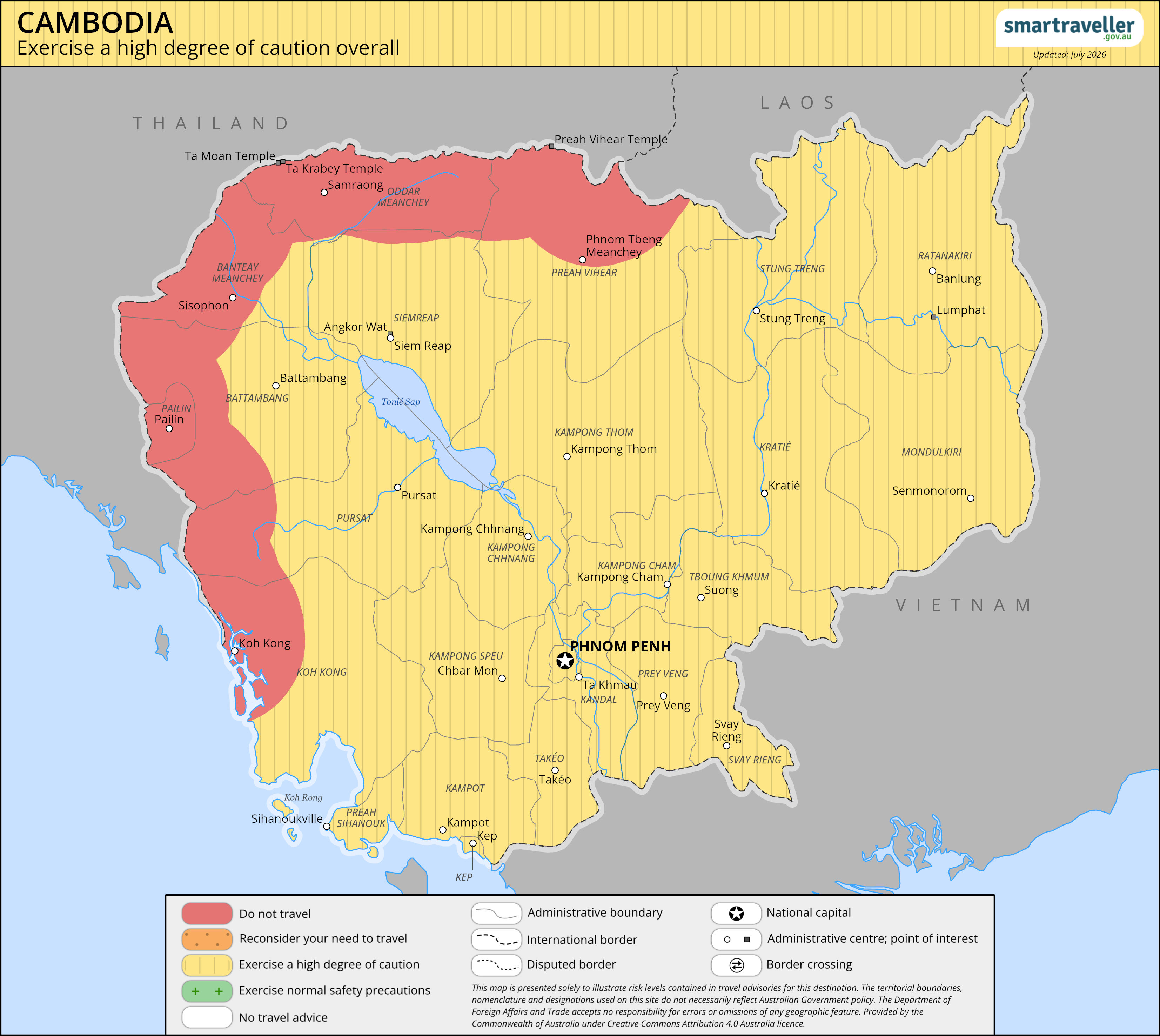
Exercise a high degree of caution in Cambodia overall due to the recent armed conflict and related security risks.
Do not travel to areas within 50 kilometres of the Cambodia-Thailand border in the provinces of Banteay Meanchey, Oddar Meanchey, Preah Vihear, Battambang, Pailin, Pursat and Koh Kong due to the risk of armed conflict between Cambodian and Thai forces, which has included military strikes and violence, and the ongoing presence of landmines and other explosive remnants of war.
Full travel advice: Safety
Full travel advice: Health
Full travel advice: Local laws
Full travel advice: Travel
Full travel advice: Local contacts
Due to the risk of armed clashes along the Cambodia-Thailand border which have included military strikes and violence, and the ongoing presence of landmines and other explosive remnants of war, we advise do not travel to areas within 50 kilometres of the Cambodia-Thailand border in the provinces of Banteay Meanchey, Oddar Meanchey, Preah Vihear, Battambang, Pailin, Pursat, and Koh Kong.
We advise exercise a high degree of caution overall due to recent armed conflict and related security risks. The security situation remains unpredictable. Land border crossings between Cambodia and Thailand remain closed.
Check local and international media for updates, follow the instructions of local authorities and pay close attention to your personal security. Australians in Cambodia should read our general advice about protecting your safety during an armed conflict.
Public protests and events that draw large groups of people may turn violent. Local police and security forces have occasionally responded with force and may not distinguish between demonstrators and bystanders.
Authorities may arrest and deport foreigners involved in protests, or who are filming or taking photos of demonstrations, the military or the police.
In Phnom Penh, possible sites for rallies include:
Roadblocks can be set up with little warning, restricting access through the city. Armed security personnel on the streets can increase around the time of political events such as elections.
Land and border disputes along Cambodia's borders with Vietnam and Thailand have resulted in:
Tourist attractions and border crossing points in these areas can close with little or no notice.
To protect yourself during periods of unrest:
More information:
'Snatch-and-grab' crimes against travellers are common. Thieves often travel on motorcycles and steal from people who are walking along streets or using motorcycle taxis, tuk-tuks or rickshaws.
Foreigners have been injured in these thefts. Be prepared to surrender your valuables rather than risk injury in a struggle.
Some thieves use knives to cut bags as they snatch them.
Significant celebrations often attract large crowds and can lead to petty crime, pickpocketing or more serious threats.
Australians have had valuables stolen from locked hotel and guesthouse rooms, often in cheaper accommodation.
Theft from luggage on buses can occur.
To help protect yourself from theft:
More information:
Foreigners have been the target of sexual assault, particularly in tourist areas.
Criminals often target victims:
To keep safe:
Parties, including organised raves on coastal islands, can be risky. They may place you at greater risk of sexual assault, robbery, injury or losing belongings.
Coastal islands are often isolated. Access to medical or emergency assistance may be limited or not exist.
Get medical attention immediately if you're involved in a violent crime, especially rape. There's a risk of contracting HIV/AIDS, hepatitis, and other sexually transmitted diseases in Cambodia.
More information:
Gun and knife crime has been reported across Cambodia, including in areas visited by tourists. Violent incidents may arise from commercial, personal or other disputes, and bystanders can get caught up. Be aware of your surroundings and report criminal incidents to police.
Foreigners are at risk of armed robbery, home invasions or assault, particularly late at night or when travelling alone.
To help keep yourself safe from assault:
At night, car travel is often safer than travel by motorbike or tuk-tuk.
Rideshare services (such as Grab and PassApp) are common in Phnom Penh, Siem Reap, Sihanoukville, and Kampot and are often safer than a flagged down taxi, motorbike or tuk-tuk.
More information:
Travellers in Cambodia can be targeted in different types of scams, such as:
To protect yourself against scams, understand the warning signs and take steps to reduce your risk. See our advice on protecting yourself from scams and how to help someone who is being scammed.
Be careful of accepting assistance from strangers offering to help with visas or transportation, or inviting you to private homes or businesses. You may be scammed.
Online relationship scams also happen. Australians involved in these scams have been asked to take items with hidden drugs out of Cambodia or may be asked to send large sums of money to assist with fake problems. Never carry parcels or luggage for anyone.
Be aware of business and employment offers that appear 'too good to be true'. Foreign nationals have been trafficked into Cambodia and forced to work in fraudulent activity, with poor pay and living conditions, restrictions on movement, and severe mistreatment.
There are reports of 'scam centres' operated by organised crime, where foreign victims are tricked into coming to Cambodia and other destinations in Southeast Asia with job offers that seem genuine, but then forced to work in online scamming.
Check if job opportunities are real and legal. Look out for worrying signs, which include pay and conditions that are too good to be true, vague promises about visas, insistence on secretive communication and pressure. You can also learn more about business and employment scams on ScamWatch.
Kidnapping can happen anywhere, even in places that seem safe.
The Australian Government’s longstanding policy is that it doesn’t make payments or concessions to kidnappers.
More information:
If there’s a terrorist incident, leave the area if it’s safe to do so and follow the instructions of local authorities.
More information:
Severe weather can happen without warning in Cambodia. In the wet season from July to November, beware of:
Floods may disrupt travel to some provinces. The Mekong River Commission provides news on flood levels for the Mekong River.
To stay informed and safe:
If there's a natural disaster, follow the advice above and:
Mental health services in Cambodia are extremely limited and expensive. Certain medications can be difficult to purchase and be less effective due to the heat or stomach issues travellers may experience. Consider your personal mental health needs carefully before travelling.
Local pharmacies may sell fake medication. It can be difficult to tell real medication from fake.
Insect-borne diseases are widespread in Cambodia, such as dengue, chikungunya and Japanese encephalitis.
Malaria is also common in some regions, especially along the borders in mountain regions.
To protect yourself from disease:
You can get vaccinated against some insect-borne diseases.
Ask your doctor about health risks and vaccines before you go.
More information:
Rabies is throughout Cambodia. It's 100% fatal and is mainly transmitted by dogs, cats, monkeys and bats, but can be transmitted by all land mammals.
To protect yourself from rabies:
Rabies vaccinations and post-exposure treatments are often available at larger medical facilities in tourist areas. Treatment in Phnom Penh is usually available at:
Institute Pasteur Rabies Clinic
No.5, Monivong Boulevard
12201 Phnom Penh, Cambodia
Human cases of avian influenza have been reported in Cambodia. Although rare, avian influenza can spread to humans after close contact with infected birds, animals or contaminated environments.
To reduce your risk of infection:
More information:
Hand, foot and mouth disease (HFMD) is common. Sometimes serious outbreaks occur.
HFMD mostly affects children aged under 10 years old. However, adult cases (especially young adults) also occur.
To reduce the risk of HFMD, practise good hygiene. Wash your hands well and often.
Waterborne, foodborne, parasitic and other infectious diseases are common. They include:
Serious outbreaks sometimes occur.
Freshwater sources, such as rivers and lakes, carry parasitic diseases like bilharzia (schistosomiasis).
To protect yourself from illness:
Get urgent medical attention if you suspect food poisoning, have a fever or diarrhoea.
Hot weather and high humidity often cause heatstroke and dehydration. Drink plenty of water, wear a hat and lightweight clothing, and avoid being in direct sun or doing heavy exercise in hot weather.
Cities experience episodes of high air pollution, which can worsen lung and sinus conditions, allergies or asthma. Get advice from your doctor before you travel.
People who have pre-existing medical conditions, particularly heart and lung conditions, may be especially affected.
If you're concerned about the levels of air pollution:
There’s no agreement between Australia and Cambodia for free healthcare. Tourists must pay for all medical care, even if they need to stay in hospital or be evacuated. If you become seriously ill or injured, you'll need to be evacuated to a place with better facilities. This can be very expensive. Make sure your travel insurance covers you. The Australian Government won't pay for these costs.
Public medical facilities in Cambodia are generally poor in quality. The services they can provide are limited.
Private medical clinics are available in cities, including Phnom Penh, Siem Reap, Kampot and Sihanoukville.
Outside Phnom Penh and Siem Reap there are almost no medical facilities that can deal with medical emergencies.
Hospitals and doctors generally require cash up-front before they'll treat you, even in an emergency. Sometimes they'll accept proof of your medical insurance.
Hospital stays can be expensive. Costs often increase to thousands of dollars. The hospital might keep your passport until you pay.
More information:
Medical tourism is growing in many countries in Asia, including Cambodia. However, medical care in Cambodia doesn't generally meet international standards.
Elective and cosmetic surgery in Cambodia is unregulated. Operations by unqualified surgeons can lead to life-threatening complications.
Laws in Cambodia, including those related to incitement and defamation, can be broadly defined and applied. Be aware that some activities that could be considered the normal exercise of freedom of expression and association could be deemed by authorities in Cambodia to constitute crimes, even if they wouldn't in Australia.
Cambodian authorities have a zero-tolerance policy for drug offences. Don’t use or carry drugs in Cambodia, including cannabis.
Drug offences can attract severe penalties, including life imprisonment with no parole.
Possession of even small quantities of drugs for recreational purposes can lead to long jail sentences and deportation.
It is a crime to have drugs in your system, and you may be required to take a drug test if police suspect you of using drugs.
There are strict security and investigative measures to stop drug trafficking. Never carry parcels or luggage for others.
More information:
Commercial surrogacy is illegal in Cambodia.
Australia doesn't have an intercountry adoption program with Cambodia. This means the Australian Government can't process adoption requests.
The Attorney-General's Department is watching to see if Cambodia will accept intercountry adoption. The department is also waiting to see if Cambodia will comply with the Hague Convention.
More information:
If you intend to marry a Cambodian citizen, you'll need approval from the Cambodian Ministry of Foreign Affairs and International Cooperation. This doesn't apply if you're also a Cambodian citizen.
More information:
In Cambodia, it's illegal to:
It's also illegal to:
Australian and Cambodian authorities are committed to combating child sex offences. Penalties are severe under both Australian and Cambodian law.
You can be punished either in Cambodia or at home under Australian law. Penalties for having sex with anyone younger than 18 years include long jail terms.
Cambodian authorities enforce 'modesty' laws at sites of religious significance, such as Angkor Wat. Dress respectfully, including covering your knees and shoulders. You can't enter if you don't. The Cambodian government have published an official code of conduct for visitors to Angkor Wat.
Don't take photos of people without their permission, especially monks and other religious figures. It's culturally inappropriate.
Avoid taking photographs near sensitive sites, such as:
Same-sex marriage is not legal in Cambodia, however same-sex relationships are legal. Overt public displays of affection are uncommon, regardless of sexual orientation.
More information:
Cambodia recognises dual nationality.
Under Cambodian law, you can't give up Cambodian citizenship, even if you become a national of another country.
You must use your Australian passport to enter and leave Australia.
If you enter Cambodia on a Cambodian passport, local authorities may not view you as Australian. This may limit the consular services we can provide if you’re arrested or detained.
Cambodian dual nationals may be required to enrol in compulsory military service.
If you're a dual national, contact the nearest embassy or consulate of Cambodia before you travel.
More information:
You need a visa to visit Cambodia. Tourists and business travellers can apply for an e-visa online or get a tourist visa on arrival. These are valid for 30 days. For longer stays or other situations, apply for a visa through an embassy or consulate of Cambodia.
Don’t overstay your visa. This is a serious offence (see below).
Entry and exit conditions can change at short notice. Contact the nearest embassy or consulate of Cambodia for the most current visa, entry and exit information.
You can only stay for 30 days from the date of your arrival on a tourist visa. Other visa types will list the date by which you must leave Cambodia or extend your visa.
Overstaying your visa is a serious offence. Authorities will stop you from leaving Cambodia until you resolve your visa overstay. If you overstay your visa, you will be subject to Cambodian immigration law, which involves a fine and may also involve being detained at an Immigration Removal Centre, deported and banned from returning to Cambodia. Conditions at Immigration Removal Centres are harsh and deportation is at your own expense.
Overstay fines are USD10 per day, with no upper limit. If your overstay period is less than 30 days, you can pay the overstay fine upon departure at a border crossing. If your overstay period is more than 30 days, you will be required to pay the fine at the Visa Office. The Visa Office is located opposite the former Phnom Penh International Airport.
Check your visa and the dates carefully. If it was issued outside Cambodia, the expiry date is not how long you can stay. It's the final date you can use it to enter.
If you want to stay in Cambodia for more than 30 days, you must renew your visa. Tourist visas can only be renewed once. Your passport must be valid for at least 6 months from the start date of the visa renewal.
If you obtain a new passport after entering Cambodia (this includes an emergency passport), you will require an exit visa to enable you to depart. You can apply for an exit visa at the Visa Office. The fee is USD30 and the processing time is typically three business days.
You must complete and submit the Cambodia e-Arrival Card within 7 days prior to your arrival in Cambodia by air. On arrival in Cambodia, you'll need to show your completed Cambodia e-Arrival Card. There's no charge for this.
The Cambodian General Department of Immigration requires all foreigners to be registered in the Foreigners Present in Cambodia System (FPCS). Registrations are completed by hotel/guesthouse staff or residence owners. Make sure they register you. Foreigners in self-owned accommodation are required to self-register.
You can renew your visa at some travel agencies, visa agents, hostels or guesthouses.
You can also visit the Department of Immigration office opposite the former Phnom Penh International Airport to renew your visa.
If you plan to retire in Cambodia, consider how you are going to support yourself financially and maintain a valid visa. You will need to regularly renew your visa, manage your health and maintain access to funds. Some individuals find living in Cambodia comfortably affordable but then face significant financial challenges during a health or other emergency. There's little social support available for basic needs and accommodation. Read our advice on going overseas to retire.
If you plan to enter or exit via a land border crossing, first confirm it's open to foreigners. Check you can get a visa when you arrive or apply for a visa in advance. Day trips are not permitted at land border crossings.
Be alert to the security status of border regions and land crossings between countries. Due to recent armed conflict, all land border crossing points along the Cambodia-Thailand border are closed. Landmines and other explosive remnants of war are a risk along the border areas with Thailand, as well as in other areas of Cambodia (see ‘ Safety and Local travel').
If you plan to work in Cambodia, you need the correct visa and a work permit. Your employment status isn't relevant.
The Ministry of Labour and Vocational Training issues work permits.
More information:
To enter Cambodia your passport must be valid for at least 6 months from the date of arrival. If your passport is damaged or has pages missing, you will likely be refused entry into Cambodia.
The official currency of Cambodia is the Cambodian Riel (KHR). USD are also legal tenders.
ATM facilities are available in major cities including Phnom Penh, Siem Reap, Battambang, Sihanoukville and Kampot.
In other areas, ATM facilities are limited and may be unreliable.
Card skimming happens throughout Cambodia. Check for skimming machines before using ATMs, use authorised ATMs in secure areas and check your transaction statements. Keep your card in sight when paying for goods or services.
Take enough US dollars to cover basic travelling expenses.
Ensure your US currency is in good condition. Sellers may not accept:
Fake money is common in Cambodia, check received notes carefully, particularly high value notes.
Landmines and other explosive remnants of war resulting from both historic and recent conflicts are a danger in rural and remote areas throughout Cambodia, particularly along the border with Thailand and in the north and north-west of the country.
If you visit these areas, always stay on marked pathways and pay close attention to official warning signs.
If you want to drive a car or motorcycle larger than 125cc, you’ll need an Australian licence and an International Driving Permit, or a Cambodian licence.
Short-term travellers who want to drive a car or ride a motorcycle larger than 125cc must have a valid Australian licence (digital licences may not be accepted) and an International Driving Permit.
Long-term Cambodian visa holders are required to obtain a Cambodian licence. You can apply for a Cambodian licence equivalent to your Australian licence in person at the Ministry of Public Works and Transport. They have a main office in Phnom Penh and service centres located at Aeon Malls 1 and 2 in Phnom Penh and at the Heritage Walk mall in Siem Reap. If you don’t have a valid foreign licence you’ll need to undergo testing to receive a Cambodian licence. To find out more, contact the Ministry of Public Works and Transport.
Under Cambodian law, you can ride a motorcycle with an engine capacity of up to 125cc without a licence. However, check with your insurer first. Some travel insurers may not cover you for riding a motorcycle at all, even if you're fully licensed. Others won't cover riders unless they hold an Australian motorcycle licence, even if riding a motorcycle with capacity less than 125cc.
Travel by road, especially at night and outside major cities, is dangerous because of:
Road traffic accidents are very common and serious injuries occur everyday. Driving standards are usually poor and vehicles and roads are often not well maintained.
Be alert at all times on the roads, follow local traffic laws and avoid travelling at night outside major cities.
Large crowds can form quickly after road accidents. If you're in an accident, people might try to take advantage of you. If you’re in an accident, follow directions from police and contact your insurance company for assistance.
Speed limits for cars are:
If you get a speeding ticket, you need to pay the fine at a payment centre within 30 days. Always ask for a receipt.
More information:
Motorcycles are a common form of transport in cities. If you plan to travel via motorcycle, either as a driver or passenger, make sure:
Hire companies and motorcycle taxis rarely provide helmets, and most helmets in Cambodia don't meet Australian standards. You should buy or bring your own helmet if you are planning to travel by motorcycle.
Many motorcycle hire companies don’t have insurance. If you have a motorcycle accident, you could be responsible for any damages, loss or costs associated with injury to others. The Embassy can't help you negotiate on compensation demands.
Never give your passport as a deposit or guarantee when renting a motorcycle.
Speed limits for motorcycles are:
Official, metered taxis are generally safe and convenient. However, be alert to possible scams and safety risks.
Registered drivers with ridesharing services are available in Phnom Penh, Siem Reap, and Sihanoukville. Limited services operate in Kampot and Battambang.
Flagged-down motorcycle taxis (moto), tuk-tuks and rickshaws are often used for short trips.
Many drivers do not use metered fares and may charge according to:
Drivers sometimes take passengers without understanding their destination. Destinations are often identified by common landmarks, such as the nearest pagoda.
Before using a moto, tuk-tuk or rickshaw, you should agree on the fare with the driver, have some idea of the best route to take, or use ride-hailing apps such as Grab and PassApp. Check the licence plate number of the vehicle with the number shown on the app before getting in.
Rail services are unreliable and limited. Expect frequent changes and interruptions to schedules with little notice.
More information:
Travel by boat can be dangerous.
Boats taking passengers to islands off the coast of Sihanoukville have sunk.
Even modern boats may be overcrowded and lack basic safety gear.
To help keep yourself safe on the water:
If safety standards are not in place, find another boat.
More information:
The safety and maintenance standards of local aircraft may be low.
Local airlines often cancel or reschedule flights at short notice.
Check Cambodia's air safety profile with the Aviation Safety Network.
More information:
Depending on what you need, contact your:
Call 118.
Call 119 in Phnom Penh or go to a hospital. Outside of Phnom Penh you will need to contact a hospital directly.
Call police on 117 or contact the tourist police in your area.
Tourist police have booths in tourist areas and most cities. In other towns, you can contact the nearest police station. You may need an interpreter.
The police may not have the resources to help you in an emergency or look into reports of crime.
Police stations may not be available 24 hours a day. Phone operators may not speak English.
Be wary of putting your fingerprint or signature on a police document if you can't read it.
Always get a police report when reporting a crime.
The Cambodian National Police have a 24/7 hotline for foreigners to report issues or seek assistance. The hotline can be reached on +855 (0) 31 201 2345, +855 (0) 31 601 2345, or hotinfocnp@police.gov.kh.
Your insurer should also have a 24-hour emergency number.
The Australian Government aims to provide high quality consular assistance. There are limits to what we can do. Read the Consular Services Charter to understand how we can assist you overseas.
For consular assistance, contact the Australian Embassy in Cambodia.
No. 16B, National Assembly Street
Sangkat Tonle Bassac
Khan Chamkarmon
Phnom Penh, Cambodia
Phone: +855 (0) 23 266 500 or +855 (0) 99 266 500
Email: consular.phnompenh@dfat.gov.au
Website: cambodia.embassy.gov.au
Facebook: @AustralianEmbassyPhnomPenh
X: @AusEmbPP
Check the Embassy website for details about opening hours and any temporary closures.
In a consular emergency, if you can't contact an embassy, call the 24-hour Consular Emergency Centre on:
Be the first to know official government advice when travelling.