Fire and rescue services
Call 999.
Medical emergencies
Call 999 or go to the hospital.
Police
Call 999.

Call 999.
Call 999 or go to the hospital.
Call 999.
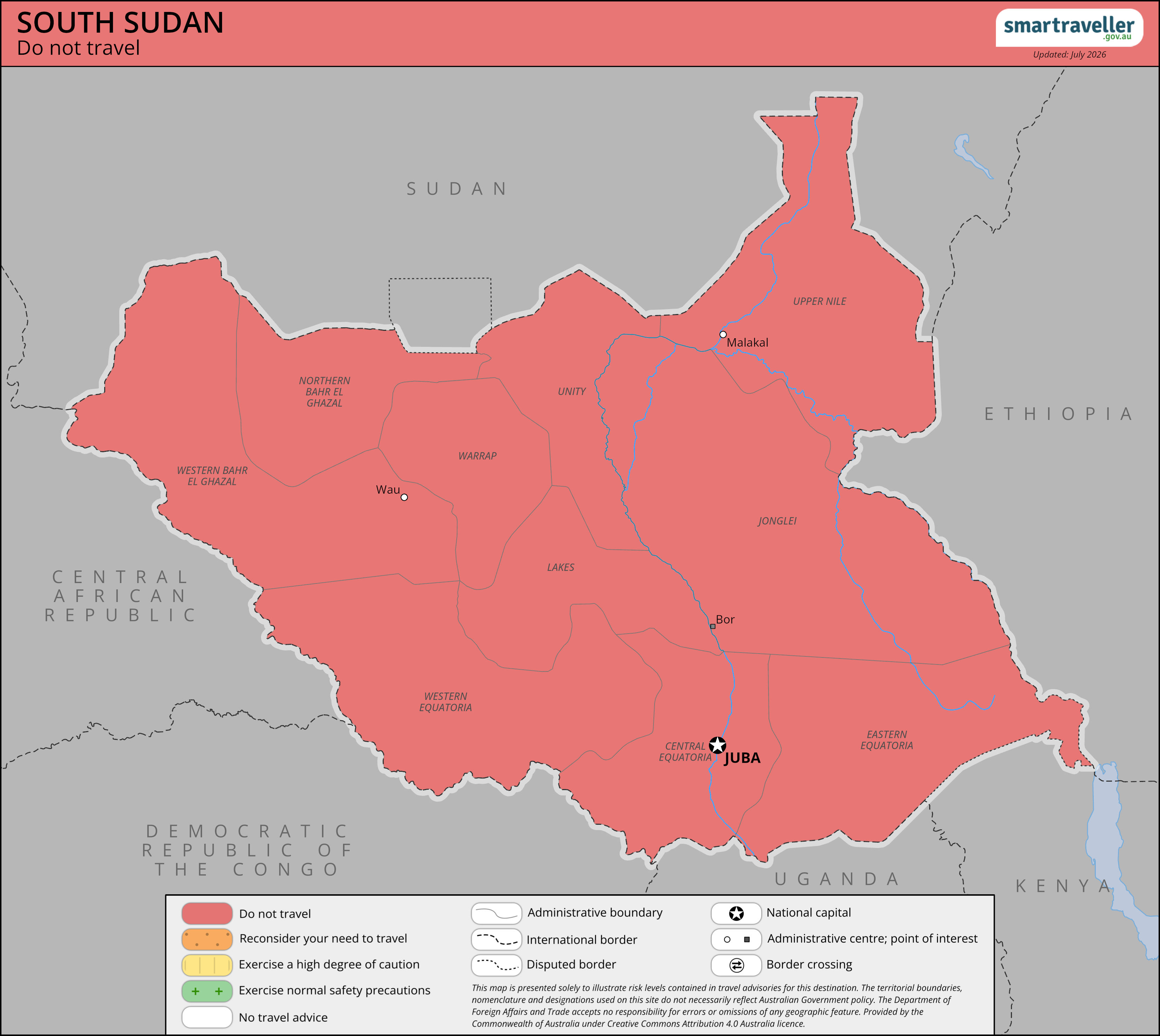
Do not travel to South Sudan, including Juba, due to the dangerous security situation and the threat of armed conflict.
Full travel advice: Safety
Full travel advice: Health
Full travel advice: Local laws
Full travel advice: Travel
Full travel advice: Local contacts
We continue to advise do not travel to South Sudan. Our ability to provide consular services in South Sudan is extremely limited. The Australian Government may not be able to assist you to leave. If the security situation deteriorates further, routes into and out of South Sudan may be blocked and you may be unable to leave for an extended period.
If you travel to South Sudan, despite our advice, be highly vigilant, monitor security developments closely and abide by any imposed curfews. You should also:
Armed conflict between rival factions continues, including air strikes, in some parts of South Sudan resulting in many casualties. Due to continuing tensions in the country, there is a heightened military presence in some parts of the country.
Political tensions remain high. Lack of law and order across the country is a serious threat, the security situation is volatile and could deteriorate with little warning, including in Juba. Thousands of people have been killed in South Sudan since violence began in 2013. Intercommunal violence and fighting between armed groups continue across the country. Border areas are especially dangerous.
There's a serious risk of attacks on civilians. National or international events could prompt attacks on foreigners. Due to the extremely volatile security environment, South Sudan remains a dangerous operating environment for journalists, aid workers and foreign nationals.
With little warning, local authorities can impose:
Juba airport may close or be inaccessible, flights could be suspended and routes in and out of the country may be closed with little or no warning.
The main road connecting Juba to Uganda is highly dangerous.
Landmines and unexploded remnants of war are a danger throughout South Sudan.
Public protests and events that draw large groups of people can turn violent.
To reduce your risks of being affected by demonstrations and protests, you should:
If civil unrest or conflict happens, shelter indoors and stay off the streets.
More information:
Terrorism is a threat worldwide. Terrorist attacks could occur anywhere and at any time. Be alert to possible threats, especially in public places.
Security presence at official facilities is high. Terrorists may look for easier targets, such as housing compounds.
Terrorists may target places popular with travellers, including tourist areas, hotels, clubs, restaurants and bars. Airports, bus stations and other transport hubs are also possible targets.
Other possible targets include:
If despite our advice, you are in South Sudan, be alert to possible threats and report any suspicious behaviour or items to police.
Carefully plan your activities and reconsider travelling to places known to be terrorist targets.
To protect yourself from terrorism:
If there’s a terrorist incident, leave the area if it’s safe to do so and follow the instructions of local authorities.
More information:
Violent crime is widespread and can happen at any time of the day. Armed robbery, including ambush and roadside crime, is common.
Murder, shootings, home invasions, armed robbery, carjacking and sexual assault are common throughout South Sudan, including in Juba.
Gun crime happens frequently and may include:
Petty crime is common and can include:
Criminals are often armed and there's been an increase in the number of crimes involving guns.
Curfews may be imposed at short notice. Most embassies and international organisations have a self-imposed curfew. The time varies depending on local events.
If, despite our advice, you travel to South Sudan:
HIV/AIDS is common. If you're a victim of rape or violent crime, seek immediate medical assistance outside of South Sudan as availability of HIV prophylaxis and psychosocial support may be limited.
Kidnapping occurs across the world with political, ideological, and criminal motives. Foreigners, including Australians, have been kidnapped overseas whilst travelling. Kidnaps can happen anywhere, even in places that seem safe.
Violent crime is widespread in South Sudan and kidnappings are common. Kidnappers mainly target journalists, aid workers and foreign nationals associated with infrastructure in remote and contested areas. The risk is elevated in proximity to the borders of Chad, Sudan and the DRC.
You’re responsible for your own safety:
You can find more information on how to reduce your risk of kidnapping here: Kidnapping.
The Australian Government's longstanding policy is that it doesn't make payments or concessions to kidnappers. Ransom payments to kidnappers have funded further terrorist attacks and criminal activity. Ransom payments to terrorist groups are likely to contravene Australian counter-terrorism financing laws.
If despite our advice, you travel to an area with a high risk of kidnapping our ability to provide consular assistance in these destinations is extremely limited.
More information:
South Sudan experiences natural disasters and severe weather, including:
If, despite our advice, you travel to South Sudan and a natural disaster occurs:
Flooding often occurs in South Sudan, particularly during the rainy season from July to November.
Floods can lead to shortages of drinking water and food. Transport and communication infrastructure can also be damaged.
You're still at risk of waterborne disease after the floodwaters recede.
Northern areas of South Sudan often experience high temperatures. During the hottest months of the year, the temperature can be higher than 50˚C.
Sandstorms, drought and dust storms can occur.
More information:
Yellow fever is widespread in South Sudan. Yellow fever is a potentially fatal virus spread by mosquitoes. It's prevented by vaccination. Get vaccinated before you travel.
Find out about re-entering Australia after exposure to yellow fever.
More information:
The World Health Organisation (WHO) declared an outbreak of Ebola disease in the Democratic Republic of the Congo (DRC) a public health emergency and also reported cases in Uganda. The Bundibugyo strain of Ebola has no approved vaccines or specific antiviral treatments.
Ebola can be transmitted to humans through physical contact with an infectious person, infected animals or contaminated materials. Ebola is often fatal with a mortality rate of around 50 per cent.
Symptoms of Ebola can include:
Seek medical advice immediately if you experience these symptoms. Maintain strict hygiene standards and avoid physical contact with anyone displaying symptoms.
Some countries may introduce health screening on arrival or impose entry restrictions for travellers who have visited countries affected by Ebola. These measures can change quickly and may also affect transit passengers. Check the latest requirements with your airline or travel provider before departure.
Further information and updates on Ebola can also be found on the World Health Organization (WHO) website.
The risk of polio in South Sudan is high.
Make sure you've completed a primary course of polio vaccination and get a booster dose before you travel.
If you're unsure, check with your doctor at least 8 weeks before you travel.
Malaria is common throughout the year across South Sudan.
Other insect-borne diseases occur, including:
To protect yourself from disease:
Get medical advice if you have a fever, muscle pain, rash or severe headache.
HIV/AIDS is common. Take steps to reduce your risk of exposure to the virus.
If you're a victim of rape or violent crime, seek immediate medical assistance outside of South Sudan.
South Sudan is currently experiencing a Cholera outbreak with large number of cases across the country.
To reduce your risk of exposure to the virus, travellers should practice safe food and water precautions. Drink bottled water with intact seals. Boil water that is not from a sealed container. Drink only boiled or bottled water. Avoid raw or undercooked food. Don't swim in fresh water.
Waterborne, foodborne, parasitic and other infectious diseases are common. These include:
Serious outbreaks sometimes occur.
To protect yourself from illness:
Get medical advice if you have a fever or diarrhoea.
Ask your doctor about health risks and vaccines before you go.
More information
Most Australian travel insurance policies won't cover you for travel to South Sudan. You need special travel insurance if you’re travelling to a high-risk destination, which can be expensive.
There’s no agreement between Australia and South Sudan for free healthcare. Tourists must pay for all medical care, even if they need to stay in hospital or be evacuated. This can be very expensive. You'll need to pay cash up-front before doctors and hospitals will treat you.
You'll need to be evacuated if you get seriously ill or injured. Medical evacuation may not be possible and can be very expensive. Make sure your travel insurance covers you. The Australian Government won't pay for these costs.
Medical facilities are basic in Juba and extremely limited elsewhere.
Specialised doctors, surgeons and operating facilities are inadequate in Juba and don't exist elsewhere.
Air ambulances aren't available at short notice. Juba airport is closed after dark.
You're subject to all local laws and penalties, including those that may appear harsh by Australian standards. Research local laws before travelling.
If you are arrested or detained, ask police or prison officials to notify the Australian Embassy in Addis Ababa immediately. The Australian Government will do what it can to help you under our Consular Services Charter. But we can't get you out of trouble or out of jail.
Penalties for drug offences are severe and may include the death penalty.
More information:
Legal proceedings can be lengthy and ineffective. Be aware of your rights and responsibilities.
Seek professional advice if you do anything that involves local legal matters. This is especially the case for family law matters, including:
Penalties for criminal offences can include:
It is illegal to take any photos without a permit from the Ministry of Information. This includes photos taken with a mobile phone.
Same-sex relationships are illegal in South Sudan and may lead to severe punishment, including lengthy jail terms. Discrimination based on sexual orientation is widespread and may lead to harassment by the public and police. LGBTQIA+ travellers should carefully consider the risks of travelling to South Sudan.
More information:
South Sudan recognises dual nationality but considers its dual nationals as South Sudanese first.
This limits the consular services we can give if you're arrested or detained. You may not be allowed to tell us of your situation.
Border officials may scrutinise the travel documents of dual nationals. This may lead to delays at the airport. Previously, officials have stopped some dual nationals from leaving.
More information:
Conservative standards of dress and behaviour are expected in South Sudan, especially in rural areas.
Same-sex relationships are illegal and may lead to harassment by the public and police. LGBTQIA+ travellers should carefully consider the risks of travelling to South Sudan. Avoid public displays of affection.
Take care not to offend. If in doubt, seek local advice.
If, despite our advice, you plan to travel to South Sudan, you need to get a visa issued in advance. You won't be allowed to enter the country without one. Check Department of e-Visa and Immigration Services to get a visa.
Entry and exit conditions can change at short notice. Make sure to keep all travel documentation up to date. Contact the nearest South Sudanese embassy or consulate for details about visas, currency and customs. To extend your visa, contact the Ministry of the Interior in person or email: info@mol.gov.ss.
Ensure your ID and travel documents and those of your travelling family members are up to date and kept securely. This includes passports.
There may be significant delays in obtaining records locally, including certificates of birth, death or marriage. There are limited postal services and internet outside of Juba and limited courier services. Allow sufficient time when trying to obtain records locally or for processing travel documentation, including visas.
The airport at Juba and all land border points can close with little or no warning. Plan sufficient travel time and check your flight status before leaving for the airport. Juba Airport is closed after dark.
Check with your security provider for up-to-date information and security assessments on entry points to South Sudan.
You'll need a valid yellow fever vaccination certificate to enter South Sudan. Some airlines may want to see one when you leave.
Find out about returning to Australia after exposure to yellow fever.
More information:
Arriving travellers may be screened at Juba International Airport and some land entry points to South Sudan.
South Sudan requires you to have at least five blank pages in your passport on arrival.
The local currency is the South Sudanese Pound (SSP).
South Sudan is a cash-based society.
You'll need to pay cash in local currency or US dollars dated 2017 onwards for all purchases, including hotel bills. Shops and restaurants may refuse US dollar notes that are worn, damaged or marked.
Exchange rates for SSP can vary significantly. It is recommended you carry sufficient funds in US dollars to cover expenses for the duration of your stay.
Credit and debit cards, traveller's cheques and cash cards are generally not accepted. ATMs are scarce and often unreliable.
Landmines and unexploded remnants of war are a danger throughout South Sudan.
Use only main roads and paths marked as cleared by a competent de-mining authority.
Road travel is very dangerous due to poor road conditions and the security environment.
Hazards include:
Police presence on roadways outside major towns is limited. Traffic police are poorly trained.
Local drivers regularly ignore traffic signals, and traffic accidents are common.
Road conditions deteriorate during the wet season from July to November.
Highways and other roads may become impassable and some parts of the country can become inaccessible for months.
Roadblocks, official and unofficial armed checkpoints are common throughout South Sudan, including in Juba and especially after dark. Approach all vehicle checkpoints with caution.
Diplomatic, UN and NGO drivers have been stopped and harassed at checkpoints.
There are regular reports of money being demanded from drivers and passengers at these checkpoints.
If despite our advice, you need to drive in South Sudan:
More information:
Avoid public transport.
Many vehicles are badly maintained. Driving standards can be poor.
Check South Sudan's air safety profile with the Aviation Safety Network.
More information:
Depending on what you need, you should contact your:
Call 999.
Call 999 or go to the hospital.
Call 999 or 777.
Always get a police report when you report a crime.
Your insurer should have a 24-hour emergency number.
There are limits to what consular assistance we can provide in high-risk locations. Read the Consular Services Charter to understand how we can assist you overseas.
Australia doesn't have an embassy or consulate in South Sudan. For consular assistance, contact the Australian Embassy in Addis Ababa, Ethiopia.
The security situation and other factors mean the Australian Government's ability to provide consular services in South Sudan is extremely limited.
Turkish compound (off Cape Verde Street)
Bole Subcity, Woreda 3
PO Box 3715
Addis Ababa, Ethiopia
Phone: +251 11 6672651 / 6672652 / 6672693 / 6672694
Email: Consular.AddisAbaba@dfat.gov.au
Website: ethiopia.embassy.gov.au
Facebook: @AusEmb.ET
Twitter: @AusEmbET
Check the Embassy website for details about opening hours and any temporary closures.
In a consular emergency, if you can't contact an embassy, call the 24-hour Consular Emergency Centre on:
Be the first to know official government advice when travelling.