Fire and rescue services
Call 18.
Medical emergencies
Call 18 or go to the hospital.
Police
Call 17 or go to the nearest police station.
Call 18.
Call 18 or go to the hospital.
Call 17 or go to the nearest police station.
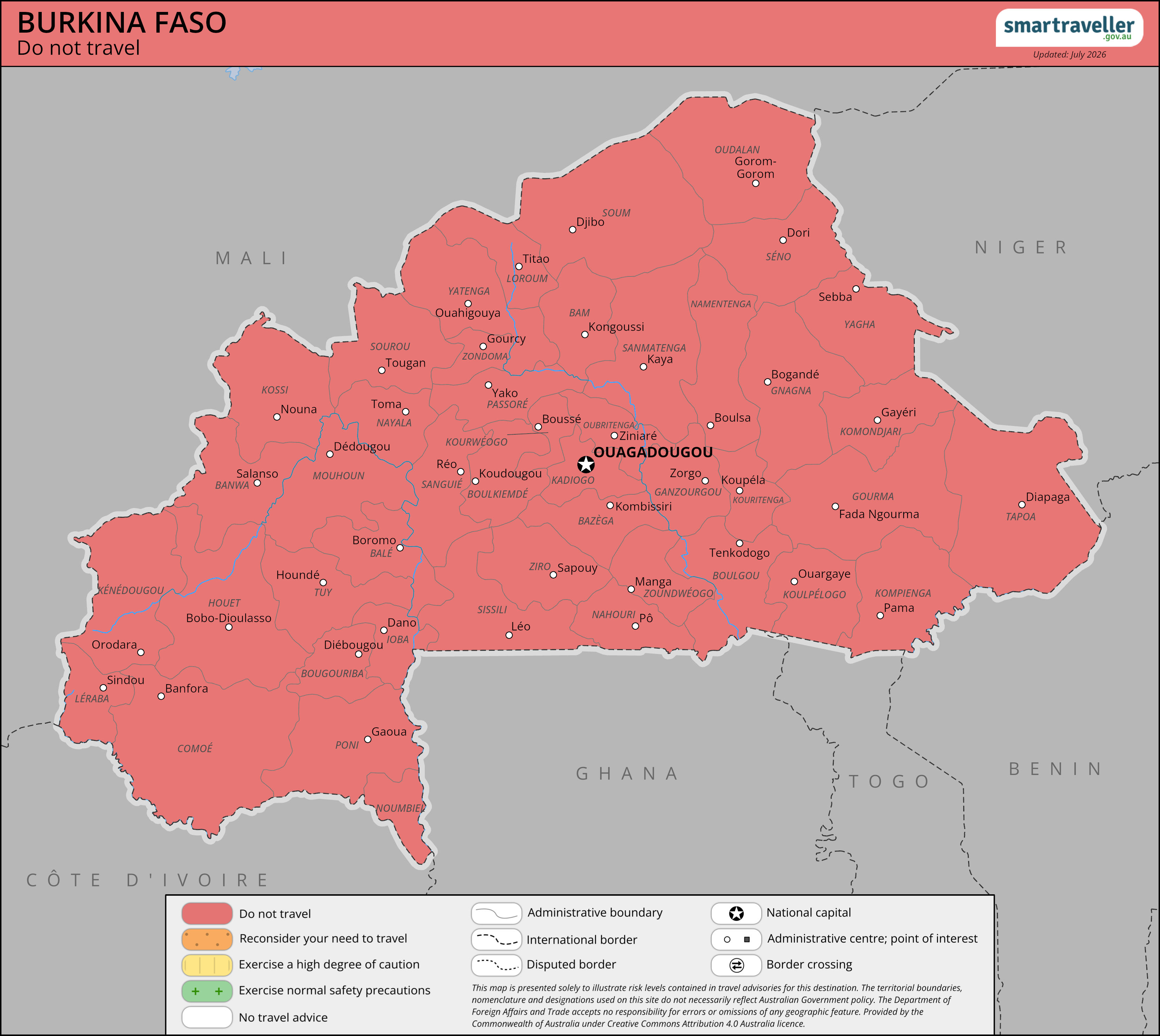
Do not travel to Burkina Faso due to the dangerous security situation and the high threat of terrorism, kidnapping and violent crime.
See Safety
Full travel advice: Safety
Full travel advice: Health
Full travel advice: Local laws
Full travel advice: Travel
Full travel advice: Local contacts
The security situation across Burkina Faso is dangerous and volatile, and there's an ongoing and very high threat of terrorist attacks and kidnapping.
Kidnapping by terrorist groups is a very high risk across Burkina Faso, and is particularly high in areas bordering Mali and Niger. Several foreigners, including Australians, have been kidnapped in Burkina Faso. Active terrorist groups maintain the intent and capability to kidnap foreigners.
Terrorists and other armed groups regularly conduct attacks targeting security forces, civilians and foreign interests. These groups have fuelled inter-community tensions in the area, resulting in regular ethnic group clashes. There are ongoing military operations throughout the country.
If you're in Burkina Faso, despite our advice, you should consider leaving by commercial means if it's safe to do so.
Further attacks are very likely, including in the capital Ouagadougou. Attacks can occur in places visited by foreigners, including:
If, despite our advice, you travel to Burkina Faso, stay alert to protect yourself from terrorism:
Have an exit plan ready if you must go to a place that is a possible target. Maintain a stock of supplies, including food, water, fuel, and medical supplies, in case you need to shelter in place.
If there’s a terrorist incident, leave the area if it’s safe to do so and follow the instructions of local authorities.
More information:
Kidnapping occurs across the world with political, ideological, and criminal motives. Foreigners, including Australians, have been kidnapped overseas whilst travelling. Kidnaps can happen anywhere, even in places that seem safe.
Kidnapping by terrorist groups is a very high risk across Burkina Faso, and is particularly high in areas bordering Mali and Niger. Several foreigners, including Australians, have been kidnapped in Burkina Faso. Active terrorist groups maintain the intent and capability to kidnap foreigners.
The kidnapping risk to foreign nationals in southern Burkina Faso is also increasing. Foreign nationals and foreign interests, including mining operations, may be targeted. Other possible targets include aid workers and long-term residents of Burkina Faso.
If, despite our advice, you travel to an area with a high risk of kidnapping, our ability to provide assistance in these destinations is extremely limited.
You’re responsible for your own safety. You can find more information on how to reduce your risk of kidnapping here: Kidnapping
The Australian Government’s longstanding policy is that it doesn’t make payments or concessions to kidnappers. Ransom payments to kidnappers have funded further terrorist attacks and criminal activity. Ransom payments to terrorist groups are likely to contravene Australian counter-terrorism financing laws.
More information:
A transitional government assumed control in 2022 following two coup d’états in Burkina Faso. The situation remains unstable and could deteriorate quickly. Monitor security alerts from the US Embassy in Burkina Faso and the Canadian Embassy in Burkina Faso.
A state of emergency is in place in the following 8 regions: Centre-Est, Est, Centre Nord, Nord, Boucle du Mouhoun, Sahel, Hauts-Bassins and Cascades. Local authorities periodically declare a state of emergency in various regions due to terrorism threats. The measure gives security forces extra powers to conduct searches, restrict freedom of movement and detain persons of interest. Some civil rights may be suspended, including the right to protest and to hold large meetings.
If, despite our advice, you travel to a region where a state of emergency is in effect:
Maintain a stock of supplies, including food, water, fuel, and medical supplies, in case you need to shelter in place.
Public protests and events that draw large groups of people can turn violent. Demonstrations may occur throughout Burkina Faso with little or no warning. Expect roadblocks or groups of large demonstrators in central Ouagadougou and the surrounding area. Avoid large gatherings, particularly in the lead-up to, during and in the aftermath of key dates (such as religious or public holidays) in your location, monitor media and follow the advice of local authorities.
To reduce your risk during periods of unrest:
If a protest happens near you, leave the area as soon as it's safe.
Maintain a stock of supplies, including food, water, fuel, and medical supplies, in case you need to shelter in place.
More information:
Crime can occur across the country. Attacks can happen anywhere. Foreigners may be targeted. Be mindful of your surroundings and personal security.
Purse snatchings and muggings are common, especially in Bobo Dioulasso and Ouagadougou.
Thefts are sometimes committed by one or two people on a motorbike.
Security risks increase at night and during holiday periods.
Take sensible precautions. Don't carry valuables in public places or walk alone at night.
Violent crime occurs across Burkina Faso. This includes:
The risk of violent crime can happen at any time of the day but increases after dark. Your risk also increases if you're a woman travelling alone. If you're a victim of a violent crime, including sexual assault, get medical assistance. Same-sex relations are illegal in Burkina Faso and victims of same-sex sexual assault may be prosecuted.
Armed roadside banditry is a problem across the country. Buses and other vehicles are targeted, especially on main and secondary roads connecting major cities within Burkina Faso and nearby countries. Armed thieves use roadblocks to stop vehicles and may open fire. Some thieves use spotters to identify victims at roadhouses and checkpoints.
Criminals in urban areas may carry a knife or sharp weapon to cut the straps on bags, purses, or backpacks and can become violent if the victim resists.
To reduce your risk of crime:
More information:
Internet fraud is common and often starts in West African countries. People have lost money to internet scams.
Internet scams may present to you as romances, friendships, or business and employment opportunities. These scams usually start via internet dating sites or chat rooms.
Victims have also travelled to West African countries to meet a friend or someone they intend to marry that they have met online or to get back money. They've been at risk of kidnapping, assault and robbery. Some victims have been killed.
Criminals might:
To protect yourself from scams:
If you're the victim of a scam, get legal advice. Don't travel to Burkina Faso to get your money back or to get revenge. You could be in danger.
More information:
Flooding may occur in the wet season from June to October. Floods can close roads.
Extreme weather can affect your travel. Monitor local media for up-to-date information.
If, despite our advice, you travel to Burkina Faso and you're visiting an area affected by severe weather:
In the event of flooding and severe weather, follow the advice of local authorities.
Register with the Global Disaster Alert and Coordination System to receive alerts on major disasters.
Sandstorms can occur at any time, particularly during the summer months in the south of the country. From November to May, the Harmattan, a wind blowing from the Sahara, brings sand and dust.
During a dust storm:
More information:
Yellow fever is common in Burkina Faso. Yellow fever is a potentially fatal virus spread by mosquitoes. It's prevented by vaccination. Get vaccinated before you travel.
Malaria, dengue and other insect-borne diseases are common.
To protect yourself from disease:
Get medical advice if you have a fever, muscle pain, rash or severe headache.
The rate of HIV/AIDS infection is high. Take precautions if you engage in activities that may expose you to the virus.
Waterborne, foodborne, parasitic, and other infectious diseases are common. These include:
Serious outbreaks sometimes occur. Follow the advice of local authorities if there is an infectious disease outbreak.
To protect yourself from illness:
Get medical advice if you have a fever or diarrhoea.
Ask your doctor about health risks and vaccines before you go.
More information:
There’s no agreement between Australia and Burkina Faso for free healthcare. Tourists must pay for all medical care, even if they need to stay in hospital or be evacuated. This can be very expensive. Make sure your travel insurance covers you. The Australian Government won't pay for these costs.
Medical facilities are poor, and emergency services are very limited, particularly outside Ouagadougou.
Local health services may have difficulty responding to outbreaks of infectious disease.
You may need to pay cash up-front before doctors and hospitals will treat you, even in an emergency.
You'll need to be evacuated if you get seriously ill or injured. Medical evacuation may not be possible and can be very expensive. Most Australian travel insurance policies won't cover you for travel to Burkina Faso.
More information:
When you travel to another country, you must follow their laws. Even if they seem strict compared to Australia's. Before you go, learn about the local laws in that country.
The Australian Government is limited in how and when we can help if you're arrested overseas. We can't get you out of trouble or out of jail. Understand our limits. Read the Consular Services Charter.
Burkina Faso authorities may define certain behaviours and activities as criminal that would not be considered as such in Australia. Australians may be at risk of arbitrary detention or harsh enforcement of local laws for unintentionally breaking the law.
Penalties for possessing, using or trafficking illegal drugs are severe. You could receive a heavy fine or a long jail sentence.
More information:
It's illegal to take photos of military zones, assets or personnel, airports, government buildings (including foreign diplomatic missions) and places of worship and religious monuments.
It's also illegal to export art or cultural objects without approval from the Ministry of Culture.
Burkina Faso requires travellers to register all satellite phones.
Some Australian laws still apply even if you’re in another country. You could be charged in Australia if you break these laws overseas.
More information:
Burkina Faso has conservative standards of dress and behaviour. Take care not to offend. If in doubt, ask for local advice.
Engaging in same-sex relations is illegal and could lead to prison sentences and fines or deportation for foreign nationals.
Engaging in same-sex relationships or any behaviours 'promoting' same-sex relations, is illegal and could lead to prison sentences and fines or deportation for foreign nationals. LGBTQIA+ people are at risk of harassment or violence. Avoid public displays of affection. Consider your travel plans and personal security carefully.
More information:
If, despite our advice, you travel to Burkina Faso, be aware that entry and exit requirements can change at short notice.
Borders may close and additional security measures may be introduced without notice. Follow the advice of local authorities. Keep in contact with family and friends so they know you're safe and well.
Contact an embassy or consulate of Burkina Faso for details about visas, currency and customs.
The Australian High Commission in Accra has very limited capacity to provide consular assistance in West Africa.
You'll need a valid yellow fever vaccination certificate to enter Burkina Faso. Some airlines may want to see one when you leave.
Find out about returning to Australia after exposure to yellow fever.
More information:
The local currency is the West African Franc (CFA Franc, or XOF).
Declare all foreign currency and CFA on arrival.
It's hard to exchange Australian dollars in Burkina Faso.
You can exchange US dollars and euros at commercial banks and exchange bureaus in major centres.
Some large hotels and restaurants in Ouagadougou accept credit cards.
Few businesses outside of the capital accept credit cards. There are few ATMs outside major cities.
Plan ahead and have enough cash to meet your needs. Contact your bank to make sure you can use your cards.
To drive in Burkina Faso, you need both:
Get your IDP before you leave Australia.
Apart from the national highways, most roads are in poor condition and poorly lit.
Many vehicles are also in poor condition.
Driving outside Ouagadougou at night is dangerous. Vehicles don't always use or have headlights. Livestock can stray onto roads.
Armed criminals target vehicles across the country.
If you plan to drive:
To reduce your risks:
If you travel outside Ouagadougou:
More information:
Make sure your travel insurance covers you when using a motorbike, quad bike or similar vehicle.
Always wear a helmet.
Use registered taxis and limousines. It's best to book them through your hotel.
Don't use public transport due to safety concerns and the risk of crime. Many public buses are poorly maintained, and serious accidents occur.
If you do use public transport despite our advice, protect your belongings, especially during overnight travel.
DFAT doesn’t give advice about how safe different airlines or flight paths are.
Safety risks and weather events may cause flight delays and cancellations. Contact your travel agent or airline to confirm your plans.
Check Burkina Faso's air safety profile with the Aviation Safety Network.
More information:
Depending on what you need, contact your:
Call 18.
Call 18 or go to the hospital.
Call 17 or go to the nearest police station.
Always get a police report when you report a crime.
Your insurer should have a 24-hour emergency number.
There are limits to what consular assistance we can provide in high-risk locations. Read the Consular Services Charter to understand how we can assist you overseas.
Australia doesn't have an embassy or consulate in Burkina Faso.
You can access consular help from the Canadian Embassy in Ouagadougou. It can issue provisional travel documents. The Embassy of Canada in Ouagadougou is closed for in-person appointments due to security reasons. For consular assistance, please contact the Embassy by phone or email.
You can also get consular help from the Australian High Commission in Ghana. Subscribe to this travel advice to get the latest updates directly.
Monitor for security alerts from the US Embassy in Burkina Faso and the Canadian Embassy in Burkina Faso.
316 Professeur Joseph Kizerbo Ave
Ouagadougou 01, Burkina Faso
Phone: (+226) 25 49 08 00
Email: ouaga-cs@international.gc.ca
Website: https://www.international.gc.ca/country-pays/burkina_faso/index.aspx?lang=eng
2, Second Rangoon Close
(cnr Josef Broz Tito Ave)
Cantonments
Accra, Ghana
Phone: +233 302 216 400
Email: Accrahc.Enquiries@dfat.gov.au
Website: ghana.highcommission.gov.au
Facebook: Australian High Commission, Ghana
X: @AusAmbGHA
The Australian High Commission in Accra currently has very limited capacity to provide consular assistance in West Africa, except in Ghana.
Check the High Commission website for details about opening hours.
In a consular emergency, if you can't contact an embassy, call the 24-hour Consular Emergency Centre on:
Be the first to know official government advice when travelling.