Fire and rescue services
Call 111.
Medical emergencies
Call 111.
Police
Call 111 or contact the nearest police station.
Call 105 or go online for Police non-emergencies.


Call 111.
Call 111.
Call 111 or contact the nearest police station.
Call 105 or go online for Police non-emergencies.
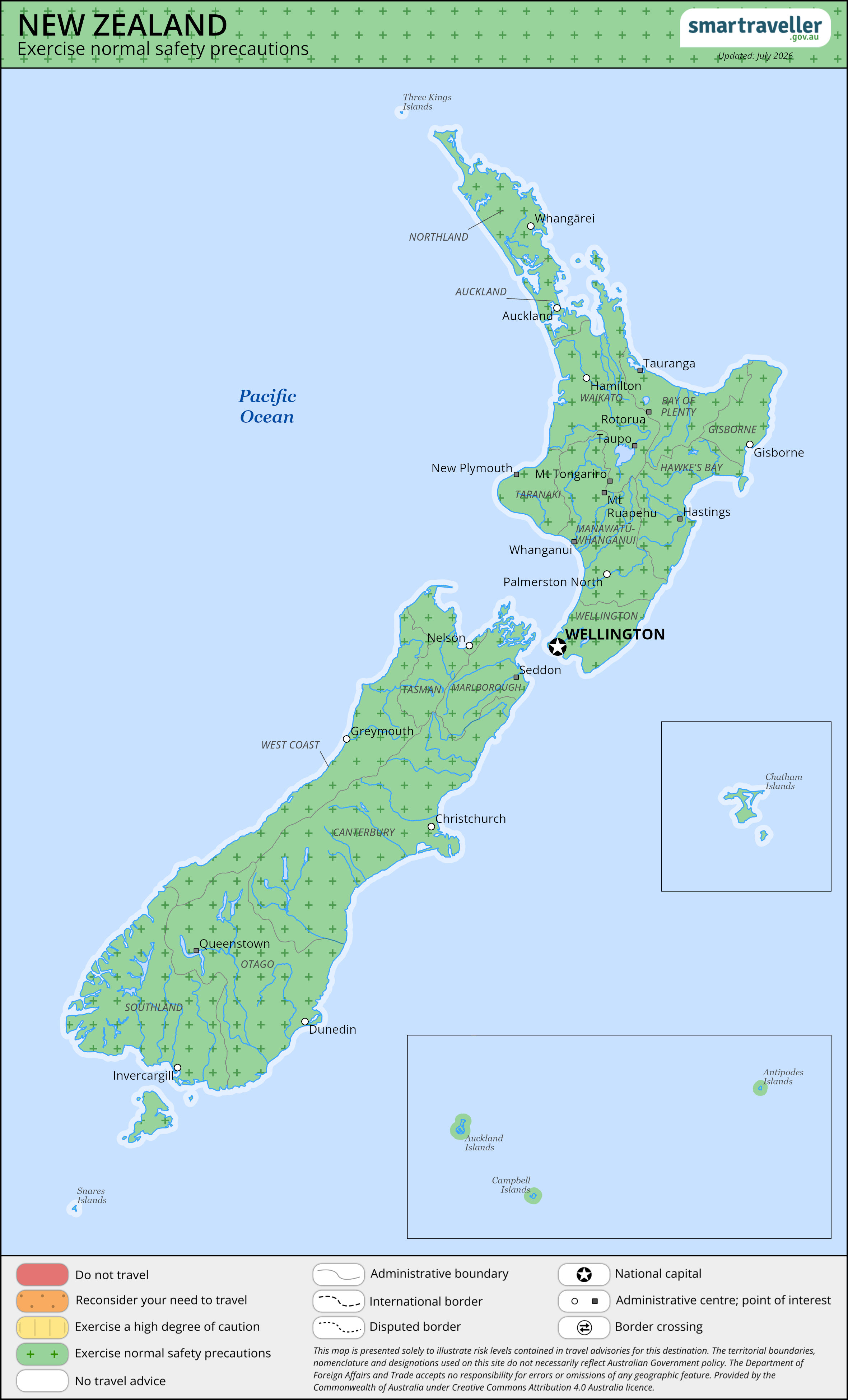
Exercise normal safety precautions in New Zealand.
Exercise normal safety precautions in New Zealand.
Full travel advice: Safety
Full travel advice: Health
Full travel advice: Local laws
Full travel advice: Travel
Full travel advice: Local contacts
Crime rates in New Zealand are similar to those in Australia.
Thieves often target valuables left in cars and campervans.
Kidnapping can happen anywhere, anytime, including in destinations that are typically at lower risk.
The Australian Government's longstanding policy is that it doesn't make payments or concessions to kidnappers.
More information:
Protests are generally peaceful. However, public protests and events that draw large groups of people can turn violent.
Follow the advice of local authorities.
More information:
Terrorism is a threat worldwide. Terrorist attacks could occur anywhere and at any time. Be alert to possible threats, especially in public places.
More information:
New Zealand experiences natural disasters and severe weather, including:
To protect yourself in a natural disaster:
Monitor local media and other sources, including:
Weather conditions can change quickly. Severe weather can occur.
Creeks and rivers can experience flash flooding after heavy rains.
Rapid weather changes could leave you stranded or injured, particularly if you're in a remote area.
Monitor weather conditions, forecasts and warnings from Metservice.
Take extra care if you're climbing, hiking or in a remote area.
Earthquakes are a constant risk in New Zealand.
Most quakes are too small or deep in the earth to feel. However, about 150 to 200 quakes are big enough to feel each year.
Large, damaging earthquakes have occurred and could happen again at any time. Aftershocks can continue for days or weeks.
When an earthquake happens, you're advised to drop, cover and hold. If an earthquake is long or strong, and you're near the coast or large body of water, you should go to higher ground immediately as a tsunami may occur.
If you're indoors during an earthquake:
If you're in bed:
If you're outdoors:
If you're in a car:
If you're in a lift:
After the earthquake finishes:
Because of the region's earthquake risk, tsunamis could happen.
All of New Zealand's coastline is at risk of a tsunami. New Zealand is a member of the Pacific Tsunami Warning System.
The National Emergency Management Agency manages the National Tsunami Advisory and Warning Plan and issues tsunami alerts on its website. These are also broadcast by New Zealand media.
A tsunami could arrive within minutes. There may not be time for an official warning.
Move immediately to high ground, or as far inland as possible, if you're near the coast and you:
Don't wait for official warnings.
Walk or ride a bike if possible because of potential road congestion.
New Zealand's active volcanoes can erupt at any time. Volcanic alert levels may rise quickly. You may be ordered to evacuate at short notice.
If there's volcanic activity:
If you plan to visit active volcanoes or surrounding areas:
Visit GeoNet for information about volcanic activity at:
Parts of New Zealand experience bushfires in hot, dry conditions.
If there's a bushfire, monitor local media and follow the advice from the local authorities.
Most people enjoy adventure activities safely in New Zealand. However, these activities carry risks.
Several serious accidents involving Australians and other travellers have occurred. People have died.
Some operators have been found to be negligent.
Safety standards can differ both between individual operators, and from standards in Australia.
If you plan to do an adventure activity:
Safety risks can increase in severe weather and remote areas.
Before you do any adventure activities:
If you're trekking or travelling in a remote area:
You can hire personal locator beacons throughout New Zealand.
When you return from a hike, check in with:
More information:
For specific information on bringing medication into New Zealand, read the New Zealand Customs Service.
General health risks are broadly similar to those in Australia. There is currently an increased risk of measles in New Zealand.
Measles is very infectious and can be severe, requiring hospitalisation.
If you're going overseas, make sure you're fully vaccinated. Vaccination is the best prevention.
More information:
Medical facilities and services are of a similar standard to those in Australia.
New Zealand and Australia have a reciprocal health care agreement. This lets Australians access public medical facilities and care.
It doesn't:
To access services under the agreement:
More information:
If you're injured in an accident, the Accident Compensation Corporation (ACC) covers the costs of hospital treatment.
The cover provided by ACC:
Penalties for possessing and using drugs may include fines and prison sentences.
More information:
You'll need photo ID to buy alcohol or enter licensed premises.
You can't use your Australian driver's licence.
Approved IDs include:
More information:
New Zealand has strict biosecurity rules.
If you don't declare items for quarantine, you'll get an instant fine.
If you make a false statement, you'll face heavy fines and prison sentences.
When you arrive, customs officers may check electronic devices they suspect are being used in criminal activity. Devices may include:
New Zealand recognises dual nationality.
If you're an Australian-New Zealand dual national, use your Australian passport to enter and leave Australia.
More information:
Most Australian citizens don’t need a visa to enter unless you have a criminal record or if you've been deported from any country.
Australian permanent residents need to apply online for a New Zealand Electronic Travel Authority (NZeTA) to enter New Zealand. Australian citizens are exempt from this rule.
For more information refer to the NZ Government Immigration website.
If you've been:
Contact a New Zealand Visa Application Centre for advice well before you travel.
Level 6
88 Pitt Street
Sydney NSW 2000
Phone: +61 2 8279 8649 Website: vfsglobal
Email: info.inzsydney@vfshelpline.com
You must complete a New Zealand Traveller Declaration Form (NZTD) before passport control on arrival. You need to answer questions about your trip and what you’re bringing into the country. You can complete it online or by using the NZTD app, there's no cost.
If you are a New Zealand visa or NZeTA holder you still need to complete an NZTD.
For more information see the NZTD website.
New Zealand's maritime border is open to all vessels, including foreign flagged vessels, cruise ships, recreational vessels (such as yachts and small craft) and specialist vessels used in research and exploration.
For more information see the New Zealand Customs Service – Travelling to New Zealand webpage.
More information:
For specific information on passports in New Zealand, read the NZ Immigration website.
The local currency is the New Zealand Dollar ($NZ).
Declare all amounts over $NZ10,000 or equivalent on arrival and departure. This covers all forms of currency, not only cash.
You can drive for up to 12 months with your Australian driver's licence.
After that, you'll need to get a local licence.
More information:
Ice, snow, fog, high winds and roaming animals can cause hazardous conditions. Heavy rain can cause landslides across roads.
Outside major cities, there aren't many motorways. Overtaking opportunities are limited.
Railway crossings don't always have barriers, particularly in country areas.
If you're driving in mountain areas or to ski fields, be aware that roads:
If you plan to drive in New Zealand:
More information:
Make sure your travel insurance covers using a motorbike, quad bike or similar vehicle.
Always wear a helmet.
Taxis and rideshares are generally reliable.
The New Zealand Transport Authority regulates taxis and rideshare apps.
Buses, trains and ferries operate throughout New Zealand. State-run services are also regulated by the New Zealand Transport Authority.
Take care of your belongings on public transport.
More information:
Several international cruise lines stopover in New Zealand.
Check New Zealand's air safety profile with the Aviation Safety Network.
More information:
Depending on what you need, contact your:
Call 111.
Call 111.
Call 111 or contact the nearest police station.
Call 105 or go online for Police non-emergencies.
Always get a police report when you report a crime.
Your insurer should have a 24-hour emergency number.
The Australian Government aims to provide high quality consular assistance. There are limits to what we can do. Read the Consular Services Charter to understand how we can assist you overseas.
For consular help, contact the Australian High Commission in Wellington, or the Australian Consulate-General in Auckland.
72-76 Hobson Street
Thorndon
Wellington, New Zealand
Phone: +64 4 473 6411
Fax: +64 4 498 7103
Website: newzealand.highcommission.gov.au
Facebook: Australia in New Zealand
Instagram: @AusHCNZ
X: @AusHCNZ
Level 7, HSBC Tower
186-194 Quay Street
Auckland City, New Zealand
Phone: +64 9 921 8800
Fax: +64 9 921 8820
Check the High Commission website for details about opening hours and any temporary closures.
In a consular emergency, if you can't contact an embassy, call the 24-hour Consular Emergency Centre on:
Be the first to know official government advice when travelling.