Fire and rescue services
Call 112.
Medical emergencies
Call 112 or go to a hospital.
Police
Call 112 or go to the local police station.

Full travel advice: Safety
Full travel advice: Health
Full travel advice: Local laws
Full travel advice: Travel
Full travel advice: Local contacts
Terrorism is a threat worldwide. Terrorist attacks could occur anywhere and at any time. Be alert to possible threats, especially in public places.
Denmark's domestic terror threat level is set to 'significant' (level 4 of 5).
The Danish Government has security measures in place, including at airports and major train stations.
The threat of right-wing extremism is rising, and ISIL-inspired extremism continues to be a threat.
In the past few years, authorities have arrested several people suspected of planning terrorist attacks. Terrorists are likely to keep planning attacks.
Terrorists have staged attacks in several European cities. Targets have included:
European security services have also stopped some planned attacks.
If there’s a terrorist incident, leave the area if it’s safe to do so and follow the instructions of local authorities.
More information:
Serious crime is low.
There have been incidents of gang-related crime in Copenhagen, especially in Nørrebro/Nordvest area and Christiania.
Pickpockets and bag snatchers often work together, targeting people in tourist areas, including hotel lobbies and public transport in and around Copenhagen.
To protect yourself from crime:
Civil unrest is rare and protests are generally peaceful. However, public protests and events that draw large groups of people can turn violent. Avoid demonstrations and follow the advice of local authorities.
Monitor the media and plan your travel to avoid affected areas.
More information:
There are many adventure activities in Denmark, including in Greenland and the Faroe Islands.
To stay safe:
The weather can be unpredictable, even during the summer months.
Check your travel insurance covers these activities. Include coverage for helicopter rescue and medical evacuation.
Tour operators don't always follow safety and maintenance standards. If you plan to do a tour or adventure activity:
Polar bears have killed and injured travellers in Greenland. Don't approach polar bears.
Most of the areas in the Arctic, especially around Greenland, are uncharted and covered by ice. Search and rescue operations in Arctic waters may take several days to arrive and are unlikely to offer advanced life support.
Before you go on a cruise, make sure you take steps to be prepared and reduce the risks of things going wrong.
More information:
Extreme weather can impact your travel. Monitor local media for updates.
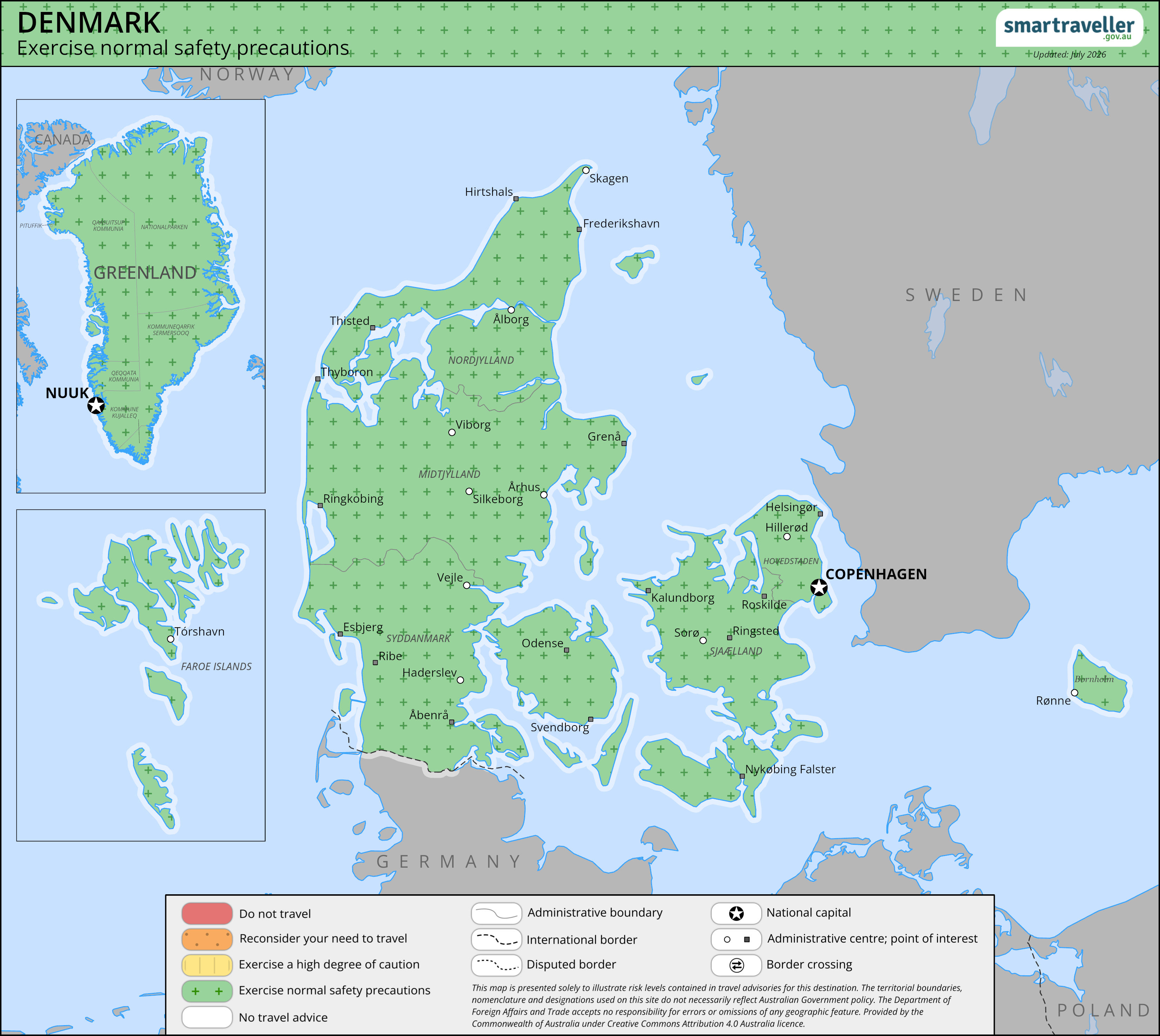
Although the main peninsular of Denmark is not prone to extreme weather or natural disasters, travellers to Greenland or the Faroe Islands should plan accordingly.
Some places in the Arctic are a long way from mobile coverage and help, including:
Search and rescue teams in the region are highly skilled. However, help depends on the weather and sea conditions in an emergency. If you need assistance, you may have to wait a long time.
If you need to be rescued or evacuated in Greenland, the search and rescue operation could cost you thousands of dollars. Plan accordingly.
If severe weather affects the area you're visiting:
Register with the Global Disaster Alert and Coordination System to receive alerts on major disasters.
For specific information on bringing medication into Denmark, refer to the Danish Medicines Agency.
Health risks are broadly similar to those in Australia.
Health risks in the Arctic can include:
Ask your doctor about health risks and vaccines before you go.
More information:
There’s no agreement between Australia and Denmark for free healthcare. Tourists must pay for all medical care, even if they need to stay in hospital or be evacuated. This can be very expensive. Make sure your travel insurance covers you medical evacuations and hospital stays. The Australian Government won't pay for these costs.
The standard of medical facilities in the main peninsula of Demark is similar to Australia. There are major hospitals in Copenhagen, Aarhus and the Odense area. English is widely spoken.
Costs are similar to, or more than, private treatment in Australia.
Medical services and facilities in Greenland and the Faroe Islands are limited. Evacuations can be required for serious illness or injury.
Penalties for drug possession, use or trafficking, even small amounts, include heavy fines and prison sentences.
More information:
It's illegal to wear clothing which covers the face while in a public place. You'll be fined if you don't comply, and the fine increases for repeat offenders. The law applies to both residents and visitors.
Penalties for vandalism, such as graffiti, may include fines, jail and/or deportation.
There are restrictions on flying drones. Contact the Danish Civil Aviation and Railway Authority for more information and guidance on registration.
Holders of Australian superannuation accounts should seek advice on taxation before moving to Denmark.
The main peninsula of Denmark is part of the Schengen area, along with many other European countries, meaning you can enter Denmark without a visa in some situations.
In other situations, you'll need a visa.
Greenland and the Faroe Islands aren't part of the Schengen area or the EU. Entry to Greenland and the Faroe Islands without a visa is possible for Visa-free countries.
Get a legible entry stamp on your passport when you enter the Schengen area for the first time.
Check the Schengen Convention before you travel.
Entry and exit conditions can change at short notice. Contact the nearest embassy or consulate of Denmark for details about visas, currency customs and quarantine rules.
Make sure you meet all entry and exit conditions. The Australian Government can't help you if you don't.
There are sporadic border controls between Denmark, Sweden and Germany. Border forces will only grant entry if you can present a valid passport.
If you're entering Denmark by boat, a valid passport is a requirement, even if you're entering from another Schengen country.
Make sure you:
The currency is the Danish Krone (DKK).
If you travel between Denmark and any non-EU country, you must declare cash of over 10,000 euros (or equivalent). This covers all forms of currency, not only cash.
If you don't declare or give the wrong information on entry or exit, you'll need to pay a fine.
You don't need to declare cash if you're travelling to or from another EU country.
ATMs are common, and credit cards are accepted in most places.
Check if your credit card has 'chip and PIN' technology. Many hotels, restaurants and shops need this.
Greenland has no serious personal security concerns, and the crime rate is low. However, the weather is extreme.
Flights can often be delayed or cancelled at short notice. You may need to remain in Greenland for some time.
There are no roads or railways between towns. Travel is by air, sea, ski, snowmobile or dogsled only.
Limited medical facilities are available in Greenland. Patients may be evacuated by helicopter to the capital or neighbouring Iceland for treatment.
Search and rescue response may come from many hundreds of kilometres away. They can only provide basic transport and medical care. Make sure you have accessible funds and travel insurance that cover your overseas medical costs, including hospitalisation and medical evacuation.
The Faroe Islands have no serious personal security concerns, and the crime rate is low. However, the weather is extreme.
Flights can often be delayed or cancelled at short notice. You may need to remain in the Faroe Islands for some time.
Limited medical facilities are available in parts of the Faroe Islands. You may be evacuated to Tórshavn (the capital of the Faroe Islands), neighbouring Iceland, or to the main peninsula of Denmark for treatment.
Search and rescue response may come from many hundreds of kilometres away. They can only provide basic transport and medical care. Make sure you have accessible funds and travel insurance that cover your overseas medical costs, including hospitalisation and medical evacuation.
More information:
To drive, you'll need both:
You must get your IDP before leaving Australia.
More information:
Always keep your headlights on.
Roads can be dangerous in winter because of ice. Vehicles are required to have winter tyres from 1 November to 31 March. Check local rules.
When driving, check cycle lanes before turning. Cyclists often have the right of way.
Take care not to walk on cycle lanes. Look both ways before crossing one-way streets, as bicycle traffic is often allowed in both directions. Accidents and injuries resulting from collisions between cyclists and pedestrians are common.
E-Scooters are common in larger cities:
More information:
Plan your route ahead of time. Cycling is prohibited on motorways and some highways.
Cycling-related accidents are the most common cause of injury among foreigners visiting Denmark.
If renting a bicycle, familiarise yourself with Denmark's cycling rules before riding.
Helmets are recommended but not compulsory when riding a bicycle or electric bike with a 25km/h top speed. For e-bikes and electric scooters with a top speed above 25km/h, helmets are mandatory, and fines apply if you do not wear one.
More information:
Check if your travel insurance policy covers you when using a motorbike, quad bike or similar vehicle.
Always wear a helmet.
Use only officially marked taxis.
Public transport is efficient and of a high standard.
More information:
Copenhagen is a hub for cruise travel to the Baltic and the Arctic regions.
Before you book a cruise, check the following:
You might be going somewhere far from search-and-rescue, evacuation and medical facilities.
Check your travel insurance covers you for the type of travel you're doing. Ensure it covers any pre-existing medical conditions.
More information:
Check Denmark's air safety profile with the Aviation Safety Network.
More information:
Depending on what you need, contact your:
Call 112.
Call 112
If not life-threatening, call +45 1813 to be referred to a hospital.
Call 112.
Call 114 or go to the local police station to report a crime. Always get a police report when you report a crime.
Your insurer should have a 24-hour emergency number.
The Australian Government aims to provide high quality consular assistance. There are limits to what we can do. Read the Consular Services Charter to understand how we can assist you overseas.
Dampfaergevej 26
2nd floor
2100 Copenhagen
Phone: +45 7026 3676
Email: copenhagen.embassy@dfat.gov.au
Website: denmark.embassy.gov.au
Facebook: Australia in Denmark, Norway and Iceland
X: @AusAmbDK
Check the Embassy website for details about opening hours and any temporary closures.
In a consular emergency, if you can't contact an embassy, call the 24-hour Consular Emergency Centre on:
Be the first to know official government advice when travelling.