Depending on what you need, contact your:
-
family and friends
-
travel agent
-
insurance provider
-
employer
-
airline
There's no national emergency number in the DRC.

Depending on what you need, contact your:
family and friends
travel agent
insurance provider
employer
airline
There's no national emergency number in the DRC.
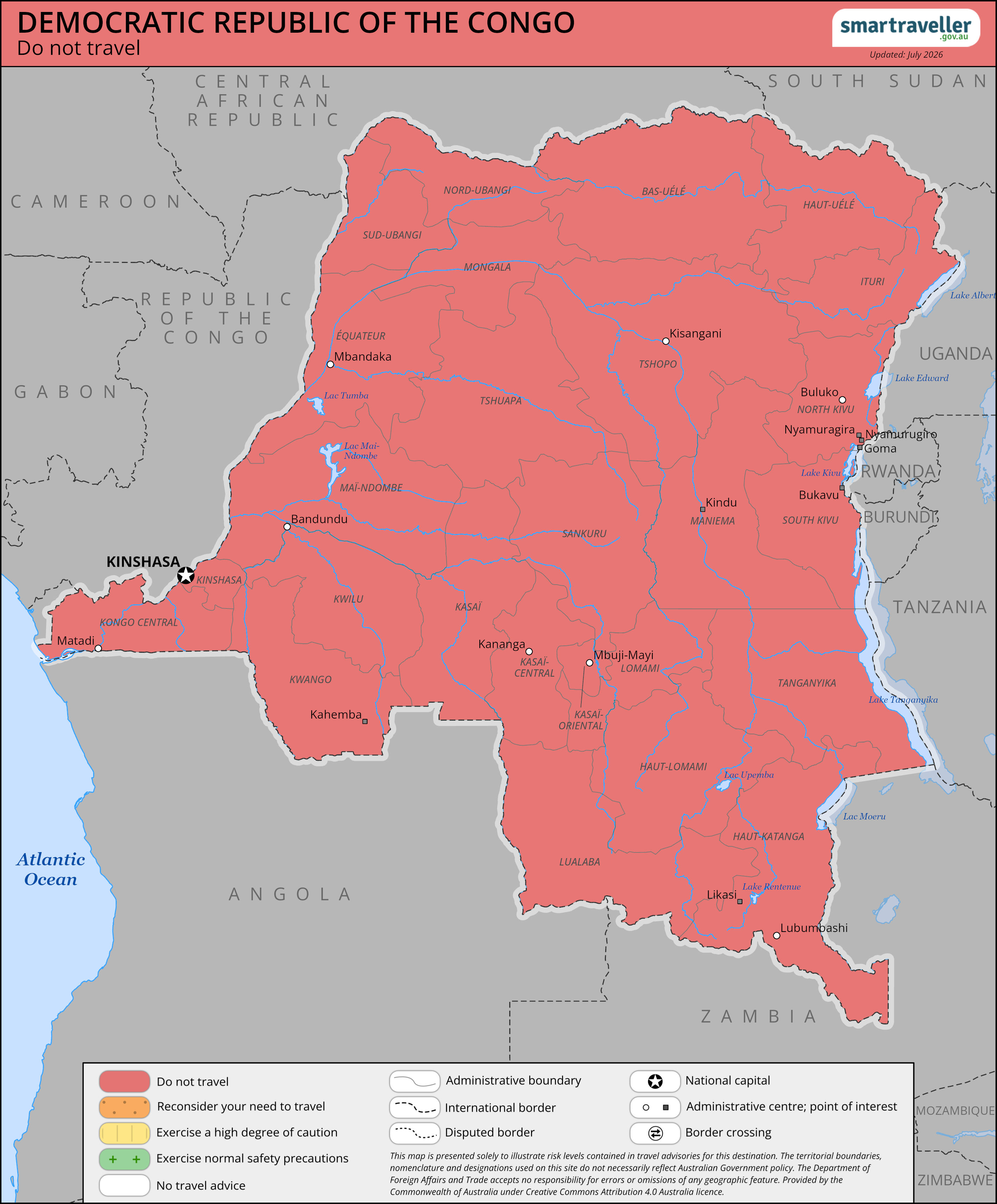
Do not travel to the Democratic Republic of the Congo due to the volatile security situation and the threat of terrorism and kidnapping.
Full travel advice: Safety
Full travel advice: Health
Full travel advice: Local laws
Full travel advice: Travel
Full travel advice: Local contacts
The security situation in DRC is volatile across the country.
Conflict between government forces and armed groups in the east has escalated. Armed groups control the towns of Goma and Bukavu.
The security situation in other regions of Eastern DRC may deteriorate with no warning.
There are over 130 active armed groups in eastern DRC. Armed conflict has caused widespread civilian displacement and deaths. Conflict between local armed groups and government forces is ongoing. It's a more serious threat in eastern and northern provinces. This includes:
In the eastern provinces of Ituri and North Kivu, military administrations have replaced civilian administrations until further notice. The military administrations have been granted extended security powers, and there is potential for increased armed conflict in the region during this time.
A large UN military presence and several aid organisations operate in the DRC. This includes the United Nations Organisation Stabilisation Mission in the Democratic Republic of the Congo (MONUSCO). In recent years, large protests in the cities of Beni, Betembo, Goma and Rutshuru have targeted MONUSCO. MONUSCO sites have been looted and the demonstrations have resulted in deaths. Avoid crowds, demonstrations and sites associated with MONUSCO in eastern DRC.
Some non-government organisations have suspended operations in North and South Kivu due to the security situation.
Intercommunal violence in Mai Ndombe province, particularly in the territory of Kwamouth, has been a regular occurrence since June 2022. Intercommunal violence may continue to increase and lead to further deaths and displacement.
If you're in an affected area:
Keep your passport and other travel documents (e.g. visas, flights) up to date and secure.
Regularly review your contingency plans in light of local developments. If you travel to DRC despite our advice, be ready to leave at short notice if the situation worsens. You should also seek professional security advice.
Civil unrest and political violence can occur in Kinshasa, including outside some foreign embassies and UN offices. Protesters may start fires and thrown rocks at vehicles. Foreigners may be randomly targeted.
Public protests and events that draw large groups can quickly turn violent.
To protect yourself from violence:
Security incidents can occur in Kinshasa, including:
During periods of unrest, the only road to the N'Djili Airport in Kinshasa may be blocked. Flight schedules may be disrupted. Confirm flight schedules with your airline or travel provider.
Curfews may be imposed with little notice. Monitor local media for updates and follow the advice of local authorities.
More information:
Kidnapping occurs across the world with political, ideological, and criminal motives. Foreigners, including Australians, have been kidnapped overseas whilst travelling. Kidnappings can happen anywhere, anytime, including in destinations that are typically at lower risk.
Kidnapping is a very high risk across DRC, it’s most common in the eastern and north-eastern regions.
Areas with a high risk of kidnapping include:
Kidnappers have engaged in highway ambushes to target foreigners. Aid and humanitarian workers have been kidnapped regularly in these areas.
Express kidnappings targeting foreigners occur. The threat is particularly high in the Gombe area of Kinshasa.
These attacks usually occur in broad daylight and victims can be abducted for a few hours and stripped of their possessions or taken to an ATM to withdraw money.
If, despite our advice, you travel to an area with a high risk of kidnapping, our ability to provide consular assistance in these destinations is limited.
You are responsible for your own safety. To reduce the risk of being kidnapped:
The Australian Government's longstanding policy is that it doesn't make payments or concessions to kidnappers. Ransom payments to kidnappers have funded further terrorist attacks and criminal activity. Ransom payments to terrorist groups are likely to contravene Australian counter-terrorism financing laws.
More information:
Terrorist attacks could occur anywhere and at any time. Be alert to possible threats, especially in public places. Terrorists may target tourist areas or other places frequented by foreigners and where large crowds may gather.
There's an ongoing threat of terrorist attacks in the DRC, particularly in eastern DRC. An attack is possible at any time. Always be alert to possible threats, especially in public places.
Areas prone to terrorist attacks include:
Possible targets for terror attacks include:
To reduce your risks:
If there's a terrorist attack, leave the affected area as soon as it's safe to do so.
Don't gather in groups after an attack. This also applies if you're evacuated from a building for security reasons, such as a bomb threat.
Terrorism is a threat worldwide.
More information:
There's a very high level of crime in the DRC. Risks increase after dark.
Criminals may use roadblocks and pose as police or military personnel to rob travellers at night.
Security authorities may target travellers to ask for bribes or make random arrests, such as at roadblocks.
Violent crime has increased in the east because of the unstable security situation.
Crimes that commonly affect travellers, especially in Kinshasa, include:
To protect yourself from crime and express kidnappings:
Carry colour photocopies of your passport and identity documents. Hand these to officials, not the originals.
The DRC experiences extreme weather and natural disasters, including:
To protect yourself if a natural disaster occurs:
More information:
The DRC experiences earthquakes and volcanic eruptions. Mount Nyiragongo, near Goma, is one of the world's most active volcanoes and last erupted in May 2021.
Exposure to volcanic ash, dust and toxic fumes is a major health risk.
Seek medical help if you have existing respiratory problems.
To protect yourself if there's a volcanic eruption:
Landslides and flooding may occur in the rainy season. This can affect transport infrastructure.
The rainy season is April to October in the north and November to March in the south.
Several outbreaks of Ebola disease have occurred in the DRC. The World Health Organisation (WHO) declared the Ebola disease outbreak in the DRC a public health emergency of international concern in May 2026. The Bundibugyo strain of Ebola has no approved vaccines or specific antiviral treatments.
Ebola can be transmitted to humans through physical contact with an infectious person, infected animals or contaminated materials. Ebola is often fatal with a mortality rate of around 50 per cent.
Symptoms of Ebola can include:
Seek medical advice immediately if you experience these symptoms. Maintain strict hygiene standards and avoid physical contact with anyone displaying symptoms.
Further information and updates on Ebola can also be found on the World Health Organization (WHO) website.
Outbreaks of polio have occurred.
Stay up-to-date with polio vaccinations and booster doses. Speak to your doctor if you're unsure if you're vaccinated for polio.
If you're staying longer than 4 weeks, you'll need to show proof on exit that you've had the polio vaccine or a booster within the past 12 months. If you don't, you may need to be vaccinated before leaving the DRC.
Yellow fever is widespread in the DRC.
Malaria occurs widely throughout the year.
Other insect-borne diseases can also occur, including:
To protect yourself from disease:
Get vaccinated against yellow fever before you travel.
Consider taking medicine to prevent malaria.
Seek medical advice if you have a fever, muscle pain, rash or severe headache.
HIV/AIDS is widespread. Take steps to reduce your risk of exposure to the virus.
Waterborne, foodborne and other infectious diseases are widespread. These include:
Serious outbreaks often occur.
To protect yourself from illness:
If you're bitten or scratched by an animal, get medical help straight away.
Get medical advice if you have a fever or diarrhoea.
Ask your doctor about health risks and vaccines before you go.
More information:
There’s no agreement between Australia and DRC for free healthcare. Travellers must pay for all medical care, even if they need to stay in hospital or be evacuated. This can be very expensive. Make sure your travel insurance covers you. The Australian Government won't pay for these costs.
You'll need to be evacuated if you get seriously ill or injured. Medical evacuation may not be possible and can be very expensive. Most Australian travel insurance policies won't cover you for travel to DRC.
Public medical facilities are basic in Kinshasa and inadequate outside the capital. Private medical facilities are of higher quality but may not meet Australian standards.
Doctors and hospitals will generally ask for payment before treatment. Evidence of travel insurance may not be accepted as a guarantee of payment at some hospitals.
More information:
Penalties for possessing illegal drugs include harsh prison sentences and fines.
More information:
Same-sex relationships are legal in DRC, with no specific laws criminalising it. However, it remains a cultural taboo and same-sex couples who engage in public displays of affection may be subject to violence and harassment.
LGBTQIA+ people face discrimination and legal challenges based on decency laws.
More information:
A number of offences carry the death penalty, including terrorism and treason.
Always carry a copy of your passport and visa or immigration permit. Police and immigration officials can ask to see your travel documents at any time.
You must also stop when passing a government installation during the raising and lowering of the national flag. This happens at about 7:30am and 6pm every day.
In the DRC it's illegal to:
Some Australian laws still apply even if you’re in another country. You could be charged in Australia if you break these laws overseas.
More information:
The DRC doesn't recognise dual nationality.
If you're a dual national, this limits the consular services we can give if you're arrested or detained.
You need to enter and exit the DRC using the same passport or you may be stopped from departing.
Always travel on your Australian passport.
More information:
You'll need a visa before you enter the DRC. You can't get one on arrival.
Entry and exit conditions can change at short notice. You can contact the nearest embassy or consulate for details about visas, currency, customs and quarantine rules.
The closest embassy of the DRC is in Tokyo.
Airlines may suspend flights to and from Kinshasa with little warning. Goma airport is not functioning at full capacity. Limited flights are available and may be delayed, cancelled, or rerouted with little warning. Other options to depart the DRC may close with no warning.
Border openings and other restrictions may change at short notice. Due to the ongoing insecurity in these areas, you should avoid the border entry points from Burundi, Rwanda, Uganda, South Sudan and the Central African Republic.
Contact your airline directly for the latest update and register with the Canadian Embassy in Kinshasa for advice on departure options.
If you travel to the DRC, despite our advice, you may encounter health screening measures on arrival and departure, including passenger locator forms and temperature checks, at airports and border crossings.
Some countries have heightened health screenings or restrictions on travellers from the DRC. Check entry requirements for the country you are travelling to or transiting.
You'll need a valid yellow fever vaccination certificate to enter DRC. Some airlines may want to see your vaccination certificate before boarding, on arrival and departure.
Find out about returning to Australia after exposure to yellow fever.
More information:
Declare satellite phones and GPS equipment on arrival.
A departure tax applies if you leave the DRC by air. The tax includes a $50 airport exit fee and a $5 boarding fee, which is subject to change with no notice. Get an official receipt and copies for each fee. You should hand the originals on request to immigration officials and at boarding and keep the copies.
If you're travelling through South Africa, South African authorities do not accept provisional travel documents. South African authorities do accept Australian emergency passports.
Strict rules apply to a child aged under 18 years travelling through South Africa.
More information:
The local currency is the Congolese Franc (CDF).
Declare local and foreign currency in excess of USD10,000 on arrival and departure. This covers all forms of currency, not only cash.
US dollars are widely accepted. Counterfeit currency is common. Check USD banknotes before accepting them.
Change currency at licensed commercial banks and exchange bureaus. Money transfer agencies operate in major towns.
Traveller's cheques aren't accepted. Some major hotels accept credit cards.
ATMs are available in Kinshasa and major centres. It may be difficult to withdraw cash from international accounts, even at major hotels.
Check that your cards will work in the DRC before you travel.
You'll need official clearance from the relevant DRC ministry or government department before visiting a mining district.
More information:
To drive in the DRC, you'll need both:
You must get your IDP before you leave Australia.
Road travel is dangerous in DRC. Dangers include:
Military and police roadblocks are common.
Following large-scale prison breaks in Kinshasa, Béni and Kasangu, local authorities increased the number of checkpoints at night. Checkpoints include Gombe, Limete, Ngaba, Kintambo, Ngaliema, Ndjili, Mont Ngafula and around Camp Kokolo.
Criminals may use roadblocks to pose as police or military personnel and rob you (see Safety).
To protect yourself while travelling on DRC roads:
Carry government-issued identification, carte rose, carte grise and driver's licence at all times.
Ask for credentials if approached by an officer.
If you travel outside Kinshasa, have contingency plans and take emergency equipment such as a satellite phone.
More information:
Check with your travel insurer whether your policy covers you when riding a motorbike.
Always wear a helmet.
Use registered taxis and limousines, preferably arranged through your hotel.
Avoid unofficial taxis or taxis hailed on the street. Robberies can occur.
Don't use public transport. Bus and rail services are unsafe due to poor safety standards and crime.
Many boats and ferries are overloaded, lack lifesaving equipment and aren't seaworthy.
Kinshasa's main ferry terminal is congested and can close at short notice. Pay attention to your personal security in and around the terminal.
Civil unrest may cause flight cancellations to and from Kinshasa at short notice.
Local immigration and customs procedures at Kinshasa Airport are difficult. You may need help from people familiar with the process. If travelling by air, arrange for them to meet you when you arrive.
Pay attention to your personal security in and around the airport.
Avoid local airlines with poor maintenance and safety standards.
Aircraft in and around Goma, North Kivu have reported experiencing interference with GPS flight systems. Some flights have been delayed, cancelled or rerouted. Monitor media, airlines' website and local authority advice for flight information in or out of Goma International Airport.
DFAT doesn’t give advice about how safe different airlines or flight paths are.
Check the DRC's air safety profile with the Aviation Safety Network.
More information:
Depending on what you need, contact your:
There's no national emergency number in the DRC.
Remember to get a police report when reporting a crime.
Your travel insurer should have a 24-hour emergency number.
There are limits to what consular assistance we can provide in high-risk locations. Read the Consular Services Charter to understand how we can assist you overseas.
Australia doesn't have an embassy or consulate in the DRC. Our ability to provide consular assistance may be limited.
The Canadian Embassy in Kinshasa provides consular assistance to Australians in the DRC. It can issue Australian provisional travel documents. Its services are limited outside Kinshasa.
17 Avenue Pumbu
Commune de Gombe, Kinshasa
Phone: +243 996 021 500
Email: knsha@international.gc.ca
Website: Embassy of Canada to the Democratic Republic of Congo, in Kinshasa
You can also get consular assistance from the Australian Embassy in Harare, Zimbabwe.
1 Green Close
Borrowdale
Harare, Zimbabwe
Phone: +263 861 200 2100
Email: zimbabwe.embassy@dfat.gov.au
Website: zimbabwe.embassy.gov.au
Facebook: Australian Embassy, Zimbabwe
X: @AusEmbZim
In a consular emergency, if you can't contact an embassy, call the 24-hour Consular Emergency Centre on:
Be the first to know official government advice when travelling.