Fire and rescue services
Call 198.
Medical emergencies
Call 190 or go to the hospital.
Police
Call 197 or 193, or go to the local police.
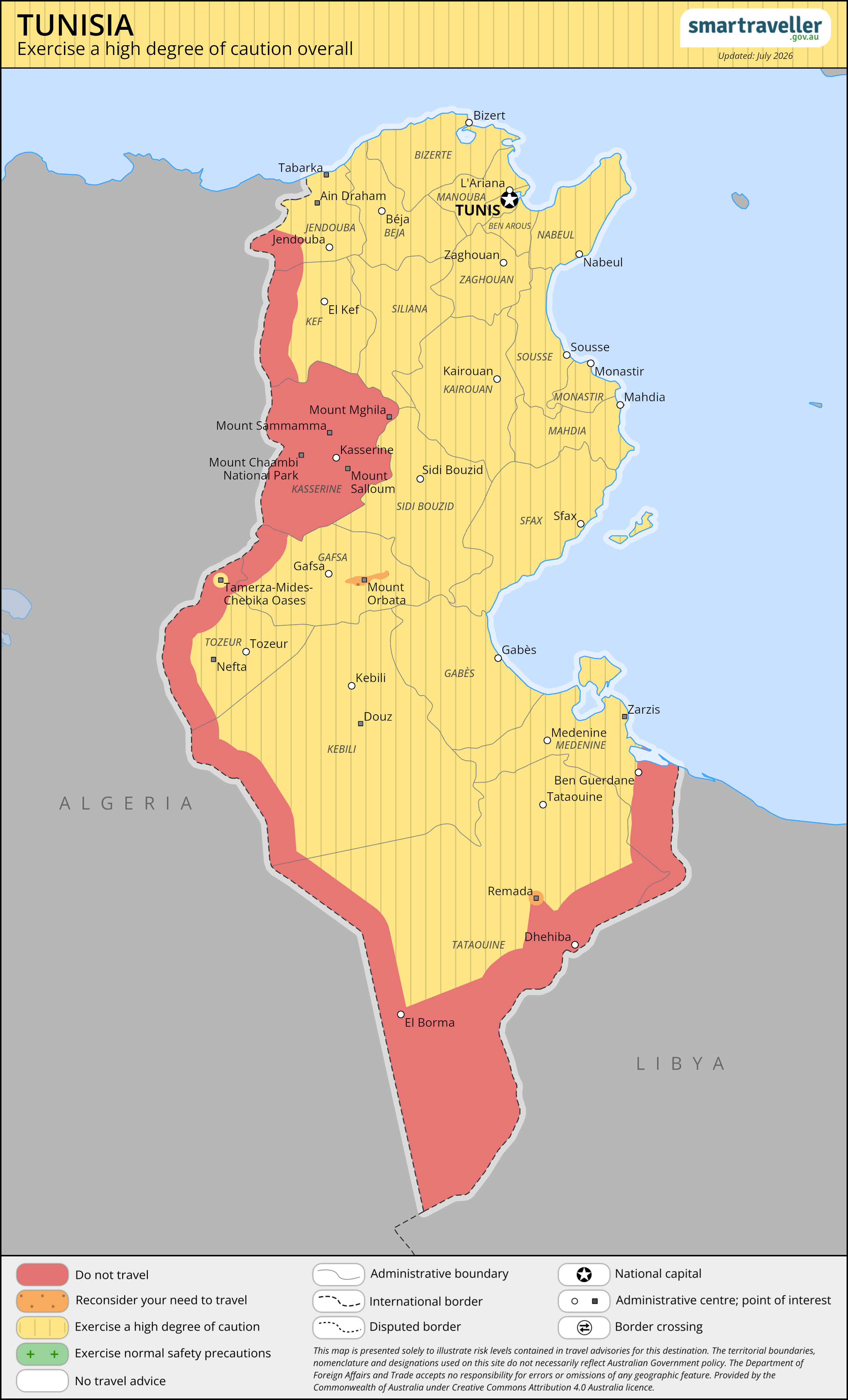
Exercise a high degree of caution in Tunisia overall due to the threat of terrorism.
Do not travel to the following locations, due to ongoing security forces operations and the high threat of terrorist attack and kidnapping:
• within 20kms of the Algerian border (except for the P7 highway to/from the Malloula border crossing and the towns of Ain Draham, Tamerza, Mides, Chebika and Tabarka, where we advise exercise a high degree of caution).
• within 30kms of the Libyan border
• the Governorate of Kasserine
• the mountain ranges and surrounding forests of Mount Chaambi, Mount Mghila (which extends to the governorate of Sidi Bouzid), Mount Sammama and Mount Selloum
• the cordoned off military zone south of the town of Remada in the governorate of Tataouine.
Reconsider your need to travel to the following locations due to the presence of a military zone, the risk of terrorism, and limited mobile phone coverage:
• the Delegation of Remada
• Mount Orbata.
Full travel advice: Safety
Full travel advice: Health
Full travel advice: Local laws
Full travel advice: Travel
Full travel advice: Local contacts
Terrorism is a threat worldwide. Terrorist attacks could occur anywhere and at any time. Be alert to possible threats, especially in public places.
Terrorists have previously targeted:
In May 2023 a fatal shooting occurred on the island of Djerba, close to where Tunisian and international visitors were taking part in the annual Jewish pilgrimage at the El Ghriba synagogue. Three security personnel and two civilians were killed. 10 other people were injured.
Authorities often arrest and disrupt militants planning attacks.
Despite the preventive efforts of security forces, terrorist acts could occur at any time. Targets for future terror attacks could include:
A state of emergency was declared in 2015 and remains in effect until further notice. The state of emergency grants authorities and security forces exceptional powers against threats of terrorism or organised crime, and allows them to:
If you’re travelling in an area where a state of emergency is in effect:
Authorities have heightened security measures in place, including:
Be aware of your surroundings when in public places. Be especially vigilant during:
The safety situation is unstable in Libya and Algeria. This has led to unstable security in Tunisia with a risk of terrorist attacks, particularly near the borders. There's a strong presence of Tunisian armed forces on the border with Libya and this border may close at short notice for an indefinite period.
Tunisian authorities have designated certain areas as 'military operations zones', where the army patrols to counter terrorist threats and attacks. These zones mainly include the central-western mountain ranges in the governorates of Kasserine and Kef, including:
Avoid all travel to fenced off military zones. The Tunisian armed forces may arrest you if you don't have prior authorisation to enter these zones.
To protect yourself from terrorist threats:
If there’s a terrorist incident, leave the area if it’s safe to do so and follow the instructions of local authorities.
More information:
Kidnapping occurs across the world with political, ideological, and criminal motives. Foreigners, including Australians, have been kidnapped overseas whilst travelling. Kidnaps can happen anywhere, even in places that seem safe.
There's a risk of kidnapping in Tunisia, particularly in the border areas with Algeria and Libya.
If, despite our advice, you travel to an area with a risk of kidnapping, our ability to provide assistance in these destinations is extremely limited.
You’re responsible for your own safety. You can find more information on how to reduce your risk of kidnapping here: Kidnapping.
The Australian Government's longstanding policy is that it doesn't make payments or concessions to kidnappers. Ransom payments to kidnappers have funded further terrorist attacks and criminal activity. Ransom payments to terrorist groups are likely to contravene Australian counter-terrorism financing laws.
Protests, demonstrations and strikes can occur with little or no warning in response to political or economic issues. This may lead to civil unrest and clashes with security forces. Although demonstrations take place throughout the country, they are mainly concentrated in downtown Tunis.
Strikes may affect essential services including ground and air transport. Avoid protests and demonstrations, monitor local media for information and updates and follow the advice of local authorities.
To protect yourself during periods of unrest:
Be prepared to change your travel plans in case of civil unrest.
If you're affected by transport disruptions, you can contact your:
More information:
A rise in crimes of opportunity has been reported across the country, including:
Thieves sometimes steal high-value items from vehicles and hotel rooms. Don't leave valuables in a parked vehicle or unsecured in a hotel room.
Women travelling alone may be harassed, including unwanted physical contact and comments.
Take care when travelling alone or at night. Always be aware of your surroundings.
To reduce your risk of crime:
More information:
Tunisia experiences natural disasters and severe weather, including:
Flash flooding can block roads, particularly in the south.
During a natural disaster:
We don't provide a comprehensive list of health risks, diseases or outbreaks for every destination. Before you travel, check the latest health advice from the Australian Centre for Disease Control (CDC) and the World Health Organization (WHO).
Insect-borne diseases including leishmaniasis and West Nile virus are common.
To protect yourself from disease:
Waterborne, foodborne, and other infectious diseases are common. These include:
Serious outbreaks sometimes occur.
Swimming in fresh water may expose you to parasitic diseases, such as bilharzia (schistosomiasis).
To protect yourself from illness:
Get medical advice if you have a fever or diarrhoea.
If an animal bites or scratches you, get medical help straight away.
Ask your doctor about health risks and vaccines before you go.
More information:
There’s no agreement between Australia and Tunisia for free healthcare. Tourists must pay for all medical care, usually upfront, even if they need to stay in hospital or be evacuated. This can be very expensive. Make sure your travel insurance covers you. The Australian Government won't pay for these costs.
Standards of medical facilities in major centres are generally adequate. Medical services in smaller cities and rural and remote areas may be limited.
Most staff in hospitals speak French or Arabic, not English.
Hospitals or doctors generally require payment in advance before they'll treat you, even in an emergency. Even with proof of insurance, you may be required to pay up front. Cash payments may be required.
You may need initial treatment or assessment at a public hospital before you can go to a private clinic.
Medications may differ from what is available in Australia and may be difficult to source (especially in rural areas).
There are hyperbaric decompression chambers for emergency dive decompression in Bizerte in north-east Tunisia and Tabarka in north-west Tunisia. Tunis Military Hospital (Hôpital Militaire de Tunis) is the definitive national centre for severe dive injuries.
Zarzis Naval Training Centre located in southern Tunisia near Djerba operates a specialised hyperbaric facility in cooperation with the Italian Navy. It acts as the frontline emergency recompression point for scuba diving incidents in southern Tunisian waters.
Penalties for possession, use or trafficking of illegal drugs are severe and subject to heavy fines and prison sentences, including up to life in prison.
More information:
Penalties for some offences, such as murder and rape, include the death penalty.
It's illegal to:
Sexual relationships between individuals of the same sex is illegal. LGBTQIA+ persons could be arrested because of their sexual orientation, gender identity, gender expression or sexual characteristics. They could also face other charges such as:
If convicted, the offender can face fines and prison sentences from six months to three years.
Avoid public displays of affection.
More information:
There are conservative standards of dress and behaviour. Take care not to offend.
If you're visiting religious sites or remote areas, avoid wearing short-sleeved garments or shorts.
Women may be harassed, particularly if they're unaccompanied.
The Islamic holy month of Ramadan is observed. This may affect government and private business opening hours. Respect religious and cultural customs and laws at this time.
During Ramadan, eating, drinking and smoking may be illegal in public during the day. If you're not fasting, avoid these activities around people who are. Seek local advice to avoid offence.
Explore our Ramadan page to learn more, including dates for Ramadan.
If you're a dual national, this limits the consular services we can give if you're arrested or detained.
Always travel on your Australian passport.
If you're a dual national, you may need to complete national service.
Check with the Embassy or Consulate of Tunisia before you travel.
A child born to a Tunisian mother or father can be considered by the Tunisian authorities as a Tunisian citizen, no matter where he or she was born and what other citizenship he or she has acquired or is entitled to.
In cases where one or more family members hold Tunisian citizenship, parents should consider the risks before their children travel to Tunisia, including:
More information:
Australian citizens don't need a visa if visiting for 90 days or less.
For other types of travel, obtain a visa before you arrive.
Entry and exit conditions can change at short notice. You can contact the Embassy of Tunisia for the latest details.
The local currency is the Tunisian Dinar (TND).
It’s illegal to import and export Tunisian dinars (TND).
ATMs are widely available in tourist areas and can be found in large cities. Many establishments in urban and tourist areas accept credit cards.
Tunisian foreign exchange regulations are strict and complex. You must declare all foreign currency on arrival, departure, or while in transit equal to or greater than 20,000 TND. Keep the declaration receipt for departure.
If you enter Tunisia with a sum exceeding the equivalent of 5,000 TND, you must declare the amount to airport customs so that any excess amount is not confiscated when you leave the country. In the event of confiscation, you'll need to request a refund using a form available on the Tunisian customs website.
You'll not be allowed to leave Tunisia with the equivalent of 30,000 TND or more, even if you have declared it upon entry.
You can exchange most major foreign currencies for TND at authorised banks or dealers. Australian dollars are unlikely to be accepted. Make sure you keep receipts.
Limits on foreign currency imports and exports can change at any time. Check the rules before you travel.
More information:
Strikes can occur with little or no notice and can affect essential services, including ground and air transport. Avoid protests and demonstrations, monitor local media for updates and follow the advice of local authorities. Check with your travel provider whether your travel arrangements are affected.
There's a heightened security presence at border crossings due to the unstable security environment in Libya and Algeria.
Crossings may close at short notice. Tunisian security forces control access.
Consult with local authorities and read the travel advisories for Algeria and Libya before deciding whether to travel.
Higher travel advice levels apply, read our advice levels for Tunisia before travelling to desert areas. Read 'Travel advice explained' for more information on what each advice level means.
You need permission from Tunisian authorities to travel to certain desert areas in the south. You must have a licensed guide.
To drive you need an International Driving Permit (IDP).
You must obtain your IDP before leaving Australia.
For longer stays, contact the Ministry of Transport (French) about local licences.
Driving can be hazardous due to:
Locals often ignore:
If you plan to drive:
Military or police security checks on roads are common.
If you encounter a security check:
More information:
Avoid using motorcycles due to poor road safety standards.
Your travel insurer may not cover you when riding a motorcycle.
Always wear a helmet. Make sure your passenger does too.
Yellow taxis are available.
If you need to travel by taxi:
Buses can be crowded. Petty crime occurs on buses.
Safety standards of intercity trains and buses may differ from those in Australia.
TRANSTU, the Tunis Transport Company, manages buses and the light railway.
The national transport company SNTRI and Trans-Tour buses travel to remote areas of Tunisia.
More information:
The railway network connects:
Regular ferry services operate between:
International cruise ship services visit Tunis and other towns.
More information:
Check the Aviation Safety Network website for details on aviation safety in Tunisia.
Security screening at Tunis-Carthage International Airport has increased.
More information:
Depending on what you need, contact your:
Call 198.
Call 190 or go to the hospital.
Call 197 or 193, or go to the local police.
Emergency service operators speak Arabic and French.
Always get a police report when you report a crime.
Your insurer should have a 24-hour emergency number.
The Australian Government aims to provide high quality consular assistance. There are limits to what we can do. Read the Consular Services Charter to understand how we can assist you overseas.
Australia doesn't have an embassy in Tunisia. The Embassy of Canada in Tunis provides consular assistance to Australians in Tunisia.
For passport and notarial services, please contact the Australian High Commission, Malta.
Rue de la Feuille d’Erable, Berges Du Lac 2
Tunis, Tunisia
Phone: +216 70 010 200
Fax : +216 70 010 392
Email: tunis.consular@international.gc.ca
Website: canadainternational.gc.ca/tunisia-tunisie
Australians may also contact the 24-hour Consular Emergency Centre on +61 2 6261 3305.
Ta' Xbiex Terrace
Ta' Xbiex XBX 1034, Malta
Phone: +356 2133 8201
Email: consular.malta@dfat.gov.au
Website: malta.embassy.gov.au
Facebook: Australian High Commission, Malta
Twitter: @AusHCMalta
See the High Commission website for details about opening hours and any temporary closures.
In a consular emergency, if you can't contact an embassy, call the 24-hour Consular Emergency Centre on:
Be the first to know official government advice when travelling.