Fire and rescue services
Call 198.
Medical emergencies
Call 117 or go to a hospital.
Police
Call 119 or visit the nearest police station.
Call 198.
Call 117 or go to a hospital.
Call 119 or visit the nearest police station.
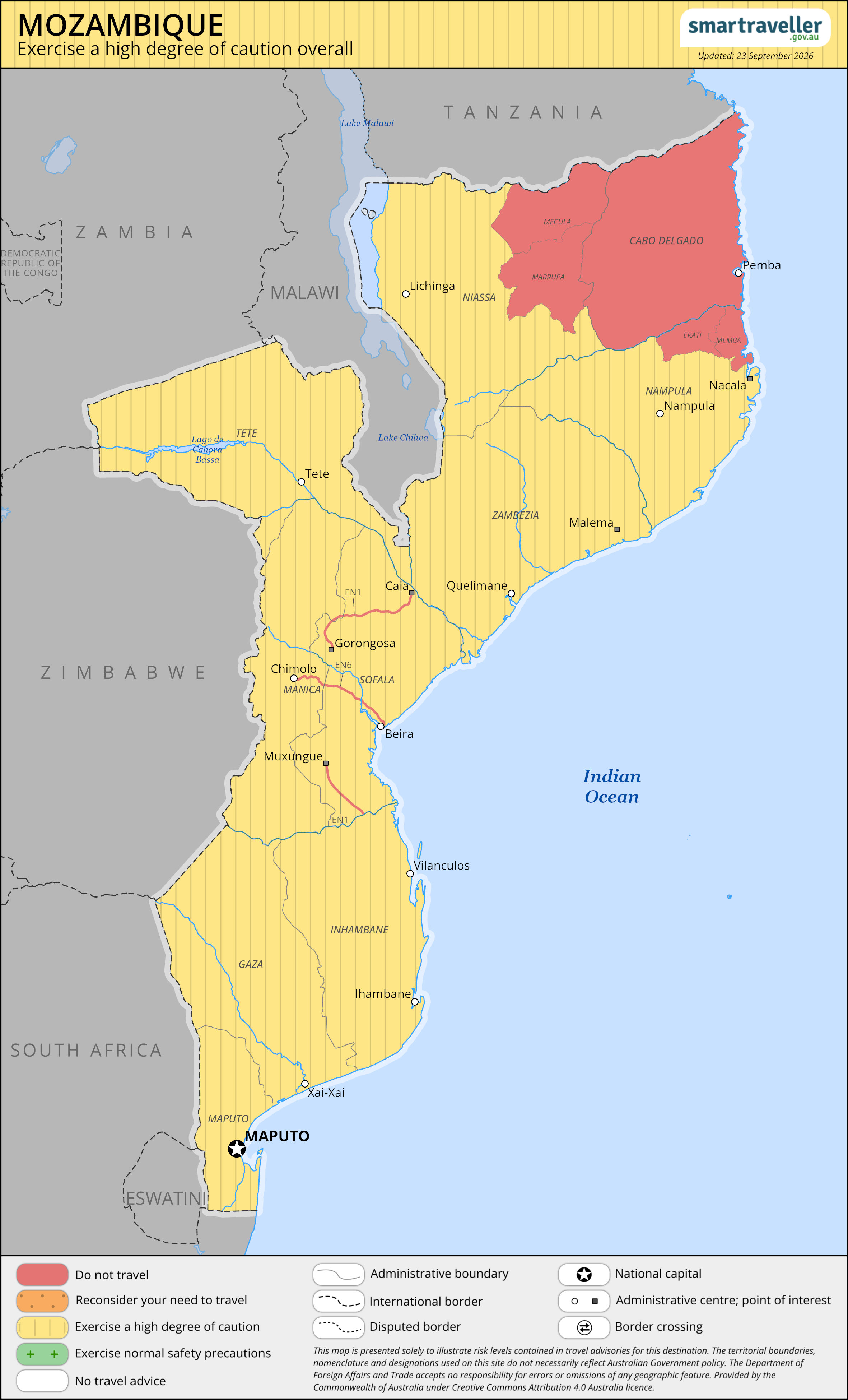
Exercise a high degree of caution to Mozambique overall due to the security situation.
Do not travel to:
due to the extreme threat of terrorism, kidnapping and ongoing clashes between armed groups and security forces.
due to armed attacks on vehicles.
Full travel advice: Safety
Full travel advice: Health
Full travel advice: Local laws
Full travel advice: Travel
Full travel advice: Local contacts
Terrorism is a threat in Mozambique, particularly in the northern provinces of Cabo Delgado and the Erati and Memba districts of Nampula province as well as the Marrupa and Mecula districts of Niassa. The security situation is unpredictable.
Violent clashes between insurgent militants and security forces occur regularly in Cabo Delgado and Nampula. Attacks are highly likely to continue in these areas, and may occur in areas not previously affected by terrorist activity.
Terrorists may target foreign nationals and foreign interests, including in towns and other areas where foreign companies operate and where expatriate staff reside.
An attack could happen anywhere and at any time.
There are times when an attack might be more likely, including:
To reduce your risks:
If there's a terrorist attack:
Don't gather in groups after an attack. This also applies if you're evacuated from a building for security reasons, such as a bomb threat.
More information:
Kidnapping occurs across the world with political, ideological, and criminal motives. Foreigners, including Australians, have been kidnapped overseas while travelling. Kidnapping can happen anywhere, even in places that seem safe.
There's a threat of kidnapping in Mozambique.
Terrorist groups with links to Islamic extremism are present, particularly in the northern provinces of Cabo Delgado and Nampula. Kidnappings occur regularly in Cabo Delgado province and have also occurred in cities such as Maputo City, Matola, Beira as well as Marrupa and Mecula district of Niassa.
Organised criminal groups also operate throughout Mozambique, and kidnappings for ransom targeting individuals perceived to be wealthy, including foreign nationals, have increased.
If, despite our advice, you travel to an area with a high risk of kidnapping, our ability to provide assistance in these destinations is extremely limited.
You’re responsible for your own safety. You can find more information on how to reduce your risk of kidnapping here: Kidnapping
The Australian Government's longstanding policy is that it doesn't make payments or concessions to kidnappers. Ransom payments to kidnappers have funded further terrorist attacks and criminal activity. Ransom payments to terrorist groups are likely to contravene Australian counter-terrorism financing laws.
More information:
Violent clashes between armed militant groups linked to Islamist extremism and security forces have occurred in Cabo Delgado province. There's an increased presence of security forces in the province, and clashes between security forces and insurgents are frequent.
Raids on towns and villages, roadside ambushes and other attacks can occur.
Militants have used machetes and firearms to conduct lethal attacks, as well as destroying vehicles, buildings and infrastructure. It is possible that violence could spill over into other districts.
We advise do not travel to Cabo Delgado and the Erati and Memba districts of Nampula province as well as to Marrupa and Mecula districts of Niassa province.
Attacks have also occurred on the EN1 road between the Save River and Muxungue and from Gorongosa to Caia, and on the EN6 road between Beira and Chimoio.
If, despite our advice, you decide to travel to these areas, you should:
Demonstrations and civil unrest can occur in Mozambique with little notice. These can lead to violence and confrontations with local law enforcement.
Disruptions to traffic and essential services and supplies can also occur.
To reduce your risks of being affected by demonstrations and protests, you should:
More information:
Violent attacks, including sexual assaults, can occur at any time of day.
Criminal activity increases at night and during holiday periods. Criminals may target travellers and those perceived to be wealthy. Be alert, avoid walking alone, especially after dark.
If you're a victim of violent crime, including sexual assault, get medical assistance. The risk of HIV/AIDS infection is high.
Petty crime is common and includes:
Armed robbery and break-ins are common in Maputo and other towns. Gangs of armed robbers have attacked restaurants and cafes after dark.
Carjacking is also common. Be extra careful:
Serious assaults and robberies have occurred in coastal resorts in Inhambane province.
To protect yourself from crime:
Mozambique experiences natural disasters and extreme weather, including:
If there's a natural disaster or severe weather:
More information:
Cyclones may occur in coastal areas from November to May. The direction and strength of cyclones can change with little warning.
If there's a cyclone or severe storm:
If a cyclone or severe storm is approaching:
The rainy season is from November to April.
Flooding can occur on low ground around rivers and in coastal areas.
Flash floods and mudslides can block roads, highways and bridges and cause disruption to essential services including telecommunications, food, water and transport.
Mozambique experiences earthquakes.
Ask about the earthquake safety measures wherever you stay, including hotels and public and private buildings.
We don't provide a comprehensive list of health risks, diseases or outbreaks for every destination. Before you travel, check the latest health advice from the Australian Centre for Disease Control (CDC) and the World Health Organization (WHO).
Malaria occurs year-round, particularly outside Maputo.
Consider taking anti-malarial medication.
Other common diseases spread by insects include:
To protect yourself from insect-borne diseases:
Get medical advice if you develop a fever, muscle pain, a rash or a bad headache.
The rate of HIV/AIDS infection is high.
Take precautions if you engage in activities that expose you to the virus.
Other waterborne, foodborne and infectious disease risks include:
Serious outbreaks sometimes occur.
To protect yourself from illness:
If you're bitten or scratched by an animal, get medical help straight away.
Get medical help if you have a fever or diarrhoea.
More information:
Medical facilities are limited.
You'll need to pay upfront for treatment, even if you have travel insurance.
If you become seriously ill or injured, you may need medical evacuation. Medical evacuation can be very expensive.
Penalties for drug offences are severe and include prison sentences.
More information:
By law, you must carry personal identity documents at all times and present them on request to the authorities.
Personal ID includes:
Keep a digital copy of your ID and all travel documents.
You must have permission to photograph:
It's illegal to export or import the local currency, Meticais.
You must have a licence to purchase or trade endangered wildlife products, such as ivory and rhino horn.
More information:
Same-sex relationships are legal, but there are local sensitivities. Avoid public displays of affection.
More information:
To enter Mozambique, you'll need a valid tourist visa, a valid working or temporary residence visa, or an identification document and foreign residence (DIRE).
You may be eligible for an eVisa, depending on the length of your stay. Go to the Mozambique official visa portal for more information.
Entry and exit conditions can change at short notice.
Contact the Embassy of the Republic of Mozambique for details on visas and document requirements.
You don't need to request authorisation to exit Mozambique.
Land border crossings into neighbouring countries may be restricted or closed at short notice.
Contact the nearest Mozambique embassy or consulate for details about currency, customs and quarantine rules.
If you’re entering or exiting Mozambique with children under the age of 18, you'll need to present certain documents to authorities.
If travelling with both parents, you'll need to provide:
If the child is travelling without one or both parents, you'll need to provide:
If you are transiting by road through South Africa with children under 18, you may be subject to special entry requirements.
Contact the nearest embassy or consulate for more information.
Yellow fever is a serious disease caused by a mosquito-borne virus. It is preventable by vaccination. You need a valid yellow fever vaccination certificate to enter Mozambique if you're arriving from a country with yellow fever. If you cannot present your yellow fever certificate you will be detained and returned to your country of departure. Some airlines may want to see one when you leave.
Find out about returning to Australia after exposure to yellow fever.
More information:
If you're travelling through South Africa, you may also need:
South Africa doesn't accept provisional travel documents. Other conditions may apply.
More information:
The local currency is Mozambique Metical (MZN). It's illegal to export or import MZN.
You can get MZN by exchanging:
You can only change traveller's cheques for MZN. It's difficult to change traveller's cheques outside of Maputo. You may be charged a high rate of commission.
In Maputo, ATMs will often accept international credit cards. You can use credit cards in most places. Mastercard is not accepted by all vendors and cannot be used to withdraw cash from ATMs.
Before you travel, ask your bank if your cards will work in Mozambique.
Keep your card in sight at all times during transactions.
More information:
All known minefields have been cleared. However, risks remain.
Take care travelling away from the main road networks in remote and rural areas. Be very careful in the central and southern provinces.
Stick to well-travelled roads.
To drive, you must have both:
Get your IDP before leaving Australia.
You're more likely to be killed in a motor vehicle accident in Mozambique than in Australia. It's dangerous to drive at night on rural roads.
Driving hazards include:
If you plan to travel outside Maputo during the rainy season from November to April, you'll need a 4WD vehicle.
During the rainy season, road damage and floods may occur, including in:
Some pedestrians may deliberately cause accidents to extort money from you.
If you plan to drive in Mozambique:
Stop at police signals, including at checkpoints. Checkpoints are common. Only national police have the authority to establish a road checkpoint. Police may conduct a vehicle inspection or request identification documents. Failure to provide identification documents may result in a fine.
Police might ask for a bribe. If police request a bribe:
Unofficial checkpoints have been reported throughout the country.
More information:
Check if your insurance policy covers you when using a motorbike or similar other vehicle.
Always wear a helmet.
If using taxis, only engage registered taxis and limousines from reputable companies. Try to book them through your hotel.
App-based transport services are increasingly available, particularly in Maputo.
Avoid public transport. It can be unreliable and unsafe.
Choose to hire a car and driver from a reputable provider.
Piracy is a threat in the Indian Ocean.
Somali pirates have attacked shipping vessels up to 1000 nautical miles (1852 km) from the Somali coast. Targets include:
Read piracy reports from the International Maritime Bureau.
If you decide to travel by boat in the Indian Ocean:
Check Mozambique's air safety profile with the Aviation Safety Network.
More information:
Depending on what you need, contact your:
Call 198.
Call 117 or go to a hospital.
Call 119 or visit the nearest police station.
Always get a police report when you report a crime.
Your insurer should have a 24-hour emergency number.
The Australian Government aims to provide high quality consular assistance. There are limits to what we can do. Read the Consular Services Charter to understand how we can assist you overseas.
Australia has a consulate in Mozambique. It provides limited consular and passport assistance. The ability of the Australian Government to provide consular help to Australians in 'do not travel' locations is extremely limited.
Australian Consulate
405 Rua de Tchamba, Somerschield
Maputo, Mozambique
Phone: +258 84 693 3226
Email: australianconsulmoz@gmail.com
For full consular or passport assistance in Mozambique please contact the Australian High Commission in South Africa.
292 Orient Street
Arcadia
Pretoria, South Africa
Phone: +27 12 423 6000
Email: consular.pretoria@dfat.gov.au
Website: southafrica.embassy.gov.au
Facebook: Australian High Commission, South Africa
Instagram: Australian High Commission, South Africa
X: @AuHCSouthAfrica
Check the High Commission website for details about opening hours and any temporary closures.
In a consular emergency, if you can't contact an embassy, call the 24-hour Consular Emergency Centre on:
Be the first to know official government advice when travelling.