
GLOBAL ALERT

Travel and security impacts of conflict in the Middle East
Read more
Home - smartraveller.gov.au, be informed, be prepared - logo
Smartraveller
Facebook
Twitter
Instagram
YouTube

Search Smartraveller

Browse destinations

Main navigation

  • Home
  • Travel essentials
    • The essentials checklist
      • قائمة التحقّق قبل السفر (Arabic)
      • 渡航前チェックリスト (Japanese)
      • 출발 전 체크리스트 (Korean)
      • รายการสิ่งที่ควรทำก่อนเดินทาง (Thai)
      • Trước khi lên đường danh sách kiểm tra (Vietnamese)
      • 出行之前不忘检查确认 (Chinese Simplified)
      • 出發前檢查清單 (Chinese Traditional)
    • Travel insurance
      • CHOICE travel insurance buying guide
    • Getting a foreign visa
      • Travelling to Europe and the Schengen Area
    • Travel health
      • Healthcare agreements
      • Infectious diseases
      • Medical tourism
      • Medicine and medical devices
      • Mental health
      • Organ transplant tourism
      • Pregnancy
      • Urgent medical care
    • Following the law
      • Arrested or jailed
      • Carrying or using drugs
      • Child sex offences
      • Female Genital Mutilation
      • Modern slavery
    • Australia's biosecurity and border controls
    • Travelling safely overseas (Easy Read)
  • Planning a trip
    • Advice for different types of traveller
      • Academics
      • Colour, race, ethnicity, or religion
      • Dual nationals
      • Journalists
      • LGBTQIA+
      • Older travellers
      • Schoolies
      • Travelling with children
      • Travelling with a disability
      • Travelling with pets
      • Women
    • Advice for your planned activities
      • Adoption
      • Antarctica and the Arctic
      • Backpacking
      • Business
      • Living, working or studying overseas
      • Marriage
      • Partying safely
      • Retiring overseas
      • Sports and adventure
      • Surrogacy
      • Volunteering
    • Going overseas for a major event
      • Cultural events
        • Anzac Day
      • Religious events
        • Ramadan
        • Hajj
      • Sporting events
    • Getting around safely
      • Air travel
      • Boat travel
      • Going on a cruise
      • Public transport
      • Road safety
  • Destinations
    • View all destinations
    • Africa
    • Americas
    • Asia
    • Europe
    • Middle East
    • Pacific
  • While overseas
    • Conflict and unrest
      • Armed conflict
      • Protests and civil unrest
      • Terrorism
    • Extreme weather and natural disasters
      • Bushfires
      • Cyclones
      • Earthquakes and tsunamis
      • Floods
      • Landslides, mudslides and avalanches
      • Severe hot or cold weather
      • Tornadoes
      • Volcanic eruption
    • Personal emergencies
      • Lost or damaged property
      • Money problems
      • When someone is missing
      • When someone has died
    • Protecting yourself from crime
      • Assault
      • Cyber security
      • Kidnapping
      • Piracy
      • Scams
      • Sexual assault and harassment
      • Theft and robbery
    • What to do in a crisis
      • Nuclear incident
  • Urgent help
  • Our role
    • About us
      • Contact
      • Partnerships
      • Social media
    • Consular State of Play
      • Data
      • Case studies
      • Images
      • Videos
      • Audio
      • Historical data
    • Consular Services Charter
      • ميثاق الخدمات القنصلية (Arabic)
      • 领事服务章程 (Chinese Simplified)
      • 領事服務章程 (Chinese Traditional)
      • Panduan Layanan Konsuler (Indonesian)
      • 領事サービス憲章 (Japanese)
      • 영사 서비스 헌장 (Korean)
      • กฎบัตรว่าด้วยบริการต่าง ๆ ของกงสุล (Thai)
      • Quy định về Dịch Vụ Lãnh Sự (Vietnamese)
      • Consular Privacy Collection Statement
    • How we write our travel advice
    • What our travel advice levels mean
    • News and updates
    • Notarial services
      • Documents we can legalise
      • Notarial services in Australia
      • Notarial services overseas
      • Certificates of No Impediment
      • Notarial forms
    • Our subscription service
    • Passport services
    • Resources
      • Insurance Council of Australia reports
    • Voting overseas
    • What we do in a crisis
    • Communities
      • العربية (Arabic)
      • Bahasa Indonesia
      • 中文 简体 (Chinese Simplified)
      • 中文繁體 (Chinese Traditional)
      • 日本語 (Japanese)
      • 한국어 (Korean)
      • ภาษาไทย (Thai)
      • Tiếng Việt (Vietnamese)
      • Filipino community
      • Indian community
Breadcrumb
  1. Home
  2. Consular State of Play
  3. Consular State of Play case studies
  4. When consular leaves its mark

When consular leaves its mark

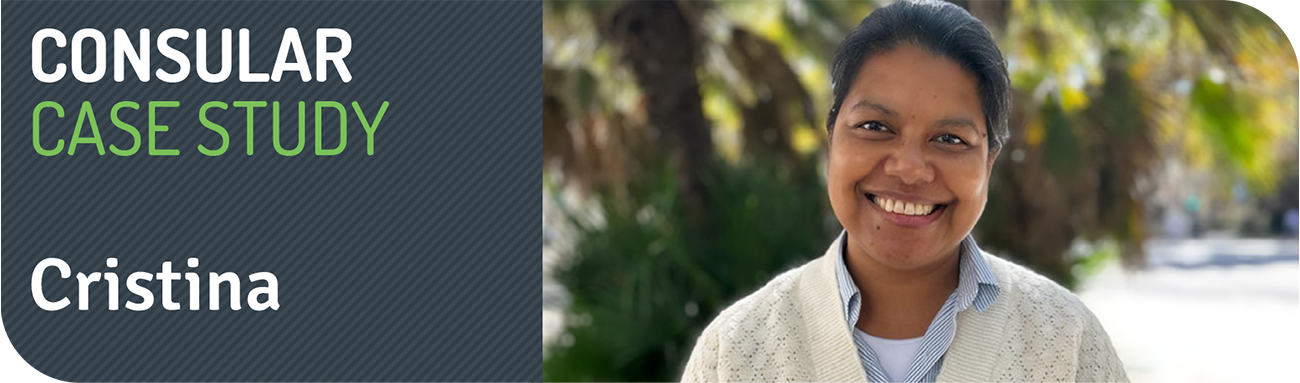
Consular case study - Cristina

A group of Australian friends were on a guided tour of Europe when their tour stopped in Lisbon. They were not to know that it would be the last destination for one of their party.

Cristina, a dual Australian-Portuguese national, has been part of the consular team at the Australian Embassy in Lisbon for over two decades. When the Embassy was contacted about the unexpected death of an Australian citizen, she stepped in to assist the deceased's partner.

"The family member was clearly distraught, overwhelmed, and being in an unfamiliar country only complicated the situation," Cristina recalls.

"Although the couple was travelling with a friend, the bereaved partner felt anxious about what to do next."

The family member was unclear about the next steps when it came to arranging the release of their partner's body, and what needed to be organised for the return to Australia.

With her extensive experience handling cases where an Australian has passed away overseas, Cristina was well placed to advise the family member on what to do next.


"Each death leaves its mark not only on the family, but also on the consular officers," she said.


"While there are standard consular guidelines for death cases, I had to think out of the box to overcome some of the challenges presented.

"Obtaining autopsy results and other reports from local authorities quickly, requires experience and some special skills."

The family member was deeply appreciative of all of Cristina's efforts, as her quick actions helped the family member make arrangements for the repatriation of their deceased partner.

"Having ready access to current information and being able to relay it to clients is important," Cristina recalls.

As the couple had taken out travel insurance prior to their trip, their travel insurance provider then stepped in, ensuring all requirements were met for the return to Australia.

While the Australian Embassy in Lisbon is relatively small, it also has responsibility for Cabo Verde, Sao Tome and Principe and Guinea Bissau, assisting with Australian passport renewals, offering notarial services and building networks with local authorities through consular visits.

Among the cases Cristina is seeing more and more, are those relating to mental health issues.


"One of the main factors that has had an impact on me since commencing at the Embassy is the increase of Australians with mental health issues," Cristina said.


"I have seen how this health problem does not discriminate by social status or age. It can affect anyone, whether impacted by an emotional situation or a substance abuse scenario.

"I have also seen the importance of, and the positive impact that happens when a person has strong family unit available to provide support.

"My role liaising with external stakeholders is key to resolving situations that Australians may find themselves overseas. These include hospitals, local mental health associations and local police authorities.

"Many times, these stakeholders have tirelessly assisted us, such as locating the whereabouts of Australians who may be in danger of causing self-harm."

Despite dealing with intense consular cases such as these, Cristina feels supported by the Department, her Embassy colleagues and regional consular officers every step of the way.

"Advice is quickly made available, so I never feel at a loss when confronted by more complex situations," Cristina said.

"Clients may feel overwhelmed and are grateful when we can help mitigate the issue with our expertise and guidance."

Situations such as the death of a loved one can be highly emotional, but Cristina appreciates how rewarding it is to be able to help someone at their most vulnerable.

"These cases are always sensitive, and a level of empathy is always necessary," she reflects.

"It's interesting to see how quickly a professional bond can develop between the client and consular officer. Trust is quickly established, and it is rewarding to have the client's positive feedback once they return home to Australia."

Smartraveller

When an Australian dies overseas, their next of kin will probably experience more difficulties than if they'd died back home. This can be challenging and expensive. Travel insurance is essential and can ease the financial and administrative burden on loved ones. 

Smartraveller provides information on what happens if an Australian dies overseas and what you should do before you travel.

Before you travel overseas, make Smartraveller your first destination.

Emergency consular assistance

The Australian Government provides 24-hour consular emergency assistance.

+61 2 6261 3305 from overseas

1300 555 135 from within Australia

For how we can help you overseas see the Consular Services Charter.

Enquiries and feedback

For non-urgent enquiries, or to provide feedback on consular services that you've recently received, contact us online.

For information on notarial services, email legalisations.australia@dfat.gov.au

To report a vulnerability you’ve identified on this website or to find out more about the department’s Vulnerability Disclosure Policy visit the DFAT website

About us

Smartraveller is provided by the Australian Department of Foreign Affairs and Trade

For more information go to about us.

Information in other languages

Find information in other languages.


Follow us

Facebook

Twitter

Instagram

YouTube

RSS

News

Read our latest news.

Resources

View resources for travel industry and media.

Was this information helpful?

Your feedback will help us improve your experience.

Footer

Australian Government logo. Department of Foreign Affairs and Trade
  • Privacy policy
  • Copyright
  • Cookies and analytics
  • Accessibility
  • Disclaimer
  • Legal
  • Sitemap

Main navigation

  • Home
  • Travel essentials
    • The essentials checklist
      • قائمة التحقّق قبل السفر (Arabic)
      • 渡航前チェックリスト (Japanese)
      • 출발 전 체크리스트 (Korean)
      • รายการสิ่งที่ควรทำก่อนเดินทาง (Thai)
      • Trước khi lên đường danh sách kiểm tra (Vietnamese)
      • 出行之前不忘检查确认 (Chinese Simplified)
      • 出發前檢查清單 (Chinese Traditional)
    • Travel insurance
      • CHOICE travel insurance buying guide
    • Getting a foreign visa
      • Travelling to Europe and the Schengen Area
    • Travel health
      • Healthcare agreements
      • Infectious diseases
      • Medical tourism
      • Medicine and medical devices
      • Mental health
      • Organ transplant tourism
      • Pregnancy
      • Urgent medical care
    • Following the law
      • Arrested or jailed
      • Carrying or using drugs
      • Child sex offences
      • Female Genital Mutilation
      • Modern slavery
    • Australia's biosecurity and border controls
    • Travelling safely overseas (Easy Read)
  • Planning a trip
    • Advice for different types of traveller
      • Academics
      • Colour, race, ethnicity, or religion
      • Dual nationals
      • Journalists
      • LGBTQIA+
      • Older travellers
      • Schoolies
      • Travelling with children
      • Travelling with a disability
      • Travelling with pets
      • Women
    • Advice for your planned activities
      • Adoption
      • Antarctica and the Arctic
      • Backpacking
      • Business
      • Living, working or studying overseas
      • Marriage
      • Partying safely
      • Retiring overseas
      • Sports and adventure
      • Surrogacy
      • Volunteering
    • Going overseas for a major event
      • Cultural events
        • Anzac Day
      • Religious events
        • Ramadan
        • Hajj
      • Sporting events
    • Getting around safely
      • Air travel
      • Boat travel
      • Going on a cruise
      • Public transport
      • Road safety
  • Destinations
    • View all destinations
    • Africa
    • Americas
    • Asia
    • Europe
    • Middle East
    • Pacific
  • While overseas
    • Conflict and unrest
      • Armed conflict
      • Protests and civil unrest
      • Terrorism
    • Extreme weather and natural disasters
      • Bushfires
      • Cyclones
      • Earthquakes and tsunamis
      • Floods
      • Landslides, mudslides and avalanches
      • Severe hot or cold weather
      • Tornadoes
      • Volcanic eruption
    • Personal emergencies
      • Lost or damaged property
      • Money problems
      • When someone is missing
      • When someone has died
    • Protecting yourself from crime
      • Assault
      • Cyber security
      • Kidnapping
      • Piracy
      • Scams
      • Sexual assault and harassment
      • Theft and robbery
    • What to do in a crisis
      • Nuclear incident
  • Urgent help
  • Our role
    • About us
      • Contact
      • Partnerships
      • Social media
    • Consular State of Play
      • Data
      • Case studies
      • Images
      • Videos
      • Audio
      • Historical data
    • Consular Services Charter
      • ميثاق الخدمات القنصلية (Arabic)
      • 领事服务章程 (Chinese Simplified)
      • 領事服務章程 (Chinese Traditional)
      • Panduan Layanan Konsuler (Indonesian)
      • 領事サービス憲章 (Japanese)
      • 영사 서비스 헌장 (Korean)
      • กฎบัตรว่าด้วยบริการต่าง ๆ ของกงสุล (Thai)
      • Quy định về Dịch Vụ Lãnh Sự (Vietnamese)
      • Consular Privacy Collection Statement
    • How we write our travel advice
    • What our travel advice levels mean
    • News and updates
    • Notarial services
      • Documents we can legalise
      • Notarial services in Australia
      • Notarial services overseas
      • Certificates of No Impediment
      • Notarial forms
    • Our subscription service
    • Passport services
    • Resources
      • Insurance Council of Australia reports
    • Voting overseas
    • What we do in a crisis
    • Communities
      • العربية (Arabic)
      • Bahasa Indonesia
      • 中文 简体 (Chinese Simplified)
      • 中文繁體 (Chinese Traditional)
      • 日本語 (Japanese)
      • 한국어 (Korean)
      • ภาษาไทย (Thai)
      • Tiếng Việt (Vietnamese)
      • Filipino community
      • Indian community