
There is no centralised number to reach emergency services.
Afghanistan
Advice levels
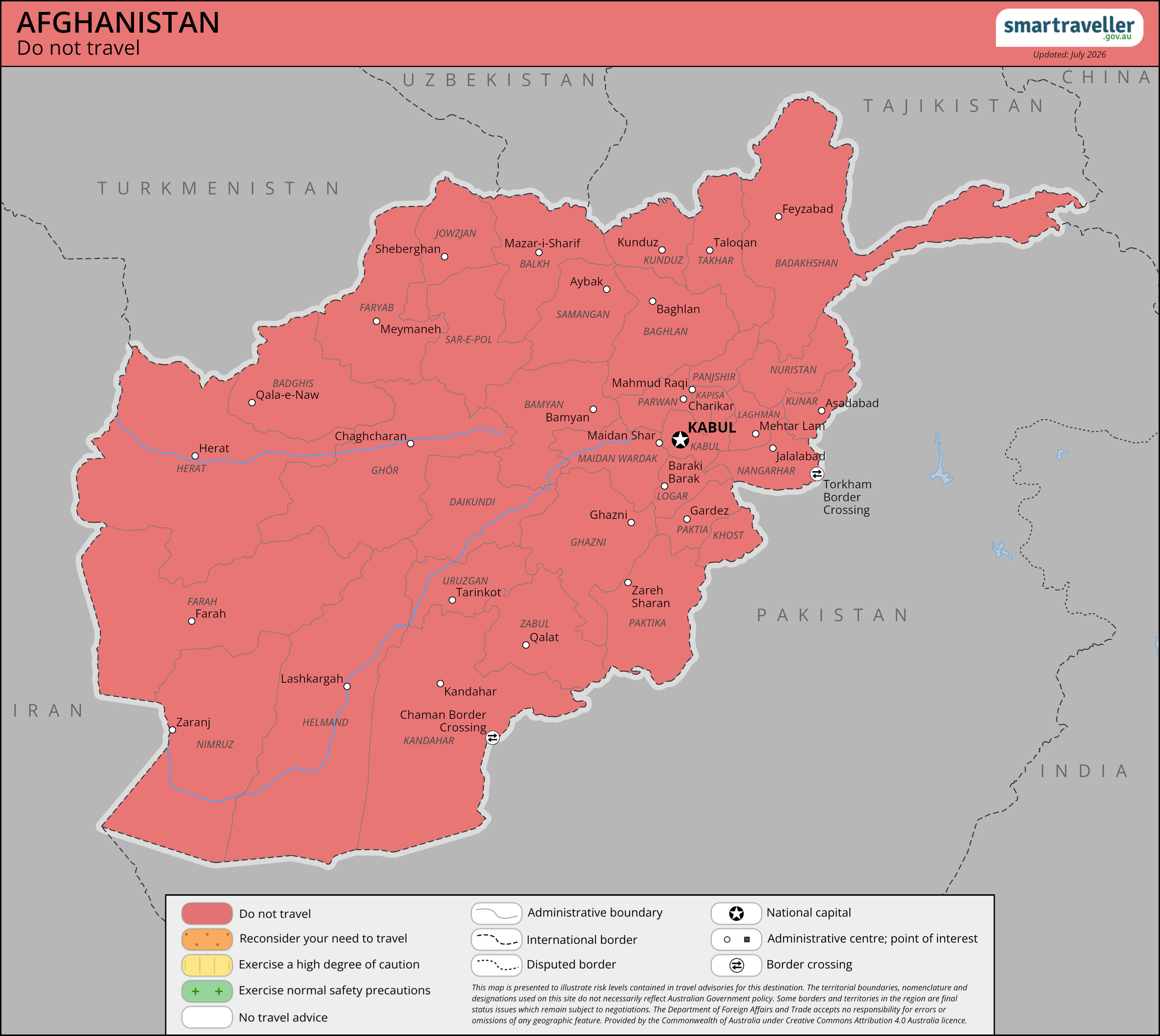
What does this mean?Do not travel to Afghanistan.
Do not travel to Afghanistan due to the extremely dangerous security situation and the high threat of terrorism, kidnapping, arbitrary detention and armed conflict.
Overview
Safety
- The security situation is extremely dangerous and volatile. If you're in Afghanistan despite our advice, you should leave immediately. If you decide to remain, you’re responsible for your own safety. Airports, flights, phone or internet services can stop working at any time. There's no guarantee you’ll be able to leave safely.
- Military conflict between Pakistan and Afghanistan has resulted in intense fighting in the border region, aerial attacks and bombings in urban centres, including Kabul, Kandahar and other cities. Armed conflict could escalate further or expand to other locations without warning. Fighting is expected to continue, especially along the eastern border. Further attacks in larger cities – Kabul, Kandahar, Jalalabad – cannot be ruled out.
- Travel throughout Afghanistan is extremely dangerous. Crossing land borders can be dangerous. Recent military action between Pakistan and Afghanistan along the shared border areas may affect the broader security environment. Increased border tensions or risk of a terrorist attack can close border crossing points without notice. Consider the risks carefully before attempting to leave by any land route. The Australian Government can't offer advice on the safety of travelling to departure points.
- Do not travel to Afghanistan for any reason, including for tourism, cultural or family reasons. Do not book a tourist trip, even with reputable tour operators. Foreigners have been targeted; recent incidents include the killing and injury of tourists. No thrill or social media attention is worth risking your life.
- There’s a high risk of terrorist attacks, including at airports and places foreigners visit. Terrorists have conducted violent attacks against foreigners and tourists. Kidnapping is a serious and ongoing threat. You could be targeted for political motivation or ransom. Terrorists and criminal groups target foreigners, dual nationals and local and foreign NGO operations across the country and in Kabul. Nowhere in Afghanistan can be considered safe from the threat of attack.
- There's a risk of arbitrary detention. Foreign nationals, including aid workers and journalists, have been detained. Reasons for detention can be unclear and you can be held for a long time. The Australian Government may not be notified of your detention.
Full travel advice: Safety
Health
- Most Australian travel insurance policies won't cover you for travel to Afghanistan. If you choose to travel against our advice, you’ll need a specialised insurance policy.
- Insect-borne diseases are common. Waterborne, foodborne, parasitic, and other infectious diseases, including polio, are widespread.
- Medical facilities are very limited. Sanitation and hygiene are poor. If you're seriously ill or injured, you'll need medical evacuation, which may not be possible and can be very expensive.
- Basic health care may be available in major cities but may be completely unavailable in rural areas.
Full travel advice: Health
Local laws
- Afghanistan is an Islamic country. The Taliban claim its legal system imposes a strict version of Sharia law. Activities considered normal in Australia or even other Islamic countries – such as playing music or board games – are illegal.
- Afghanistan uses corporal and capital punishment. ‘Moral crime’ offences such as adultery or running away from home can receive public lashings. Crimes like murder, blasphemy or espionage can receive the death penalty. The Taliban’s local application of law can change without notice. If you don’t comply you can be arrested or face severe punishment.
- Women are prohibited from travelling without a male guardian and are prohibited from many public places.
- De facto relationships, close contact between unmarried men and women, adultery and same-sex relationships are illegal.
- There are very strict codes of dress and behaviour in Afghanistan. Women must fully cover themselves in public and men must abide by strict rules.
- Preaching a religion other than Islam and renouncing Islam is illegal.
Full travel advice: Local laws
Travel
- All travel throughout Afghanistan, including by road, is extremely dangerous. Violent incidents occur across the country. Consider the risks carefully before attempting to leave by any land route. See ‘Safety’.
- There are unexploded weapons, landmines and improvised explosive devices (IEDs) on and near roads and borders. Historic munitions may be unearthed by weather events such as floods or landslides.
- Passport theft is common in Afghanistan. Your passport is a highly valuable document and can be used by criminals to commit crime. Always keep it in a safe place, including any photocopies. If it’s stolen, notify the Australian Passport Office immediately. It may not be possible to replace your Australian passport if it's lost, stolen or damaged and you are in Afghanistan.
- Airport and aviation safety infrastructure is not maintained to the same standard as in Australia. Due to safety concerns, Afghan-owned airlines are banned from flying in EU airspace. DFAT doesn't provide information on the safety of individual commercial airlines or flight paths.
Full travel advice: Travel
Local contacts
- The Australian Embassy in Kabul has closed. There are no Australian officials in Afghanistan. Our ability to provide consular assistance is severely limited. We cannot provide in-person consular help or facilitate the delivery of passports into Afghanistan.
- If you've left Afghanistan and require consular assistance contact the nearest Australian embassy or consulate.
- Australians in Afghanistan in need of emergency consular assistance should contact the Australian Government 24-hour Consular Emergency Centre on 1300 555 135 in Australia or +61 2 6261 3305 outside Australia.
- There are limits to what consular assistance we can provide in high-risk locations. Read the Consular Services Charter to understand how we can assist you overseas.
Full travel advice: Local contacts
Full advice
Safety
Security situation
Do not travel to Afghanistan. Nowhere in Afghanistan is safe - even the capital. Australians have been kidnapped, arbitrarily detained and targeted by terrorist attacks. The security situation is extremely dangerous and volatile. Military conflict between Pakistan and Afghanistan has resulted in intense fighting in the border region and bombings in urban centres, including Kabul, Kandahar and other cities. Armed conflict could escalate further or expand to other locations without warning. Airports and borders may close suddenly.
You’re at a high risk of terrorist attacks, kidnapping and arbitrary detention. Terrorists and criminal groups target tourists, aid workers and journalists, foreigners, dual nationals and local and foreign NGO operations across the country and in Kabul.
If you’re in Afghanistan, you should leave immediately. If you stay, you may not be able to leave quickly.
Travel throughout Afghanistan, including by road, is extremely dangerous. Violent incidents occur across the country. Border crossing points are often targets for terrorists. Terrorists and criminal groups can set up fake checkpoints and roadblocks to rob or kidnap you. They can close without notice if there’s an increased risk of attack.
The Taliban are suspicious of foreigners, including dual nationals. There are Taliban checkpoints on roads throughout the country. The Taliban regularly harass and detain international and local aid and humanitarian workers.
The Taliban enforce strict measures on personal behaviour. The Taliban’s local application of law can change without notice. If you don’t comply you can be arrested and may face severe punishment.
Airports, flights and telecommunications, including the internet, can be disrupted at any time.
Consider the risks carefully before attempting to leave by any land route. The Australian Government can't offer advice on the safety of travelling to any departure point. All travel options are at your own risk. You're responsible for your own safety and that of your family.
If, despite our advice, you travel to or remain in Afghanistan, take all precautions for your safety:
- Get independent, professional security advice and hire personal protection
- Adopt effective personal security measures and review them regularly
- Make contingency plans to leave
Dangerous tourism
Do not travel for any reason, including for tourism, cultural or family reasons.
Do not book a tourist trip to Afghanistan, even if offered by reputable tour operators or promoted as a guided tour. A tour operator cannot guarantee your safety. Terrorists target foreigners as part of tour groups. In May 2024, three Spanish tourists were killed and an Australian injured in a shooting while on a guided tour in Bamiyan, Central Afghanistan.
The risks of detention, kidnap and other security threats to foreigners remain high. You could die or be seriously injured while in Afghanistan.
Travelling somewhere uncommon or unsafe can seem thrilling. Especially if you’ve seen others do it and return safely. But visiting locations where we advise ‘Do not travel’ can put your life in serious danger. Don’t get influenced into taking risks. No amount of likes are worth the risks.
If you do get into trouble, our ability to provide consular assistance is severely limited. It’s also likely you won’t be covered by travel insurance.
More information:
Terrorism
There's a high threat of terrorist attacks throughout Afghanistan. Terrorist groups are active throughout Afghanistan. They’ve conducted violent attacks targeting NGO’s, humanitarian operations, medical providers and foreigners, including tourists and dual nationals. Attacks can occur anywhere and at any time. No person or location in Afghanistan can be considered safe from the threat of attack.
If, despite our advice, you travel to Afghanistan as a tourist, there’s a high risk you could be the target of a terrorist attack or kidnapping. See ‘Dangerous tourism’.
Serious, large-scale terrorist incidents happen, including attacks using vehicle-borne, magnetic, or other improvised explosive devices (IEDs) and firearms. Rocket and mortar attacks also occur. Terrorists may attack vehicles travelling along roads in and around Kabul. Convoys have been targeted.
Attacks resulting in casualties have happened near diplomatic facilities, Kabul International Airport, places of worship, border crossings and other high-profile locations.
There's a heightened threat of terrorist attacks in or around religious sites and during religious festivals, such as the month of Ramadan.
Targets of an attack in Afghanistan may include:
- airports
- Taliban administration buildings and military establishments
- embassies and residential compounds used by foreigners
- NGO and international humanitarian facilities and vehicles
- public areas such as hotels, shops, restaurants and markets frequented by foreigners
- border crossing points
- police stations, schools and medical facilities
- high-profile vehicle convoys
- religious facilities or symbols, such as mosques, shrines or madrassas
If you’re in Afghanistan, you should leave immediately. If you stay, you may not be able to leave quickly. You're responsible for your own safety. Review your personal security plans regularly.
If there’s a terrorist incident, leave the area if it’s safe to do so and follow the instructions of local authorities.
More information:
Kidnapping
Kidnapping occurs across the world with political, ideological, and criminal motives. Foreigners, including Australians, have been kidnapped overseas whilst travelling. Kidnapping can happen anywhere, even in places that seem safe.
Afghanistan is a global kidnapping hotspot. There's a high number of recorded incidents. Westerners, including Australians, have been kidnapped in Afghanistan.
Terrorist and criminal groups in Afghanistan will target anyone perceived to have money for kidnapping or extortion. This includes tourists, journalists, aid workers, doctors, business travellers and people linked to NGOs. Criminal groups may also sell their captives to terrorist groups, with victims potentially spending years in captivity.
If, despite our advice, you travel to an area with a high risk of kidnapping, our ability to provide consular assistance in these destinations is extremely limited.
You’re responsible for your own safety. You can find more information on how to reduce your risk of kidnapping here: Kidnapping.
The Australian Government's longstanding policy is that it doesn't make payments or concessions to kidnappers. Ransom payments to kidnappers have funded further terrorist attacks and criminal activity. Ransom payments to terrorist groups are likely to contravene Australian counter-terrorism financing laws.
Detention
Foreign nationals, including Australians, are at risk of arbitrary detention in Afghanistan. Australians have been previously detained, including for extended periods.
The Taliban has harassed and detained aid and humanitarian workers, tourists, and journalists. The Taliban are suspicious of foreigners working or travelling in Afghanistan, including dual nationals. It's likely your work and movements will be closely monitored.
Reasons for detention may be unclear. Detention can be lengthy, possibly months or years, and damaging to your health and welfare, with uncertain outcomes. Communication with your next of kin may not be possible.
The Australian Government may not be notified about a detention. Our ability to access information about or assist a detainee is severely limited.
There's an increased risk that the Taliban will suspect you of espionage and may detain you if you're found in possession of:
- weapons
- explosives
- tracking devices
- objectionable religious material
- military paraphernalia
- items that may be considered unusual, especially IT equipment or dual-use goods (can be used by civilians or the military)
- large quantities of money
- multiple passports
Or if:
- you have worked in the military
- you have connections to previously detained foreign nationals
Punishment for espionage or working to undermine Afghanistan’s national security may be severe.
Civil unrest and political tension
Demonstrations may happen as a result of domestic or international events or political developments in the region. Demonstrations could be perceived as dissent by the Taliban, particularly if you challenge or criticise their laws.
Activism is prohibited and all forms of communication are closely scrutinised. If you discuss, share or publish information critical of the Taliban, including on social media, you may face increased surveillance and harassment, arrest, and possibly lengthy detention. Journalists are especially monitored.
Public protests and events that draw large groups of people can turn violent.
If they escalate, people could be killed or injured. Stay away from large crowds and check media for updates.
More information:
Crime
There's a high level of petty and serious crime throughout Afghanistan, including:
- armed robbery
- rape
- carjacking
- drug trafficking
Many people carry weapons.
Armed bandits and kidnappings by armed groups are common. See ‘Kidnapping’.
Drink spiking
Methanol poisoning
Cyber safety
Extreme weather and natural disasters
Afghanistan is in an active earthquake zone. Earthquakes in recent years have caused heavy casualties and significant damage to homes and infrastructure.
Some mountainous areas experience deadly winter avalanches and heavy snow.
Heavy rainfall may cause severe flooding and trigger landslides, especially in northern and eastern provinces.
Sand and dust storms are common, especially in the southern provinces.
Water shortages are common, including in Kabul.
Follow the instructions of local authorities.
More information:
Health
Travel insurance
Most Australian travel insurance policies won't cover you for travel to Afghanistan.
Physical and mental health
Medications
Health risks
Insect-borne diseases
Insect-borne illnesses are common throughout Afghanistan, including:
To protect yourself:
- use insect repellent
- wear long, loose, light-coloured clothing
- make sure your accommodation is insect-proof
- consider taking medicine to prevent malaria
Other health risks
Waterborne, foodborne, parasitic and other infectious diseases are widespread, including:
- cholera
- typhoid
- hepatitis
- measles
- tuberculosis
- leptospirosis
- whooping cough (pertussis)
- rabies
- polio
Serious outbreaks sometimes occur.
To stay safe:
- boil drinking water or drink bottled water with sealed lids
- avoid ice cubes
- avoid direct contact with animals, including dogs, cats, monkeys, bats and other mammals
If despite our advice you travel to Afghanistan, ask your doctor about health risks and vaccines before you go.
More information
Air pollution
Household air pollution is an environmental health risk in Afghanistan. There's a higher risk during winter.
To reduce your exposure, take precautions when increased levels are recorded.
More Information:
Medical care
Medical facilities in Afghanistan are very limited and the standard of training, sanitation and hygiene are poor.
Most Australian travel insurance policies won't cover you for travel to Afghanistan.
There's no public ambulance service in Afghanistan. If you need urgent attention, speak directly with a local medical practitioner and use local transport to get to hospital when it's safe to. Ambulances sent by hospitals may require payment or evidence of insurance before they treat you.
Healthcare for women is extremely limited or non-existent. Health professionals are limited in their practice. They may not be allowed to treat women who aren't accompanied by their male guardian.
You'll need to be evacuated if you get seriously ill or injured. Medical evacuation may not be possible and can be very expensive.
Local laws
Local law
Afghanistan’s legal system is run by Sharia law and the Taliban strictly enforce their interpretation of Islam. Afghanistan imposes the death sentence and uses corporal punishment. Laws and the severity of punishments can vary from one province to another.
Foreigners, including Australians have been detained without fair treatment. The Australian government may not be notified of your detention, and you can be detained for long periods in harsh conditions. See ‘Detention’.
Relationships
It's illegal for unmarried men and women to live together or have any contact.
Same-sex relationships are illegal.
Severe penalties can apply for breaking these laws including corporal punishment, imprisonment and the death penalty.
More information:
Religious Proselytism
Religious proselytism is illegal. This includes preaching, possessing, or distributing religious literature or material. If you convert or try to convert someone from Islam to another religion, you could face a severe punishment, including the death penalty. Individuals practicing a religion other than Islam have been arbitrarily arrested, detained, and physically attacked or abused.
You could be accused of blasphemy if you engage in religious activities that contradict or challenge the Taliban’s extreme interpretation of Islamic teachings and values. Such acts are punishable by lengthy jail sentences and even the death penalty.
Other laws
The Taliban prohibit women from:
- travelling and going to public places without a male guardian (such as parks and restaurants)
- looking at unrelated men's body or face
- accessing higher education
- most employment including working outside their home, working for NGOs and the United Nations
- having their voices heard in public.
There are strict codes of dress for women, including foreign women. They must be fully covered from head to toe. If you don’t adhere to these laws, you could be arrested. Get local advice.
Men are prohibited from wearing ‘western-style clothing’ such as jeans and are not allowed to shave their beard if it's less than the width of a fist. Men are forbidden from looking at an unrelated woman’s body or face.
It's illegal to possess photographs of people, animals or other images of ‘living beings’. Musical instruments and playing music is illegal. Many board games, including Ludo and Chess are illegal. Many books, including any written by women are prohibited.
It’s illegal to photograph
- checkpoints
- government buildings
- palaces
- security or military sites, including non-Afghan installations
You could be detained and have your equipment seized. Obey signs prohibiting photography.
It’s illegal to bring drugs, alcohol or pork products into Afghanistan, or to possess or consume any of these products when you're there. If you do, you could be arrested.
Australian laws
Afghanistan is subject to Australian sanctions that apply to you. See Afghanistan sanctions framework.
Local customs
Ramadan
The Islamic holy month of Ramadan is observed. Always respect religious and cultural customs and laws.
During Ramadan, eating, drinking, and smoking may be illegal during the day. If you're not fasting, avoid these activities in front of people who are. Get local advice to avoid offence.
More information:
Travel
Visas and border measures
Each country or territory decides its own entry and exit rules. If, despite our advice you travel to Afghanistan, ensure you meet all entry and exit conditions. Not all Afghan Embassies abroad are able to issue valid travel documents. If you don't meet the conditions, the Australian Government can't help you.
Passport
Limited services
Our ability to provide any passport services to Australians in Afghanistan is severely limited. We can't facilitate the delivery of passports into Afghanistan.
Validity
Lost or stolen passport
Passport with ‘X’ gender identifier
Money
The local currency is the Afghani (AFN).
Local travel
Road travel
All travel throughout Afghanistan, including by road, is extremely dangerous. Road accidents occur often due to driver error, road conditions or poor vehicle maintenance.
Violent incidents occur across the country. There's an ongoing threat of terrorist attacks, including at border crossing points. Border crossing points may be closed without notice, especially when crowds gather or where there are concerns of an increased risk of attack. There are Taliban checkpoints on roads in Kabul and throughout the country.
Unexploded remnants of war, including landmines and IEDs, are a danger across the country, including on or near roads and borders.
The Australian Government can't offer advice on the safety of travelling to departure points. All travel options are at your own risk. Consider the risks carefully before attempting to leave by any land route. You're responsible for your own safety and that of your family.
See ‘Safety’.
More information:
Air travel
Airport and aviation safety infrastructure is not maintained to the same standard as in Australia, including aircraft, emergency response vehicles, weather services and tower communications.
Check Afghanistan's air safety profile with the Aviation Safety Network.
More information:
Local contacts
Emergencies
There's no centralised number to reach emergency services.
Consular contacts
The Australian Embassy in Kabul is closed. Our ability to provide consular assistance to Australians in Afghanistan is severely limited. We cannot provide in person consular or passport services.
24-hour Consular Emergency Centre
If you have a consular emergency call the 24-hour Consular Emergency Centre on:
- +61 2 6261 3305 from overseas
- 1300 555 135 in Australia
For non-urgent enquiries, including passports, see the contact page on the Australian Embassy Afghanistan website.
Travelling to Afghanistan?
Sign up to get the latest travel advice updates.
Be the first to know official government advice when travelling.