Fire and rescue services
Call 125.
Medical emergencies
Call 115 or go direct to the hospital.
Police
Call 110 or visit the nearest police station.

Call 125.
Call 115 or go direct to the hospital.
Call 110 or visit the nearest police station.
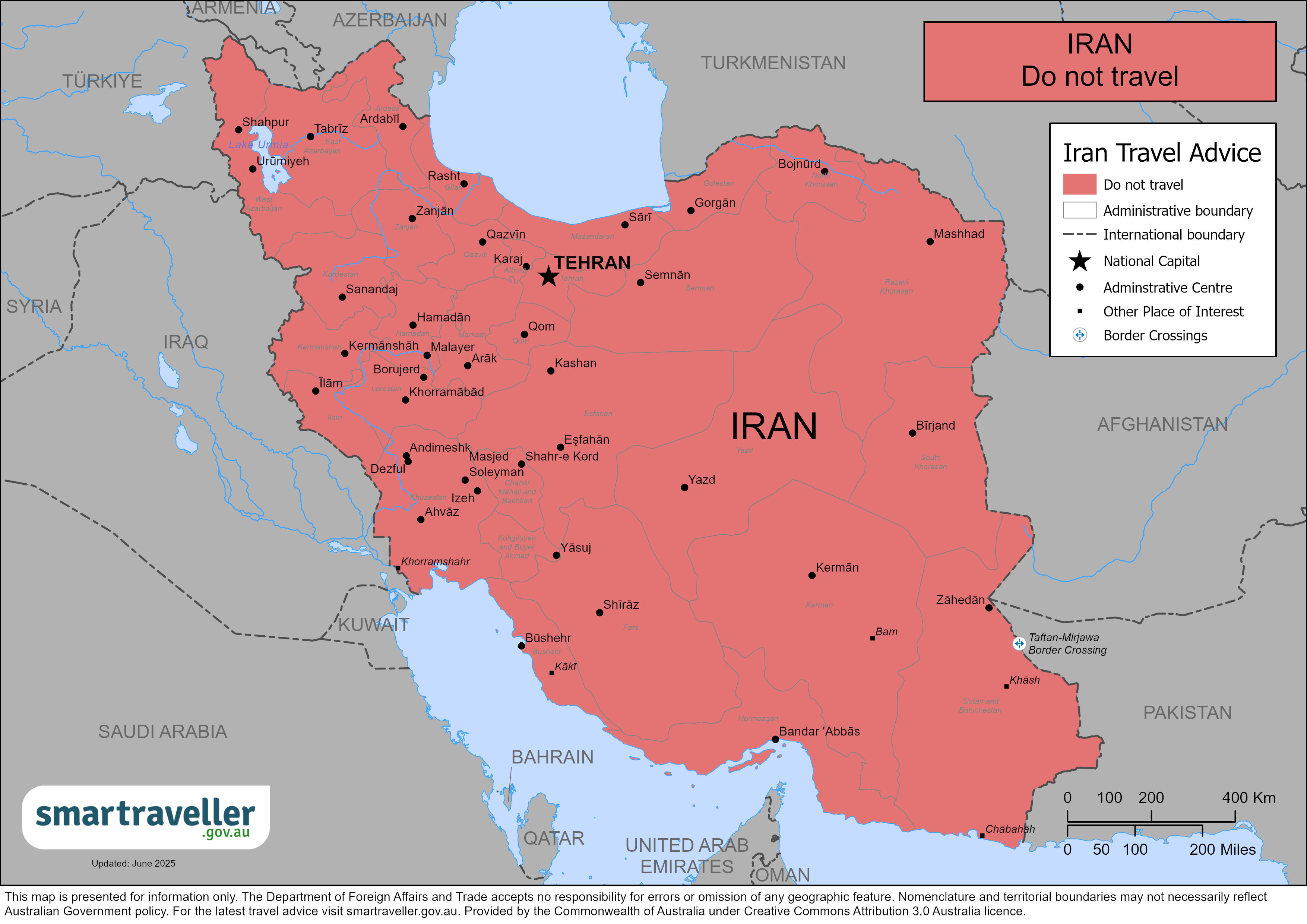
Do not travel to Iran due to the volatile security situation, armed conflict, civil unrest and the risk of arbitrary detention.
Full travel advice: Safety
Full travel advice: Health
Full travel advice: Local laws
Full travel advice: Travel
Full travel advice: Local contacts
Australians, including dual nationals, are at a high risk of arbitrary detention or arrest. Foreign nationals, including Australians, have been arrested or detained by Iran without due process of law.
You may be at greater risk of detention if authorities are suspicious of your activities or background, especially following a security incident or military conflict. Foreign journalists and other media workers in Iran may face high risks, including arrest and imprisonment. See our advice for journalists.
You could also attract the attention of authorities if you:
Do not visit military or nuclear sites; these are not always clearly marked. You can get arrested for venturing close to or taking photos of sensitive sites.
Iran does not recognise dual nationality. If you're a dual Australian-Iranian national and are detained in Iran, our ability to provide consular support is extremely limited.
The Australian Government may not be notified if you're detained. We can't guarantee consular access to any Australian detained or arrested. We also can't guarantee access to legal representation.
More information:
Do not travel to Iran. The security situation in Iran is extremely volatile.
The situation in the Middle East region remains unpredictable. The risk of attacks and escalation continues. If you are in Iran and want to leave, we continue to advise you to make plans to do so.
Consider options to depart Iran if you can secure one and it's safe to travel to the departure point. You should consider recent attacks in your area and verify the status of any border crossing before you travel by air, land or sea. Confirm local advice before heading to a land border. Make sure you have access to food, water and essential medicines
If you remain in Iran, prioritise your safety. Monitor developments closely and follow local advice, including shelter in place instructions during strikes. Be prepared to shelter in place for an extended period. Make sure you have supplies of water, food and medication. See our general advice on protecting your safety during an armed conflict.
Stay aware of your environment and avoid government, military or energy infrastructure, including oil production facilities. Avoid any locations associated with Israeli, Jewish and US interests. Follow local warning systems and, if warned of an imminent attack, move to an enclosed hardened shelter, ideally underground or close to ground level if available. If these are not available, seek an inner room without windows.
The US Virtual Embassy in Iran issuing local security alerts. We encourage you to monitor US security alerts in your location and follow this advice (see 'Safety').
The Australian Embassy’s operations are suspended. Our ability to provide consular assistance in Iran is extremely limited.
Iranian authorities are active in and closely monitor border areas with Iraq, Afghanistan and Pakistan. The security situation within 10km of the Iran-Iraq border is extremely dangerous. Borders may close without notice.
Consider the risks carefully before attempting to leave by any land route. The Australian Government can't offer advice on the safety of travelling to any departure point. All travel options are at your own risk. You're responsible for your own safety and that of your family.
Australian citizens, permanent residents and their immediate family members in Iran can register on DFAT's registration portal to receive direct updates from DFAT.
We will communicate important updates directly to registered Australians. Keep your registration details up to date so we can contact you. Refresh your browser or clear your cache if you experience website issues.
If you need emergency consular assistance, contact the Australian Government's Consular Emergency Centre on +61 2 6261 3305 (if you're overseas) or 1300 555 135 (in Australia).
Security forces’ response to protests has been severe and many protesters and bystanders have been injured, killed or detained. Large crowds can turn violent. During past protest periods, there have been increases in the number of foreign nationals arrested.
Avoid large public gatherings, demonstrations, protests and vigils. Do not take photos. Be prepared to change your plans in case of disruptions. If civil unrest disrupts transport, ask your airline, travel agent or insurer for help. Check media for updates and follow the instructions of local authorities.
Political developments in the region and local political tensions can trigger protests, demonstrations and vigils with little notice. Public protests and events that draw large groups of people can turn violent.
During times of civil unrest, Iranian authorities may impose internet blackouts. Communication options during these periods may be extremely limited.
More information:
A terrorist attack could happen anywhere in Iran at any time, including in Tehran.
A large suicide bomb attack occurred in January 2024 in Kerman, killing several and wounding hundreds.
If there’s a terrorist incident, leave the area if it’s safe to do so and follow instructions of local authorities.
For more information on common targets for terrorists and what to do if there’s a terrorist attack, read our terrorism page.
Kidnapping occurs across the world with political, ideological, and criminal motives. Foreigners, including Australians, have been kidnapped overseas whilst travelling. Kidnapping can happen anywhere, even in places that seem safe.
Kidnapping is a risk in Iran, foreigners have been targeted, including in Tehran. Kidnappings in major centres are typically carried out by financially motivated criminals. The kidnapping risk is heightened in the border areas with Afghanistan and Pakistan where armed groups are active.
If despite our advice, you travel to an area with a high risk of kidnapping, our ability to provide consular assistance in these destinations is extremely limited.
You’re responsible for your own safety.
The Australian Government's longstanding policy is that it doesn't make payments or concessions to kidnappers. Ransom payments to kidnappers have funded further terrorist attacks and criminal activity. Ransom payments to terrorist groups are likely to contravene Australian counter-terrorism financing laws.
More information:
There have been increasing reports of thieves in passing vehicles and on motor bikes snatching bags and mobile phones from pedestrians, home break-ins and robberies.
Women can face unwanted attention and harassment. Women should take care when travelling alone, particularly at night.
Bootleg and counterfeit alcoholic drinks containing methanol are prevalent in Iran. See drink spiking and methanol poisoning below.
Terrorists, drug traffickers, smugglers and bandits are active in the border areas near Afghanistan and Pakistan.
Violent incidents often occur in these areas, such as:
Travel at night in these areas is particularly dangerous.
Be alert to your surroundings, especially at night. Don't draw unwanted attention to yourself.
Men may approach foreigners and claim to be police in plain clothes. They say they're looking for foreign drug dealers and ask to see wallets and ID.
If this happens, it could be a scam. Ask a uniformed police officer for help.
Iran experiences extreme weather and natural disasters.
Iran is in an active earthquake zone. There have been several major earthquakes in recent years.
Some regions have heavy snowfall during winter.
Sandstorms and dust storms occur regularly.
Flash flooding can occur, particularly in Spring.
During periods of extreme heat or cold, areas of Iran may experience electricity blackouts and brownouts. These may last several hours.
Follow the instructions of local authorities.
More information:
Insect-borne illnesses are common throughout Iran, including:
To protect yourself from disease:
Get medical advice if you have a fever, muscle pain, rash or severe headache.
Waterborne, foodborne, parasitic and other infectious diseases occur, such as:
Serious outbreaks sometimes occur.
To stay safe:
If despite our advice you travel to Iran, ask your doctor about health risks and vaccines before you go.
More information:
Significant air pollution occurs in major cities.
There’s no agreement between Australia and Iran for free healthcare.
The standard of medical facilities varies. Facilities in remote areas are extremely limited.
Medical tourism including for cosmetic operations is common in Iran. The standard of medical service providers can vary.
Do not travel to Iran. Serious post-surgery complications and deaths have occurred.
You'll need to be evacuated if you get seriously ill or injured. Medical evacuation may not be possible and can be very expensive. Most Australian travel insurance policies won't cover you for travel to Iran.
Penalties for importing and possessing drugs are severe and include the death penalty.
Authorities have executed foreigners for drug-related offences in recent years.
More information:
Get professional advice if you're involved in local legal proceedings. In particular, seek legal advice on matters of family law, such as:
Local authorities consider domestic violence to be a private family matter. Iranian law does not prohibit domestic violence.
Authorities have stopped Australians and Australian-Iranian dual nationals, including mothers with children, from leaving Iran. Husbands can legally place border alerts ('stop orders') on their spouse and children where there are pending custodial disputes. Overturning stop orders can be a time consuming and complicated process.
The Australian Government cannot prevent or overturn a stop order on an Australian citizen.
Know your rights and responsibilities.
These activities are illegal in Iran:
Penalties for serious offences, including security-related offences, may result in death and corporal punishment. Same-sex relationships are considered serious offences.
More information:
Do not enter into surrogacy arrangements. The security situation is extremely volatile in Iran. Seek independent legal advice before considering any surrogacy arrangement.
If you travel for surrogacy and the situation deteriorates, you may be unable to leave.
Seek independent legal advice before considering any surrogacy arrangement.
If, despite our advice, you take part in commercial surrogacy arrangements, you'll need to travel to an Australian Embassy or Consulate outside Iran, at your own expense, to obtain a travel document for your child. You may need to apply for and obtain citizenship by descent through Australia's Department of Home Affairs. Your child must stay in Iran with appropriate care at your expense while you obtain the appropriate travel documents.
Our ability to provide consular support in Iran, including for surrogacy cases, is extremely limited.
More information:
Iran has strict Islamic codes of dress and behaviour.
It's illegal to behave in a way considered to offend Islam. If you convert or try to convert someone from Islam to another religion, you could face harsh punishment.
In public women are required by law to wear:
If you fail to follow these dress requirements, you may be detained, fined or denied access to government and other services.
Men should not wear shorts or sleeveless T-shirts in public.
It's illegal to photograph sensitive sites or events and you're at high risk of arrest or detention. Sensitive sites may not always be clearly marked.
Do not photograph:
Drones and electronic equipment are illegal without permission. If you carry or use these you may be arrested or detained:
Under Iranian law, dual nationals must enter and exit on their Iranian passport. Iranian immigration officials routinely confiscate the foreign and Iranian passports of dual nationals. Australians have been detained and had passports confiscated.
Iran doesn't recognise dual nationality.
If you're a dual national, you may be at greater risk of arbitrary arrest or detention. It's unlikely Iran will notify the Australian Government you’ve been detained. Our ability to provide consular assistance is extremely limited and Iran will not allow us to provide consular services.
Under Iranian law, Iranian dual nationals must enter and exit Iran on their Iranian passport. Iranian immigration officials routinely confiscate the foreign and Iranian passports of dual nationals. Dual nationals won't be able to depart Iran without their Iranian passport.
If you're an Australian-Iranian dual national, authorities may not allow you to leave Iran if you're:
More information:
The Islamic holy month of Ramadan is observed in Iran. Respect religious and cultural customs and laws during this time.
During Ramadan, eating, drinking and smoking may be illegal in public during the day. If you're not fasting, avoid these activities around people who are. Seek local advice to avoid offence.
Explore our Ramadan page to learn more, including dates for Ramadan.
The Australian Embassy in Tehran has suspended operations. Our ability to provide consular assistance in Iran is extremely limited. Our ability to provide frequent updates on border arrangements is also limited. Borders can open and close and entry and exit requirements can change without notice, especially during a conflict. Confirm local advice before heading to a land border.
We understand Iranian nationals, including dual nationals, do not require an exit visa at the border. An exit visa is also not required for Australians who are not Iranian dual nationals who entered the country legally on a valid Iranian visa and have not overstayed their visa.
Australians who are not dual nationals and do not have a current valid visa may need an exit visa to depart Iran. This includes newborns without Iranian nationality. Seek local advice. You may be able to obtain an exit visa in Tehran, or at the border, possibly for a fee.
Check the latest information from local authorities on entry requirements and border arrangements. Plan for possible delays at border crossings. Make sure you have all documentation, and enough food, water and medication.
Iran’s borders with neighbouring countries may have restrictions for foreign nationals and may close at short notice. If you plan to depart Iran across a land border, check our travel advice for the country you intend to enter before travelling to the border, including visa requirements.
The land border crossing between Iran and Armenia is open at Agarak. Border crossings into a neighbouring country may open and close at short notice. Check the latest public information from local authorities on entry requirements and border arrangements.
More information:
Authorities in Azerbaijan have reopened the Astara border crossing for exceptional crossings by third-country nationals. The border crossing on the Iranian side may be closed to all travellers, regardless of nationality. The Astara land border crossing on both the Iranian and Azerbaijani side may open and close at short notice for both pedestrian and vehicle movements. To cross the border, you will need a:
The Australian Embassy in Türkiye must request a border crossing code on your behalf. Contact consular.ankara@dfat.gov.au and provide a copy of your visa and valid travel documents. We can only request codes for Australian passport holders and permanent residents. It can take at least 4 business days for Azerbaijan authorities to issue a border crossing code. Wait times can vary significantly. Requirements for border crossings may change without notice. See 'Travel' in our Azerbaijan travel advice for details.
More information:
To cross the border from Iran to Türkiye, you will need both a visa and permission from Türkiye's Ministry of Foreign Affairs.
The Australian Embassy in Türkiye must request permission on your behalf. Contact consular.ankara@dfat.gov.au and provide a copy of your visa and valid travel document. You must also provide information on which border crossing you will enter Türkiye from. You are required to continue onwards travel from Türkiye within 5 days.
More information:
Crossing the Turkmenistan border requires a special authorisation from the Government of Turkmenistan. A passport and valid visa may not be sufficient documentation. Do not travel to the border with Turkmenistan until you are sure you have the paperwork and travel arrangements necessary to cross.
Not all border crossings may be open to persons seeking to enter Turkmenistan from Iran. Border crossings may be closed or opened with little notice, watch official notifications. The authorisation process may be lengthy. Normal visa fees may also be applied on arrival in Turkmenistan. Local transportation from the border to the airport may be expensive and not assured. We recommend you have travel services arranged inside Turkmenistan prior to crossing the border.
Access to the internet and mobile phone networks is restricted in Turkmenistan. Connectivity may not be available in rural and regional centres.
Travel restrictions may apply to Australians travelling overland from Turkmenistan to neighbouring countries.
Check the nearest embassy or consulate of Turkmenistan for any travel restrictions. Also check the rules of neighbouring countries.
More information:
Each country or territory decides its own entry and exit rules. If, despite our advice you travel to Iran, ensure you meet all entry and exit conditions. If you don't meet the conditions, the Australian Government can't help you.
If despite our advice you decide to travel to Iran, you'll need a visa to enter. You must apply for a visa before you travel. Contact the Iranian Embassy in Australia to apply.
Entry and exit conditions can change at short notice. Contact the embassy of Iran for details about visas, currency, customs and other travel requirements.
If you overstay your visa in Iran for any reason, even one beyond your control, you'll incur a fine. The Australian Government cannot pay this fine for you. You must also apply for an exit visa. You can get more information on Iranian visa and exit permit requirements from the Ministry of Foreign Affairs and the Bureau for Aliens and Foreign Immigrant Affairs.
More information:
It's against Iranian law to travel to Israel.
If there's evidence that you've travelled to Israel or intend to, you will be refused entry to Iran and deported. You may be arrested and imprisoned. Evidence includes:
The local currency is the Iranian Rial (IRR).
Declare any foreign currency you have when you arrive in Iran. If you don't, authorities may confiscate it.
You can't use international credit or bank cards.
You can't transfer funds into Iran using:
Road accidents are a common cause of death and injury in Iran. Road conditions and safety standards vary across the country.
Armed groups are active in border regions with Afghanistan and Pakistan.
The Australian Government can't offer advice on the safety of travelling to departure points. All travel options are at your own risk. Consider the risks carefully before attempting to leave by any land route. You're responsible for your own safety and that of your family.
More information:
Only use registered taxis and limousines. Book them through your hotel.
The Gulf has many areas with security issues and territorial disputes. Authorities may inspect, detain and arrest vessels. Foreigners navigating Iranian waters have been arrested and detained.
Maritime traffic in the Strait of Hormuz is currently affected by ongoing conflict, including military strikes on, and seizure of, vessels operating in this region.
Piracy occurs in the Gulf.
Check the International Maritime Bureau's piracy report.
More information:
Depending on what you need, contact your:
Call 125.
Call 115 or go direct to the hospital.
Call 110 or visit the nearest police station.
English speakers are generally not available.
Always get a police report when you report a crime.
Your insurer should have a 24-hour emergency number.
The Australian Embassy in Tehran has suspended operations.
Our ability to provide consular assistance in Iran is extremely limited.
Website: iran.embassy.gov.au
If you have a consular emergency, call the 24-hour Consular Emergency Centre on:
+61 2 6261 3305 from overseas
1300 555 135 in Australia
Be the first to know official government advice when travelling.